Translate

Showing posts with label colors. Show all posts

Monday, October 24, 2016

Sea Glass – There’s Magic in the name and Romance in its History


What is sea glass?  Where is it found? Why do so many colors end up together in one location? What can you do with the beautiful gems you’ve found?

Before you get all excited about gathering some for yourself, be aware that many beaches restrict taking any glass away. And some of the best places to find glass are out of the way locations that may be difficult to reach.

The following site explains where this glass comes from and how long it takes to make the smooth rounded pieces that people seek.
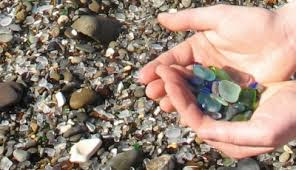

The Colors of Sea Glass
Where Do They Come From?

...Just where do the colors of beach glass come from? Sea Glass is simply old glass products that were thrown into the sea, but, "Sea Glass is JUST GLASS, like Diamonds are JUST ROCKS"©

It takes decades for broken glass to "become" sea glass.
If you think about it, the common colors of sea glass, Green, Brown & White are still in wide use today......Rarer colors of sea glass are pieces that the color has not been made or used commercially for many years.

“We have broken the colors into rarity categories, it is a general rule and not to be carved in stone (or glass!) as certain colors can be found more readily in some areas. For Example, lavender glass can be a rarity in some areas, yet abundant in Maine & Canada; but hardly ever found in the islands. Next time you're in an antique shop or flea market, look at the glass items and see if you haven't found a piece of glass this color!


“By The Sea Jewelry is proud to offer the finest Genuine Sea Glass Jewelry in just about every color of sea glass in the world! This glass knowledge is based on 28 years of collecting and decades of researching the origins of our glass.”

The rough and tumble journey back and forth in tide water creates rounded corners and a smooth surface. The colors become almost translucent. If you find some in a shop or from an artist, check it out carefully to make sure it is real sea glass and not fake. The color and clarity can give you clues.

Google has a wonderful search bar where you can find just about anything. They have a guide to show you where to find sea glass, a book on how to tell if it’s real, and items that are made from this precious glass. Remember that what makes it valuable is the origin of the original glass, and the years it took to tumble it into a smooth, clear stone.


GOOGLE LINK: All about Sea Glass

There is a difference between fresh water glass and sea glass that is made smooth and beautiful by the salt water. According to the following link, there are also legends attached to this fascinating wonder of the world. Sailors long ago thought that the blue ones were mermaid tears that spilled ashore.


For some more history and help with identification, go to:  Glass Beach Jewelry  

This remarkable gift from the sea can be yours for a price, unless you’re lucky enough to find one of those hidden coves where the tides have come and gone for hundreds of years. Many of these pieces will still be in a state of development. Their edges may be sharp; their size may be small, and their shape odd.

But if you persevere, you may find a colorful stone that possesses that clear see-through sparkle. If the color is rare and the size is large you may have the beginnings of a treasured necklace or the centerpiece of a priceless mosaic table.


Tuesday, March 22, 2016

There is Art and then there is Art

FINAL "Egrets and Mangroves" 14 x 18 acrylic on canvas; original in barn wood frame
Because the appreciation of art is subjective and personal, it is difficult to define what is and what isn’t. There are standards and elements that may be judged in one way or another; but here again, the perspective of the judge is also a personal opinion call.

I admire people who experiment and risk all in their creative journey. Sometimes you don’t know what will work unless you give it a try. In art and fashion I hate the claim that “One size fits all.” They never do! That one size may drown a small person or embarrass those who are too large.

Painting styles and techniques are never the same either. New artists may copy their teacher or the masters until they discover what works best for them. But you never will if you don't explore on your own the possibilities.


One such experimenter was Charley Harper, Illustrator. Some of his bird artwork was presented on Antiques Roadshow in Iowa a few weeks ago. The owner was amazed that at auction the suggested going price was between $12,000 to $24,000 each. 

According to the Roadshow expert, Harper’s work is a “hot” item. His style blends in well with today’s contemporary straight lines and patterns. On Charley’s professional web site we learn that:

“Charley Harper's unique minimalist approach is unmistakable. From his groundbreaking mid-century illustrations for Ford Times Magazine and Golden Books and his impeccably composed posters for the National Parks and other wildlife organizations, to his whimsical serigraph and giclée prints, Charley Harper's art is a beloved treasure and an inspiration to an entire generation of artists and designers.”


In a style Harper called "minimal realism", Charley Harper captures the essence of his subjects with the fewest possible visual elements. When asked to describe his unique visual style, Charley responded:

"When I look at a wildlife or nature subject, I don't see the feathers in the wings, I just count the wings. I see exciting shapes, color combinations, patterns, textures, fascinating behavior and endless possibilities for making interesting pictures.

"I regard the picture as an ecosystem in which all the elements are interrelated, interdependent, perfectly balanced, without trimming or unutilized parts; and herein lays the lure of the painting; in a world of chaos, the picture is one small rectangle in which the artist can create an ordered universe."

He contrasted his nature-oriented artwork with the realism of John James Audubon, drawing influence from Cubism, Minimalism, Einsteinium physics and countless other developments in Modern art and science. His style distilled and simplified complex organisms and natural subjects, yet they are often arranged in a complex fashion. On the subject of his simplified forms, Harper noted:

"I don't think there was much resistance to the way I simplified things. I think everybody understood that. Some people liked it and others didn't care for it. There's some who want to count all the feathers in the wings and then others who never think about counting the feathers, like me."

The results are bold, colorful, and often whimsical. The designer Todd Oldham wrote of Harper, "Charley's inspired yet accurate color sense is undeniable, and when combined with the precision he exacts on rendering only the most important details, one is always left with a sense of awe."


Charley, on numerous examples, also went outside the medium of graphic art and included short prose poems for the artwork he made. We can learn so much from Harper's life and illustrations. Whatever you decide to do as you develop your artistic style, enjoy it and love what you do!  (I decided to add my tiger painting below as it's a similar composition as Charley's but in a far different style)

"Namesake" 24 x 18 acrylic on canvas


Sunday, July 12, 2015

America doesn’t need Major Surgery; She needs Forgiveness to Heal her Wounds

(Here's my main model, my granddaughter)
I’ve decided that it’s very hard to think creatively when you don’t feel well or you’re in pain. Some may say that getting your imaginative juices off your own problems and onto something fun makes them better. But if you’re miserable, it’s not going to cut it for long.

The good thing is I’m starting “one week after surgery” on Monday, and it can only get better from here. People tried to make me feel better before surgery by saying it was going to be a “snap” and comparing it to the old way of incise, cut and mend. I suppose their right. But arthroscopic surgery is still surgery. Once my body gets the message that it’s so much better this way, maybe my bowels and my stomach will come along for the ride.
(I'm going to change direction of her eyes, make them lavendar and purple)
I had an arthroscopic rotator cuff repair a few years ago, but I’ve yet to forget the weeks and months of physical therapy it took to get me back to normal. Sure the incisions cover less ground so the healing is quicker, but the reason for surgery, repairing a tear or removing an organ still takes a lot of internal healing and re-directing before things get back to normal.

I’m still trying to function creatively in the mean time. I had a request from my granddaughter who is a working girl, an actress, and a creative person in her own right. She wants to use her favorite color purple in various shades to enhance a living room dominated by grays, whites and black.

(I may use black or purple stripes on her costume?)
Using a portrait of her with a Harlequin theme seemed like the winning combination. I haven’t had any feedback from her at this point in time, so I’m winging it until I do. I’m also continuing to work on my India family portrait which was interrupted by my surgery.

A lot has happened in the news of late, one of them being the removal of the South’s Confederate flag. Living in Florida has somehow immunized me against what the flag stands for to some people. For me as an artist, it was a colorful statement of the South’s unique heritage.

I worry that this decision will have a domino effect on everything else that reminds us of something we don’t like. Will statues of the Founding Fathers be tampered with because they once owned slaves?

Sometimes history is a good reminder of what we stand for and of who fought beside us. Black soldiers fought side by side with Yankees in the Civil War and with other American’s in the Revolutionary War. African Americans have also risen to great heights in every other war we’ve conducted.

(Love black 'n white checks -- a checkerboard?)
Arguments should represent not just one side in a debate, but both sides.  Before we start changing history, let us remember what Dylan Thomas penned long ago to his father who was going blind: “Do not go gentle into that dark night” lest we “throw out the baby with the bath water,” or cut America’s nose off to spite her face.”

(Lower quadrant of drawing --- my shadow on canvas)

Top upper quadrant of drawing. Working Title:  "Queen of Diamonds"


Wednesday, August 1, 2012

Spring Green, Lime Green, and Fern Green are Hot Trends


In the 70s, I had a hallway that had light green walls, white baseboards and door, and a black table. Flipping through a current “Better Homes and Gardens” magazine, I discovered those same colors are a new trend teemed up with orange, hot pink or watermelon accessories.

Trends come and go; they also get revived and recycled. The problem is so does taste in fashion and art. Instead of buying art for aesthetic reasons or because of how it makes you feel, people buy art to decorate a room or to add a pop of color.


It has always been so. Our day and age is no different. At least there is a reviving interest in the arts, if only for its ability to shock or entertain. Street artists and their messages of activism and boldness are exposing more people to art and its impact on political action.

Chalk artists spend hours on three-dimensional art that is often a singular experience enjoyed by a few. Temporary by nature, better ways are being found to save and preserve these artistic expressions by housing them in covered walkways and on interior walls. 

Acrylic paints enable bigger and broader coverage that is changing the urban scene and filling its dark decaying walls with hope and color.


Artist Joe Bucci, who combines impressionist and expressionist styles was featured in a June “the Artist Magazine.” I was impressed with his colorful landscapes and his use of vibrant color.

Speaking about the changing art scene down through the centuries, Joe said: “one thing hasn’t changed: in order for a visual statement to become art, it must have an abstract quality. It’s not enough that a painting be a picture of something—it must communicate via composition, shape, color, rhythm, line, texture, mass and planes (visual or ‘plastic’ elements).


“The skill that causes an outstanding artist to rise above the pack is not the talent to draw or paint objects, but the ability to see relationships between those visual or "plastic" elements and their relationship to the artist's overall vision.”

How well an artist pulls this relationship off makes the difference between remarkable art that's remembered or so-so art that's soon forgotten.


Featured Artist
Deb Haugen – the “Organic Artist” has been featured in galleries and museums, and has won many prizes and awards. Deb is from Malibu, California. Here is a fantastic sample of one of her paintings. To see more of her work, go to Deb’s facebook page (see below):