Translate

Showing posts with label Germany. Show all posts

Friday, January 8, 2016

Political Art – Does it make a Difference?


For an artist, it isn’t enough to envision, create, and wallow in paint up to your elbows. You have to read about art. Indulge your muse. Suspend your free time thumbing through art magazines to expand your knowledge. You have to scour what’s out there for knowledge and inspiration.

I’ve been doing just that by reading B.A. Shapiro’s latest novel “The Muralist.” Now I can see her in person on Tuesday, January 12 at the Alliance for the Arts in Fort Myers. Shapiro will be there in person to sign her new book and discuss its plot and characters with attendees.

"From the author of the New York Times bestseller The Art Forger comes a thrilling new novel of art, history, love, and politics that traces the life and mysterious disappearance of a brilliant young artist on the eve of World War II."

The book keeps me turning pages. Of course, it’s about a time period that has always intrigued me, and about the horrors that engulfed the entire world; but especially the Jewish people. Hitler and his minions hated, pursued, and incinerated millions of Jewish victims.


Shapiro not only covers the history well, but she knows art which makes the book that much more important on your lists of must read.

Many artists through the centuries have made political statements through their art, but most have avoided it as being too in your face or detrimental to their personal success. Some brave pioneers used art as a platform to voice their own strong feelings and to influence their audiences.


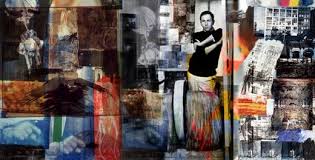
"Vik Muniz Photographer and mixed-media artist best known for repurposing everyday materials for intricate and heavily layered re-creations of canonical artworks. Muniz works in a range of media, from trash to peanut butter and jelly, the latter used to recreate Warhol’s famous Double Mona Lisa. 

"Layered appropriation is a consistent theme in Muniz’s work: in 2008, he undertook a large-scale project in Brazil, photographing trash-pickers as figures from emblematic   paintings, such as Jacques-Louis David’s “Neoclassical Death of Marat, and then recreating the photographs in large-scale arrangements of trash. The project was documented in the 2010 film Waste Land in an attempt to raise awareness for urban poverty. Muniz explained the work as a “step away from the realm of fine art,” wanting instead to “change the lives of people with the same materials they deal with every day.”

Others, like Thomas Hart Benton, passionately document history. War correspondents and artists fall into this category. This is why some people become angry when others in later generations wish to discredit or discard offensive images that were an actual part of history. Once we destroy history, we chip away at our own identities. History should stand, whether we like it or not.


Slavery is abhorrent to us now. It is a part of our history that we’re ashamed of and wish hadn't happened. But we can learn from our mistakes and vow never to make the same ones again. We can learn from the horrors of Hitler. The German people would like to bury this part of their past, but they haven’t. We and they must keep even the horrors of our past so that later generations will remember and perhaps be saved from repeating the same mistakes.


Our country seems intent on following in Europe’s footsteps. But, instead, we should learn from them:

Socialism has brought financial ruin. A flood of refugees has changed the face of many major cities across the globe.

The whole world is teetering on the brink of disaster. We would be fools to ignore what has happened and think we know best, that it can’t happen here because we’re just too damn smart.

All it takes is a few concessions here, a blind eye there, a white lie behind closed doors, and a willingness to ignore the obvious right in front of our collective noses.


If an artist or a writer can awaken us to the truth, all the better.


(Charles McNaughton, artist -- and below)


Tuesday, July 16, 2013

In the Looking Glass; Vanity at Its Worst

"hand feeding cat fish" on Bear Lake
Society places far too much value on appearances. The attractive, the gorgeous, the svelte or muscular often become the rich and famous. Add to that beauty, charm, wit, and a smooth-talking tongue, and you have an unbeatable combination. If used for good, all is well; if not, it’s a recipe for deception and destruction. This has been true since the beginning of time.

Vanity, and the downfall thereof, has been the topic of scripture, great literature, Legends and Fairy Tales. Remember when the wicked Queen in “Snow White and the Seven Dwarfs" looks in the mirror and asks: “Mirror, mirror on the wall, who is the fairest of them all?” 

We know she’s an ugly old hag; but the mirror, knowing that it will be broken if it speaks the truth, tells the ruthless queen that she’s “the fairest one of all” in spite of the evidence against it.


Like the queen’s looking glass, there are individuals who fawn over famous people; even becoming “yes” men and women in order to “share the wealth” and stay in good favor. The sin of vanity is not only a preoccupation with one’s physical appearance, but includes pride, greed, dishonesty, and misuse of power.

Some people lean their ladder of vanity on the tree of fame and fortune, only to find that they’ve chosen the wrong tree. In their struggle to climb the ladder of success, they willingly crush others under their feet as they scramble to the top. Their ego and thirst for money and power leaves the person they once were behind and they forget their core values. It becomes “all about me.”

"Another view of Bear Lake from the Wasatch Mountains"
Like "Alice’s adventures in Wonderland," things are not always as they seem. I read a wonderful book titled: “Bonhoeffer” a history and biography of Dietrich Bonhoeffer a Christian Pastor in Germany during the rise and fall of Hitler’s Third Reich.

The book chronicles the power struggle between the Christian Church in Germany and the Furor’s ravenous appetite for a perfect society--an Aryan race. Eventually, there is a split in the Christian Church between those who want to support Hitler at all costs, and those who don’t.

"Park City Utah" (on vacation)
People became obsessed with the progressive vision of Hitler’s Germany. They were concerned with seeking approval and gaining professional recognition and advancement. 

If that meant tweaking the Bible here, and removing a few passages of scripture there, so be it. 

If that meant forcing compliance of the government’s new and improved German Christian Church; it was for the good of Germany. Christ’s gospel was far too restrictive, anyway, and much too lenient in its treatment of miscreants, half-breeds and inferior people who would simply limit Germany’s rise to greatness.

The complexities of Hitler’s march into evil and infamy boils down to this: The people were misled by a tyrant with a silver tongue who was expert at disguising his evil intents through lies and manipulation (a "wolf in sheep's clothing"). By the time they discovered the truth, the laws had turned against them and there was nowhere to turn.

"Street scene in Park City, Utah"
One such appeaser was Martin Niemoller. A man Hitler appointed to run the government’s newly created “German Christian Church.”

Niemoller realized too late what he had done—what they had all done! When he began to oppose Hitler, he was placed in a concentration camp for eight years. Later, he shot himself.

During his imprisonment he penned this:

“First they came for the Socialists, and I did not speak out –because I was not a Socialist. Then they came for the Trade Unionists, and I did not speak out—because I was not a Trade Unionist. Then they came for the Jews, and I did not speak out—because I was not a Jew. And then they came for me—and there was no one left to speak for me.”

Who will speak for you? If Beauty and worth are in the eye of the beholder, how will you be perceived by others? In the same token, How will your artwork be viewed by others? Integrity is living what you believe and acting in accordance with your values. First you must define who you are and what you stand for.


"Winston" my sister's hot Westie!  He's sooooo smart!

Monday, April 23, 2012

Famous Foreign Films bring Laughter, Soul Searching, and Insight


"Tansy's Pride"


I’ve always enjoyed foreign films from the plays and comedies coming via BBS to America’s PBS to imports on the big screen. Like Shakespeare’s dialogue, the subtitles are a temporary impediment. Once you get used to the rhythm of speech and the nuances of character, reading while watching is a snap.


My most recent movie was “In Darkness,” filmed in Poland with Jewish, German, and Jewish actors. My husband and I were able to absorb the interaction of three languages and experience Nazi anti-Semitism at its worst.

Crowded in an underground sewer, we see the stress of the hunted testing each individual’s character to the limits. Their lack of simple amenities, the stink of the sewer, and their fear when the sewers were searched increases tension.

Man’s inhumanity to man was the thrust of the plot; balanced by refreshing scenes where kindness and empathy offered the hope that led to a positive conclusion. The movie was an authentic glimpse into the horrors of being a Jew under Hitler’s rule and rise to power. His insatiable hunger to conquer the world became brutal; his reactions savage.

We can learn from foreign films. There are vast differences between a Hitler and a Gandhi, for instance. One worked for his own aggrandizement, the other for the good of his country and his people.

"Skudeneshavn Norway

On a lighter note, the film “Life is Beautiful” shows another side to grim evil: Guido, a Jewish Italian waiter is sent to a Nazi Concentration Camp along with his wife and young son. “Refusing to give up hope, Guido tries to protect his son’s innocence by pretending that their imprisonment is an elaborate game, with the grand prize being a tank;” An uplifting look at the courage and optimism of the human spirit.


Another favorite: “Amelie” played by Audrey Tauton helps us understand the life of ordinary people in France. Amelie’ finds a long-hidden trove of toys behind a baseboard in her tiny apartment. She is inspired to give them a new look and offer them to the poor children in her area. Her impulse at generosity “sparks more benevolent acts” not only in her own life, but in the community. Amelie’ is a celebration of life and love. It reminds us that small wonders surround us if only we will look. A joy to watch.


“Babette’s Feast is filmed in Denmark. Two sisters turn down a chance to leave their small Danish town to remain and take care of their Pastor father and his small church. They realize all too soon their dismal future and the fact that they will never marry.

Thirty five years later, a French woman seeks refuge after losing everything. The sisters take her in. Everyone in the village is skeptical of this new stranger. Babette seeks to win them over by preparing an extraordinary feast in gratitude. A heartwarming endeavor “eclipsed only by her secret.”


Foreign films show us that in spite of our differences, we human beings are more alike than we can even imagine. Perhaps that’s why I not only enjoy watching films made in other countries, but I adore painting exotic and endearing scenes of fellow human beings. I like to illustrate how beautiful people everywhere show goodness, bring laughter and comfort, and have the capacity to uplift us through their humanity.