Translate

Showing posts with label books. Show all posts

Friday, July 8, 2016

It's Spring -- Bless the Baby Birds!

I couldn't resist sharing a childhood experience with you. The story probably accounts for why I love birds and delight in painting them.


 Robin Hood
******
He was pink, blind and featherless when I found him lying in the bright spring grass. His lifeless three-inch body brought back a rush of memory and I was eight years old again, looking down on another fragile baby bird.

"Tufted Titmouse" drawing

He had fallen so far from the nest that I convinced myself his mother would never miss him. Carefully, and with a modicum of shame, I scooped the tiny fledgling into my cupped hands. I would nurse him back to health and become his protector. In turn, he would be my friend, my pet. He could perch on my finger and I would teach him how to do tricks. He could sing for his supper. Surely mother would let me keep him.


"Courtship" pencil drawing
She shook her head when she saw him; a bad omen. But when she gave me an empty matchbox, I grew hopeful. We stuffed the matchbox with tissue and laid the bird gently on the soft white sheets. His head wobbled back and forth as his tiny body struggled to get up. The dark swollen eyes were closed, but the hungry beak gaped wide in a perpetual state of readiness.

My mother went for the “crumb jar;” the kind you fill up with leftover toast or stale bread until there are enough pieces for croutons or crumbs on a casserole.

We moistened a small chunk of bread in warm milk; and while mother left to prepare dinner, I dropped soggy snippets of bread into the bird’s open mouth. The feeding lasted until the tantalizing smells from the kitchen and the clatter of dishes distracted me.


"Berry Picking Time" 16 x 20 acrylic on panel
It was nearly bedtime before I remembered. I skipped to the back porch, half expecting birdsong to greet me. Instead, I slammed into a cold wall of silence. I held my breath and peered into the matchbox. The bird’s too-large head lay angled against the white tissue, his pale colored beak hung open. The bread I had pushed down his throat earlier was now stuck like a gummy wad of dough. I yelled for mother.


"Hut Two Three Four" drawing
She came quickly with tweezers in hand. “He’s too weak to swallow,” she said, making one final effort to remove the dough from the tiny gullet. “He’s not breathing,” she muttered to herself. And then seeing my tears, she added, “It’s not your fault. He’s too young, that’s all. His eyes aren’t open. He has no feathers.” In spite of her words, I cried. Sad lesson learned -- end of story, or was it?

Returning to the present and my adult moorings, I studied the baby bird at my feet. If I left him here, a neighbor’s cat or a hungry hawk would surely destroy him or a child’s bicycle could crush him unawares. Impulsively, I scooped him into my hands. I had to give him a second chance. Who knows? This time I might succeed; and, perhaps, redeem my childhood guilt in the bargain.
"Star Billing" mixed media on 14 x 18canvas

Monday, June 20, 2016

You can make a Difference if you don't Give Up

"Tansy's Pride"
In addition to loving books written about the Depression Era and World War II, I enjoy novels about slavery, especially from the perspective of a slave. Once immersed in the heartaches and hardships that come out of these historical time periods, you can better relate to the families that came after and those in the present day.

Everyone has a different memory of the same event. There were courageous and honest people who helped others and made their own lives count, and there were shallow people whose actions were hateful and spiteful. There were those who committed monstrous acts of violence and treachery that can only be called evil.

In the book "On to Richmond 1861-1862" The second book in the Civil War series written by Ginny Dye, the slave Rose asks her mama "How do you endure? How do I endure, Mama?" Her mother answered: "by going around every obstacle and embracing every hard time as if it were a friend carrying you to your final goal." Talk about positive attitude.


Reading opens up your world. You can gain understanding of other peoples and races. You can learn new skills. Education may expand your thinking and change the way you see your life. With knowledge comes responsibility. Your capacity to change your circumstances and conversely change the world becomes tangible. You can make a difference!

I taught myself to do many things while I raised six children. Each week we selected 10 books from the library that they could share. I also chose a few for myself. I studied writing, I read plays, I created scripts. I went on to study art in all of its forms. I experimented. I grew. I hungered to learn. I think my children caught my enthusiasm because they were full of never-ending questions.

If you're feeling trapped and think that you don't have the time or money for classes or that you'll be stuck in the same rut for the rest of your life, think again. You have it in your hands to create the life you want.

Think creatively. Reach out for help. Don't give up just because your life doesn't fit in with the pattern of others. Like the slave Rose learned from her mama, "embrace every obstacle, every hard time as if it were a friend carrying you to your final goal."

Nothing worthwhile is easy. You've probably heard that many times. It's easy to give up. You give into your fears, your imperfections, your lack of self-confidence. But you don't have to! Your state of mind determines where you go in life and how you end up. Take the reins of your thoughts and accomplish what God intended for you.

Norman Vincent Peale a famous Pastor and the author of many motivational books wrote this challenge in "Positive Thinking for Every Day of the Year:"
"Are you going to live all your life and never feel the presence of God?"

I issue a similar challenge. Are you going to live the rest of your life never feeling the exhilaration of overcoming weakness or the power that comes from self-control? Be in charge of your life. Don't succumb to indifference, laziness or fear.

The painting below is the first coat of paint on a gesso board. You can still see the white gesso show through in come places. I will show this work-in-progress over the next few weeks.
(Work in Progress)

Friday, January 8, 2016

Political Art – Does it make a Difference?


For an artist, it isn’t enough to envision, create, and wallow in paint up to your elbows. You have to read about art. Indulge your muse. Suspend your free time thumbing through art magazines to expand your knowledge. You have to scour what’s out there for knowledge and inspiration.

I’ve been doing just that by reading B.A. Shapiro’s latest novel “The Muralist.” Now I can see her in person on Tuesday, January 12 at the Alliance for the Arts in Fort Myers. Shapiro will be there in person to sign her new book and discuss its plot and characters with attendees.

"From the author of the New York Times bestseller The Art Forger comes a thrilling new novel of art, history, love, and politics that traces the life and mysterious disappearance of a brilliant young artist on the eve of World War II."

The book keeps me turning pages. Of course, it’s about a time period that has always intrigued me, and about the horrors that engulfed the entire world; but especially the Jewish people. Hitler and his minions hated, pursued, and incinerated millions of Jewish victims.


Shapiro not only covers the history well, but she knows art which makes the book that much more important on your lists of must read.

Many artists through the centuries have made political statements through their art, but most have avoided it as being too in your face or detrimental to their personal success. Some brave pioneers used art as a platform to voice their own strong feelings and to influence their audiences.


"Vik Muniz Photographer and mixed-media artist best known for repurposing everyday materials for intricate and heavily layered re-creations of canonical artworks. Muniz works in a range of media, from trash to peanut butter and jelly, the latter used to recreate Warhol’s famous Double Mona Lisa. 

"Layered appropriation is a consistent theme in Muniz’s work: in 2008, he undertook a large-scale project in Brazil, photographing trash-pickers as figures from emblematic   paintings, such as Jacques-Louis David’s “Neoclassical Death of Marat, and then recreating the photographs in large-scale arrangements of trash. The project was documented in the 2010 film Waste Land in an attempt to raise awareness for urban poverty. Muniz explained the work as a “step away from the realm of fine art,” wanting instead to “change the lives of people with the same materials they deal with every day.”

Others, like Thomas Hart Benton, passionately document history. War correspondents and artists fall into this category. This is why some people become angry when others in later generations wish to discredit or discard offensive images that were an actual part of history. Once we destroy history, we chip away at our own identities. History should stand, whether we like it or not.


Slavery is abhorrent to us now. It is a part of our history that we’re ashamed of and wish hadn't happened. But we can learn from our mistakes and vow never to make the same ones again. We can learn from the horrors of Hitler. The German people would like to bury this part of their past, but they haven’t. We and they must keep even the horrors of our past so that later generations will remember and perhaps be saved from repeating the same mistakes.


Our country seems intent on following in Europe’s footsteps. But, instead, we should learn from them:

Socialism has brought financial ruin. A flood of refugees has changed the face of many major cities across the globe.

The whole world is teetering on the brink of disaster. We would be fools to ignore what has happened and think we know best, that it can’t happen here because we’re just too damn smart.

All it takes is a few concessions here, a blind eye there, a white lie behind closed doors, and a willingness to ignore the obvious right in front of our collective noses.


If an artist or a writer can awaken us to the truth, all the better.


(Charles McNaughton, artist -- and below)


Wednesday, November 11, 2015

Information Overload – Opinion, Hype or T.M.I.?

(This is Peaches, and I'm going to paint her portrait)
I have read and written about the book “Grapes of Wrath” by John Steinbeck at least four times. After the first reading, I was captured by that generation and the “Great Depression” era. Since that time, I’ve read both fiction and nonfiction books on that time period. 

After my first experience, a high school student at my church was bewailing the fact that “Grapes of Wrath” was required reading that year. She called it a filthy book, and said that the language was coarse and trashy. She didn’t understand why she had to read that kind of a book, anyway.

Her remarks prompted my second reading of Steinbeck’s novel. What on earth was she talking about? I didn’t remember any bad language. The book had inspired me and aroused my sympathy for the plight of the hungry and poor.

As I flipped through the pages, I was stunned. Sure enough, there were enough four-letter words on every page to make a sailor blush. Why had I not recalled such “filth” on my first reading? Perhaps because I was so caught up in the lives of the characters and their very real story.

By the time I finished the book, I loved it even more. So much so that I quickly forgot the student who disdained reading it and her remarks. The whole book is full of symbolism about life, about the roles of men and women in society, and the desperation that comes when everything you ever depended upon is gone.

When the husbands and fathers were jobless and down on their luck, they leaned heavily on their women who gave them strength and propped up their sagging egos. The mothers succored their children, managed to find things for them to eat, and gave their families hope. They were the backbone of society.

(Work in Progress "Peaches 'n Cream") The drawing and first layers of acrylic paint.
In the final chapter, the loose ends are connected in the cycle of life. A woman loses her baby because of poor nutrition. Broken and unresponsive, she wanders away from her family. Her breasts are engorged with milk, and she doesn’t know what to do or where to turn. At wits end, she comes across a man on the ground at her feet who is dying from hunger. Many men went without food so that their women and children could eat.

The forlorn woman lays down beside him and gives him her milk-swollen breast; the only sustenance she has to offer. By this we know that not only will he live, but that they both will survive to witness another day’s struggle.

"Bella Bellissimo" 16 x 20 acrylic on canvas (SOLD), but prints available.
Steinbeck recreates the Garden of Eden showing the dependence of male and female on each other, and in society’s ongoing battle for life, liberty and the pursuit of happiness.

Great literature and great art cannot be picked apart by focusing on that which is taken out of context. Without the whole there is no meaning nor purpose. How and what you remember when the last chapter is read is the measure of a book. It will rise and fall not on a useless hunting and pecking exercise, but on how well it is judged through the eyes of history and truth.
"Winston" Portrait of a Westie (SOLD) prints available. (mixed media)

Sunday, January 4, 2015

Long ago, it was: “Let it all Hang Out!" Today they sing: “Let it Go – Let it Go!”

"Living the Dream" Valentine Card @ https://www.etsy.com/people/AnfinsenArt 
In the process of making goals and resolutions, I’m reading two books that I would highly recommend: The first is “Transform: Dramatically Improve Your Career, Business, Relationships and Life: One Simple Step at a Time” by Jeff Haden, a motivational style book filled with great suggestions. And the second is “Hooked: How to Build Habit-Forming Products” by Nir Eyal with Ryan Hoover that contains practical advice on how to make things happen.

For example, Jeff Haden directs: “Do little things differently.” We usually think our goals should be larger than life and that we need to “eat an elephant” in order to really accomplish anything. Precisely why we give up too soon and don’t fulfill our dreams leaving us feeling discouraged and disappointed.

But if we do small things first and enjoy a sense of accomplishment, we are more likely to keep going. Even better, if we try to do those “little things” in a different way, we may develop style and flare. We will stand out from the crowd. Haden’s theme is probably a new twist on the old “Think outside the box.”

"Flamenco Flamingo" https://www.etsy.com/people/AnfinsenArt 
Nir Eyal provides a real study guide, discussing the importance of devising a “trigger” designed to “hook” your audience/buyer into “Action” by offering “variable rewards” for their initial “investment” of time and money; all designed to increase “retention” (of customers) and get them into the buying or reading habit. Of course, the study is much more detailed than this, but you get the picture.

Most of us have allowed things to slide during the holidays, and now it’s time to get back to work! I know I’m dusting in places that haven’t been touched in weeks. Bits of glitter and pine are nestling into my carpets and will probably catch my eye for many weeks to come.

I’m intent on cleaning out the cobwebs in my head, the contents of my desk and the inside of my closets. Like Elsa in the Disney movie “Frozen,” I’m determined “To Let it Go – Let it Go” as I cleanse the house of clutter and excess. My jammed closets will finally get relief as this “saver and hoarder” is determined to purge or perish!

"Flamingoes in Love" https://www.etsy.com/people/AnfinsenArt
Always preparing for “hard times,” I hold on too tightly and too long to things that have already served their purpose. Even my older paintings have probably brought me to a higher skill level and deserve to be retired and given a fresh coat of paint and a new perspective.

I’m going to come to grips with what I am: an artist and a writer, and quit trying to be like every other woman I know. I’m me. Yes, I can be messy at times, and I’m not a fanatic housekeeper; but I sure do enjoy creating a new story or composition using colors I’ve never tried before or trying to express, in a new way, my passion for living. 

Whatever it is in your life that you’re trying to unleash and bring into focus, I hope you’re successful. At the very least, you should enjoy the process.

"Puppy Love" https://www.etsy.com/people/AnfinsenArt

“Let it Go” from the Disney Movie, “Frozen”

Saturday, June 14, 2014

Chasing Perfection – is it a Wild Goose Chase?

"With these Hands -- Love"  24 x 18 oil on canvas
We all want the perfect life, the best husband or wife, wonderful children, and a great job. If you’re a creative, you also want a bestselling novel, a T.V. series, or a show in a prestigious gallery. That perfect project is almost within reach, you can feel it in your bones, if only you can find the right combination of skill and good luck.

If you don’t believe this is true, take a look at recent sales of self help books. As people chase after their dreams and unrealistic expectations, these books continue to fly off the shelves. Their banquet of promises serves up redemption (of career and soul) with a helping of hope for the hopeless. Their combined themes provide a dose of inspiration and a jump-start of motivation. 

But there’s one thing these novella's leave out: the work involved in becoming “all that you can be” is up to you. You must do the work. You must practice every day. The grueling effort to succeed must be done by you. When you close the book, you are alone.

"With these Hands -- Hope" mixed media on 16 x 20 canvas
I gave up on perfection long ago when I discovered that it was impossible. We mere humans are simply too fallible. We’re programmed for failure, and we must accept this. Failure does not mean the end of anything. For some it is the beginning if we pick ourselves up and try again. Our success should not be dependent on what others think or say, but on what brings us joy and satisfaction.

Some people defy logic and become successful in spite of criticism or failure. Why? Because of their drive and their love for what they do. When they fall, they get back up. They face their demons and try again. Their tenacity may seem foolhardy to some, but it is what gets them up in the morning.

That perfect novel or perfect painting does not exist, anyway. In fact it is the slight errors, the overlaps, the imperfections that give artwork its “painterly” effects. Only beginners strive for perfection trying to make the lines perfect and straight. The seasoned artist is satisfied with illusion, energy and emotion. Once you give up trying to be perfect, that blend of relaxation and looseness takes over and guides your brush intuitively.

In the beginning we must learn the steps that lead to perfection and know the rules that govern our craft. After that, we must joyously create in order to express the passion within. If we are lucky (or blessed), our journey will include not only mistakes and possible failures, but moments of clarity that will make our efforts worthwhile. 
"With these Hands -- Wonder" mixed media on 18 x 24 canvas

Friday, December 20, 2013

Victorian Art Has a Message and so much More


After reviewing Russian Lacquer art, Victorian art seems like child’s play. When the Pilgrims made their trip to America and cut off ties with their European forefathers, they also cut themselves off from the depth of culture and training that had inspired previous generations. Except for memories, many of them had no books or paintings until later immigrants brought them.

There is an innocence about their first efforts at duplicating what they saw; although, drawings from the Lewis and Clark expeditions are fairly detailed and accurate.

Children's books were not only written to entertain, but to teach values and principles.
During the Victorian era, the drawings appear playful and somewhat unskilled. Many scenes are detailed, but the characters seem misshapen or top heavy. Perhaps this was part of their naivety and charm.

At a garage sale a few years back, I purchased an old book titled: “Little Wide Awake, an anthology of Victorian Children’s Books and Periodicals,” by Leonard De Vries. Printed in 1967, the description states: "an authentic and fascinating panorama of the world of the children of a bygone era.”


“Little Wide-Awake” was one of the most popular children’s periodicals of the 19th century. It reveals shocking details of life in the Victorian world. The stories contain surprising grimness and more stark realism than many of the children’s stories of today.

These black silhouette drawings were a favorite!
In contrast, there is also a cloying sweetness in many stories and poems that many may find “sappy” and sentimental. To quote from the cover: “The religious ideas of the period are expressed in selections from publications of the Religious Tract Society. Also included are fine examples of books of instruction, alphabets, and forerunners of the comic strips.”


Nevertheless, there is humor and lightness in rhyme, as well as superb examples of poetry and “early art nouveau illustrations.”

Young women were taught to mend. Imagine having to darn socks, but it was economical.
The author, Leonard De Vries would be worth one blog on his own. While studying physics and chemistry in Amsterdam, his education was brought to an end when the Nazis overran Holland. De Vries was born in 1919 in Semarang, Indonesia, and considered life a voyage; a discovery full of adventures and surprises. This attitude helped him get through the war and inspired him to write children’s books.

I loved the composition of this drawing.
In 1957, when looking in the attic of a children’s library in Amsterdam for pre-war juvenile books  on science experiments, Leonard found some 18th century children’s books. These were the basis for this anthology and for many of the over two dozen children’s books that he wrote.

His experiences during the Nazi persecution, and a stay in Israel in 1953 helped him write “The Land is Bright.” In 1960, De Vries made a trip around the world, wandering many months through Thailand and Ceylon, to write a book about the inspiring work of UNICEF. 

Whether you like Victorian art or not, the appealing characters and stories of the period give us a glimpse into the past.

The last painting below is my favorite in the book for its overlapping elements.


Saturday, October 12, 2013

“Shit Happens” and Somebody Somewhere Experiences their Last Straw!

Third Place Win in Juried Competition for "Swamp Angel" oil on canvas
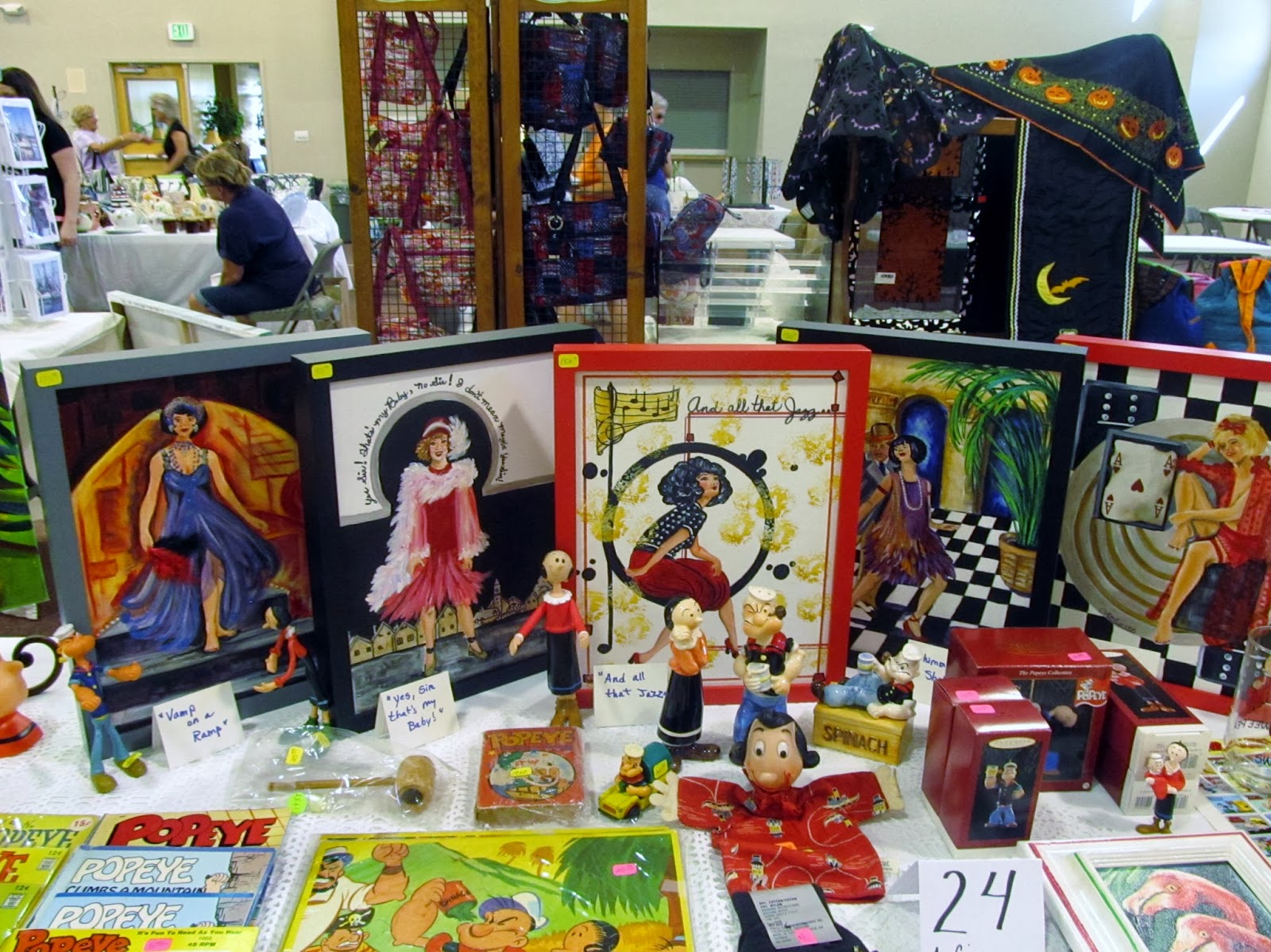
There are shows, and then there are shows. On the plus side, I had an opportunity to display my Popeye collection which is rare. The bazaar was seeking artwork, antiques, collectibles, and high-end used clothing and household items. The rules stated, “definitely not garage sale items.”
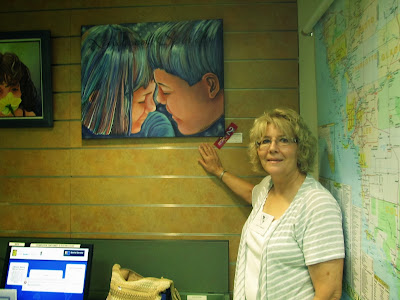
Second Place win in Acrylics for "Kindred Spirits"
Of course, whenever you make a rule, there are at least five people who will bend it or break it. It’s hard to place artwork next to a table that has used items for sale under $5. 

By the end of the show, a few vendors decided they’d rather give their stuff away than take it home. That made the situation even worse!

The artists who did participate will likely not come back. One jewelry maker remarked that she usually sells $600 to $1000 at one of these shows. She sold only $100.

There were more than 45 tables. Our hopes were high. But competition always makes or breaks a show. There were three other shows going on simultaneously in the area. These were also rummage sales that attracted a different clientele where people expect to pay a little and get a lot.


My own story was even sadder. I had a mixture of Popeye memorabilia and low-cost art. I thought, at the very least, I’d be advertising my portrait skills. I sold a few Popeye pieces and drew an interested fun loving crowd to my artwork.

 A gentleman took my card and said he’d be interested in talking to me about buying the whole Popeye collection. From experience, I know that usually means a bargain for him and a loss for me.


Could our show have been more successful in November by tapping into Christmas and holiday buying? Perhaps. Did the word bazaar throw people off? Were they expecting more bargains similar to a rummage or garage sale?


With many people out of work and low on cash, the timing may have been off. In a good year things could have been different. It’s hard to believe that in America, one of the most prosperous countries in the world, we are in decline; not only financially, but morally and spiritually.

To make matters worse, my husband ran errands while I was preoccupied and someone backed into his car. It was more than a ding. The at-fault-driver was in a truck which suffered little or no damage. Our car was dented in the fender and the door. My husband was 2/3 out of his parking spot, and she backed right into him. Did she have blinders on her eyes?

She claimed she was worried about the other driver she saw who was waiting for her spot. Impatience, stress and carelessness cause most of the accidents in our society. She was guilty of all three. At any rate, the support of friends and the camaraderie of fellow artists saved a weekend that could have been a total loss.


When we got home, I had a nice nap to sleep off my anxiety, and my husband warmed up some killer enchiladas that he’d made a few days before. It’s always the simple things in life that get us through the bad times. A smile, a hug, a thoughtful gesture can make up for so much when things go wrong.

My favorite Fall tree: the "Golden Rain Tree." Following spikes of yellow flowers seed lanterns form.
I wish some of my FB friends and social connections would remember that the next time they reply to a message or a comment. I’ve experienced some mean-spirited and ugly remarks recently because of political anger or someone who doesn’t agree with my faith or with something I’ve said. Civil disagreement is expected and deserved. But name-calling or saying that someone would be better off dead or buried is quite another.

If the world were only a nicer place, there wouldn’t be so many lonely and unhappy people out there who later become a forgotten statistic because someone somewhere vented their anger or became an ugly bully without regard for someone else’s feelings.


Monday, October 7, 2013

Will Libraries be Obsolete in 2020 and beyond?

"An Open Book" acrylic on canvas SOLD (prints available)
I haven’t checked out a library book since I purchased my Kindle a few years back. I must say, my experience was a refreshing change. I’m more at home in a library than anywhere else in the world next to a paint store or an Office Depot.

I love the smell of books, the excitement of having the world at your fingertips, and the thrall of people with the same sense of drama. Today was no exception. Our library is adjacent to the local high school, and is home to a poor but diverse community.

"Broken" mixed media on canvas SOLD (Prints available)
On this Saturday, every computer, every chair, every table was filled with students and adults reading magazines or searching for books, and parents helping their children find books for themselves. Movies were being checked out in abundance. Non-fiction books seemed more popular than fiction.

I was struck by how vital a library is to a community; especially one with few resources. I sensed that this weekly or monthly trip to the library was an exciting part of each family’s agenda. Eager smiling faces added to the vibrancy that filled the building.

I waited in line with my books: two on pastel techniques, and two on general basics; my way of taking a refresher course in between regular painting sessions and classes. A woman next to me said, “Oh, you’re an artist, too!” Then she proceeded to tell me all about the class she was taking and how she picked up some books to reinforce what she was learning.

"Victims of War" mixed media on canvas
I hope the public library will always be with us. It meant so much to me as a child. I’d walk a few streets on my own and spend the whole afternoon in its warm embrace reading books, sniffing their wonderful pages, and settling into an imaginative world that took me from my small town roots into an adventure with other worlds and cultures.

In some regions, they are already phasing out the library as we know it. Books are being replaced by computers and digital books. You can download books and never have to return them. It seems to be catching on.

I’m sad for the children who will never experience what it feels like to curl up with a real book and smell the wonder of its pages. As a child, I’d sneak a flashlight into bed. After my mother left the room, I’d read under cover for as long as I could. When she discovered my secret, the magic ended, but not my love for books.

"Fish Market" acrylic on canvas; Uganda
That day in the library, I was happy to see parents and children who still had the excitement of books written on their faces. They renewed my hope in America and in the world. Hunger and thirst for knowledge is a good thing. I hope we never lose it!

The freedom to ask questions and search for answers is what keeps us alive and thriving. Without it, we would become puppets of the state and emotional zombies unable to appreciate a world of wonder and beauty.

"A Joyful Heart" 9 x 12 pastel on Bristol; man from Uganda