Translate

Showing posts with label Minnesota. Show all posts

Monday, August 8, 2016

Vacation Musings bring Insight and Patience


This morning I had my first cup of coffee on our son-in-law's deck in Minnesota. It was in the mid-70s with a slight breeze. Exhilarating after leaving Fort Myers 95 degree 90% humidity. We had to take a breather from the heat, so headed for Minnesota's cooler and breezier climes. Here the weather may change in an instant, but for now it is intoxicating.

We're on the go so much that I haven't been in one place long enough to blog. Today we're going to spend some time with my husband's great grandson Marcus. We haven't seen him, except for photos, since he was a few months old. Now he's walking. The family was eager for us to see their new home.

After 13 years in Fort Myers, my husband wants to move back to be near family. Now we've added house hunting into the mix on the condition that we can sell our villa. My online life is not affected in any way except for the transition periods, and the reason why this blog and others are super late.


Since my own children are scattered across the country, where I live does not seem to matter. The only change will be that they must visit us rather than have us fly out to see them. Aging does have its disadvantages. But more than getting older, ill health this year has cut a big swathe across my extracurricular activities.

We all have ups and downs in our lives no matter what age. How we handle the crises that come to us will determine whether we allow circumstances to get us down or to serve as a stimulus to our malcontent which motivates change.

Degas taped his paintbrushes to his arthritic hands so he could continue painting. Beethoven lost his hearing, but could hear the notes in his head and continued composing.

Countless other artists and musicians have overcome obstacles to create beauty with their feet or teeth. They have been blind and limbless, but have gone on to become famous using their internal gifts in spite of their disabilities.


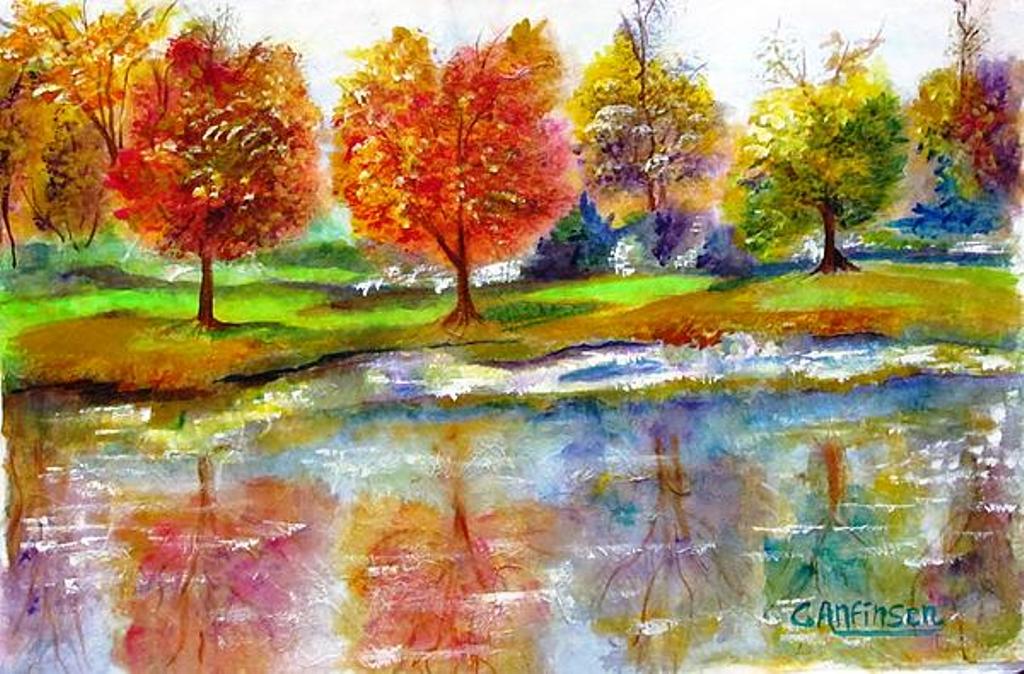
Fall in Apple Valley, MN, water color on silk

Why not you? Why not me? You are more than the imperfect body you have been given. Your spirit and soul reign supreme. Your gifts are eternal and intrinsic to who you are. Don't give up on life just yet. Discover the power you have within. Test your limits. If you believe in a higher power harness your dreams to something greater than yourself.

Monday, June 8, 2015

Home is Where the Heart is and the Twins Baseball Team!

(Son-in-law's beautiful backyard)
I told you I was heading for Northern climes, and here we are in Minnesota waiting for my husband’s first Great Grandson’s birth. 

The temperature’s are in the 80s with blue skies. Thrilled and delighted to be here. As a result, there’s not much going on in my art life except some incredible photos and “would be” paintings. I hope you enjoy!

Here is Katie with her soon-to-be-born son.


This is "Clarke" an Australian Collie with Katie.


I took some photos while I played with Clarke until the others returned. He's an absolute doll!
"I'll be really good if you give me a taste."


"Oh, come on -- I'm begging here!"

"See how patient I am?"

Tomorrow night we're going to a Twins game and so looking forward to it! There's nothing like an outdoor baseball game in the new stadium!

See the weather isn't too shabby in Minnesota, especially in June. 

On Thursday, we're heading out for Seattle to see my oldest daughter and her family whom I haven't seen in 6-7 years. So many new kiddies to hug.


"Fuchsia"
Here are some additional photos of "potential" paintings. Although I must do a painting of Clarke (above) who captured my heart.
My next blog will be written from Seattle with some brand new scenes. Stay tuned!
(Another scene from son-in-law's backyard)
"Begonia's in a planter"

Sunday, February 8, 2015

Sensory Encounter -- Access to Museums and Galleries for the disabled


Every grade school usually has a time for experiencing the arts. Most of us can remember the fun of finger painting: how it felt, slimy and cool to the touch; how it smelled, and some of us even how it tasted. We learned the basics of creativity and how to cover the slick white paper with fingerprint smears in less than five seconds flat

Learning is always enhanced when we stimulate our five senses with color, sound, smell, taste and touch. For hundreds of years, the art experience has only been for the few.  It has only been in recent years that museums, art galleries and nature have been made available for the sensory impaired and the disabled.

My first exposure to a tactile garden prepared specifically for those who were blind was in Minnesota. Here the seeing impaired visitor was able to touch and smell the leaves, petals and stems without fear of being pricked by a thorn. Some plants were there specifically for the tasting. Walkways were kept unobstructed and safe so people could walk, use a wheelchair or sit down to rest.
Unfortunately, most museums don’t allow touching of sculptures and galleries discourage the touching of paintings because the oils from our skin may eventually leave a soiled mark that promotes disintegration. People are generally curious and want to touch areas of sheen and smoothness or patches that look rough even though it may be an illusion. Today more and more cities are opening sensory gardens and museum areas where disabled children and adults may enjoy acoustics, music, fragrance, light, and texture.
(Seeing impaired students are allowed to feel texture)

 From "Magical Gardens for the Blind, Deaf, and Disabled" The Daily Beast, by Elizabeth Piciuto

 “When I walk into the Stephen Knolls School’s greenhouse, cheerfully bright even on an overcast day, the humidity frizzes my hair into a delirious halo. The school’s principal, Kim Redgrave, is explaining the school’s gardening program to me when three boys who are maybe 10 to 12 years old join us. Two of them are in wheelchairs. The third walks unsteadily, led by a grown-up holding his hand. I try to catch the eye of this third boy, but he plops down onto a stool and avoids my gaze. I turn to one boy who rewards me with a giant, hammy smile.

“They are here to measure their plants,” explains their teacher. From the looks of the seedlings in their plastic pots, the boys have planted their seeds just a few weeks ago, and they are growing vigorously.

“Just a few years ago, I hate to admit that in my total ignorance of disability, I would have assumed that these boys were barely aware of their environments. More attuned, I now see how all three boys become absorbed in their plants’ progress.
“Reams of research demonstrate that gardens and plant care can help students with disabilities develop crucial knowledge, skills, emotional regulation, and self-reliance: those with less intensive disabilities, more intensive disabilities, cognitive disabilities, physical disabilities. Even children without disabilities, for that matter, experience the same benefits. 
“Spending time in gardens can reduce the need for medication in children with ADHD,” Sachs pointed out, even after walks that last just 20 minutes.
“As a result of this research, there has been a growing movement to include what are known as “sensory gardens” in many schools for children with disabilities, as well as many botanical gardens in children’s hospitals. Sensory gardens are gardens that are designed not only to be accessible to people with disabilities, such as having winding paths appropriate for wheelchairs, but to “systematically and sensitively nourish the five basic senses,” says Amy Wagenfeld, professor of occupational therapy at Rush University and one of the authors of the forthcoming bookTherapeutic Gardens: Design for Healing Spaces. Such gardens provide opportunities to see, smell, touch, listen to—and sometimes taste—plant life and garden fixtures, such as scented herbs, smooth river rocks, or velvety lamb’s ears.” 

“In a workshop using scent in art, I learned that the same scent can smell differently if given a different label, such as cheese or vomit; or by changing the color of lights in an olfactory art sculpture from red to blue. In the round table "Putting Theory into Practice," several museum curators and educators, spoke about personalizing the museum experience and creating multisensory exhibits. John Bramblitt, an artist who lost his sight, had to find new ways to do his art again by using other senses and art materials. He brought in some of his paintings, where I was able to feel the contrast of a smooth plastic background and the raised ridges of his acrylic paint.

“The last day of the conference, I went on a verbal description and touch tour at the Whitney Museum, led by Danielle Linzer, where we viewed an abstract painting, "The Magnificent," by Richard Pousette-Dart, which we were able to touch after donning silk gloves. I was amazed by the amount of texture I could feel on the painting, which I was unaware of when I just looked at the piece.” 
 Japanese sensory museum http://youtu.be/pCcIbL0AyCo 
Opening of the exhibition "Sensory Journey" , conception and paintings by Silvana Di Martino, photos by Michel Versepuy and music soundtrack by Denis Barbier. in Paris 2011 the 13th of October. at the space Altura near La Bastille.

The exhibition presents a new concept, "the synaesthetic exhibition". What is a synaesthetic exhibition, you might ask? Well, it is a physical experience of sensory signals interacting with each other (visual, auditory, olfactory, tactile and gustative). 
By simulating sensations, other senses are awakened and brought to life. The paintings were meant to be touched and observed.   http://youtu.be/5-f9m40qhlQ
 
Most museums and art galleries have “do not touch signs” everywhere. Try it and you’ll find a docent or guide looking over your shoulder “Do not touch the paintings,” they warn which is why these sensory gardens, galleries and museums are catching on everywhere.

You’ll enjoy this video. “Good Mythical Morning” “Don’t Touch the Art.” \Gotta’ love these guys! http://youtu.be/IbT7xNf9zXQ 


Friday, December 19, 2014

Let's Illustrate a Book -- I can dream can't I?


LINK:   Inez Ibis Flies Again, the story of a courageous ibis who never gave up

It’s not easy illustrating a children’s book. It’s even harder to get published, especially if you’re both writer and illustrator. That goal has been on my bucket list for years! When I was simply a writer, I had many stories published in leading children’s magazines of the day. The bug to illustrate came later with my book: “Inez Ibis Flies Again; the story of a courageous ibis who never gave up.”


Inez still lives in my neighborhood after eleven years, and she still limps; but she has born several clutches and never seems to lack for a mate. When I see her struggling along as she forages for food, my heart goes out to her. But up in the air she soars with the best of them, free and unhampered by her disability.

Today in my blog, I’m featuring my illustrations and some accomplished idols: names like Harriet Peck Taylor, Syd Hoff, Ben Sowards, Richard Clark and Charley Parker.

Harriet Taylor’s interest in coyote lore began with a young coyote who lived in the foothills near her home. “It used to follow me on hikes with my dogs,” she says, “and once even touched noses with them.”


Most of her books include Native American Lore and nature because “If people can appreciate the beauty of the land, they will perhaps want to protect it.”


Harriet’s Coyote story is based on a Wasco Indian legend about the origin of the constellations.  
Harriet Peck Taylor's Web Site

Syd Hoff wrote many of my children’s favorite books such as “Danny and the Dinosaur.” 
I liked Hoff’s simple drawings and felt his style was more likely to become mine.
Syd Hoff's Web Site

Jane Yolen has also written several humorous dinosaur books that are full of fun like “How do Dinosaurs say Merry Christmas!”  

Yolen has found a unique way to teach children about dinosaurs in a fun way by making them almost human and bringing them into a child's world.  Jane Yolen's Book

And I can’t forget Charley Parker who is a master at creating dinosaur cartoons.
Charley Parker's Web Site


Christmas Oranges was retold by Linda Bethers and illustrated by Ben Sowards. His realistic and tender pictures remind us of the old masters in their detail and magnificence. Based on a true story, the action takes place in an orphanage many years ago.


The next book has its origins in Minnesota and dear to my heart. My husband was born there, and is a full-blooded Norwegian. The expression “Uff da” is Scandinavian for “Good Grief!”

Born in America, my own second generation Swedish grandmother had her own version of uff da when she said: “ooh ha.”  A little Scandinavian history helped me see that what she was really saying (or meaning) was “uff da.”


The illustrations and the humorous tale, written by Cathy Martin and illustrated by Richard Clark, keep us laughing and turning pages.  
Uff Da on Amazon

Thursday, February 2, 2012

Redwing Sighting


The air smelled heavy and earthy. The sun melted the last wisps of morning fog and warmed my back as I stood in the wet grass. A few yards away, a pair of male redwing blackbirds sparred in the underbrush, rising and falling like miniature conquistadors sporting shiny black satin and flashy red epaulets.


They lunged at each other, lifting exultant wings; their talons poised and threatening. Between lusty bouts, they perched on low-lying branches until the urge returned and they faced off again with aggressive thrusts and retreating pirouettes.

From the corner of my eye, a brown streaked bird with a long broad tail flapped into view. Was this plain, undistinguishable female the reason for this extravagant display of testosterone? She hovered over them casting her spell, flapping her wings like a butterfly on steroids.


First she tried to distract them by darting from side to side. Then she swooped near, pretending to protest their dual of love. When this didn’t work, she trailed after them as they whirled from bush to bush; a visual reminder of her stake in the outcome.


I left before their contest was over. I never witnessed the losing male’s defeat or the triumphant coming together of the welded pair. What I took away was an impression that later became a painting and brought back memories of Minnesota my second home.


The redwing blackbird is a year-round resident of both Florida and Minnesota. Their red shoulders and ebony black feathers make a striking contrast against the rolling sunflower fields of the upper Midwest where they flock in great numbers. The male exposes red epaulets during the mating season and can become quite aggressive, even attacking passing hawks, crows or people who invade their territory.

Redwing, Minnesota’s sandstone cliffs are a favorite gathering place for many of these migrating birds, attracting hundreds of tourists each summer to this normally quiet city. In October, the changing leaves along the Mississippi river and the quaint antique shops lure additional visitors to Redwing, one of my favorite cities.

In my acrylic painting, the wings and feathers of the redwing replicate the petals of the sunflowers and inspired my title: “Blending in.”For this and other bird art go to my online gallery @ http://carol-allen-anfinsen.artistwebsites.com