Translate

Showing posts with label tradition. Show all posts

Sunday, December 14, 2014

What Every Woman Wants: Baubles, Bangles and Beads -- or is it?

"A Joyful Heart" pastel on bristol board, matted and ready to frame
I may be the odd woman out, but jewelry is not my cup of tea. Topping an outfit off with a smashing pair of handmade earrings is more my style. Gaudy and expensive jewelry is not.

I prefer an understated look. I was never into ruffles which make me feel silly. I prefer simple classic lines that enhance my comfort and put me more in touch with the person I am.

We all have different tastes, likes and dislikes. We are each uniquely created. In the same way that our fingerprints and eyes are not alike, so our preferences in food, music and clothing vary. The same goes for artwork. None of us will ever see the same thing. One painting may draw us, the other may repel. That’s how the “power of the purse” works, and why certain things appeal to a broad spectrum of people while another is less popular.

"Tansy's Pride" pastel on bristol board; matted and ready to frame
The buying public is also fickle. Discrimination is often based on current trends and popular opinion. Someone once said “We are a nation of sheep.” In most instances we are.

Still, there are ways for an artist to move past that shallowness. We can acquire a “universal” appeal that extends beyond the bounds of personality, culture, and tradition. Certain subjects have broad appeal such as family, love, hope, fun, dancing, merriment, shared experiences, and familiar landmarks. I’m sure there are many many more.

A mother and child will usually arouse warm sentiments. A child learning or experiencing something new for the very first time is another appealing delight. Animals and especially pets touch a soft spot within almost everyone. Suffering, pain and sorrow strike a chord that vibrates the very soul. Any action whether joy, hate or anger that captures the human condition can be related to by many people.

"Broken" mixed media on canvas SOLD, but prints available
The skill of an artist in relating these universal truths to others in a way that is visually exciting and moving can make the experience have even more impact. Familiar shapes and hues arranged in such a way as to lead the viewer on an eye-opening or emotional journey is another way of revealing our shared humanity.

When the common things that surround us are portrayed, others can relate. Illustrate the simple beauties of the earth and in the eyes of the viewer their value is elevated and appreciated. Patterns and textures that replicate nature’s vast chromatic surface add another layer of “simpatico” that reaches out to others.

Wise use of space or sparseness of color may also emphasize loneliness, emptiness, or baroness in a way that detail and color could not; emotions that most of us associate with loss, devastation, and tragedy which we all experience at some point in our lives.

The more universal appeal your artwork contains, the greater the chances that you’ll be successful.
"With these Hands -- Hope" oil over acrylic under painting

Tuesday, October 1, 2013

Veils throughout History have Concealed, Tempted and Deceived


Veils have been with us almost since the beginning of time. Certainly they had religious significance. For example, in the Biblical story of Salome, Jezebel’s daughter, Salome danced with seven veils to seduce her father so she could ask for the head of John the Baptist. John had criticized her mother’s marriage to wicked King Ahab who had unlawfully taken his brother’s wife.

 In the Book of Genesis within the Hebrew Bible, the story goes that Jacob was tricked into marrying the homely Leah instead of his beloved Rachel, because Leah had hidden her flaws behind a veil.


Tradition had it that the groom could not lift the veil and look upon his bride until after they were married. When Jacob found out it was Leah, he honored her, but continued to love Rachel. He worked for her another seven years before she became his 2nd wife.

The Bridal veil has always provided a sense of mystery. A veil declared that the woman was spoken for; she was forbidden to any but her betrothed. It was also believed to be a holy covering.


A veil separated the Holy of Holy’s in the temple where only the High Priest could go to offer sacrifices for the sins of the people. The veil in the temple signified it was forbidden to go beyond that point. The veil protected what was within and anyone without authority could be killed for crossing the forbidden barrier.

One of the most celebrated paintings of the Italian Renaissance by Raphael is “The Woman with the Veil (La Donna Velata),” c.1516 This irresistibly beautiful portrait was once considered the most famous painting in the world. Completed circa 1516 – four years before Raphael died at age 37 – the painting has had a profound influence on artists and writers both of his day and since. Not only is it beautifully painted, but a myth of intrigue envelops the work: there is a long-held belief that the sitter was Raphael's lover and muse.


Raphael developed in this portrait his own idea of female beauty and deportment. The sitter’s veil indicates that she is married, while the sleeve conveys both opulence and, in abstract terms, the sitter’s hidden but complex psychology. She appears as a model in many of Raphael's most important works.


“The Girl with a Pearl Earring” by Johannes Vermeer uses a veil to portray the young girl’s modesty and innocence.

"Fish Market" acrylic on canvas
The painting of fabric has always intrigued me. If done well, the illusion is so perfect that the viewer must touch it to see if it’s real. The creation of folds is a result of the undulating movement of the cloth as it rises and falls. Highlights are placed on the highest points, and shadows on the most recessed. Pulling the brush in the direction of the fold rather than vertically creates roundness.

"India Rising -- the Found" mixed-media on canvas
Many cultures and religions use veils and coverings to protect from harsh weather, provide concealment and modesty, and to create mystery and beauty.


Monday, March 18, 2013

Do cramped closets and overstuffed drawers have you by the throat?


I didn’t realize what a pack rat I’d become until I tried to clean out my jewelry boxes and a bulging chest of drawers.

My rationale went like this: “If we move back up North, I might need these sweaters, these gloves, and this flannel nightgown.”

The jewelry was no different: “If I had this fixed, got a new clasp, a new link, I could wear this necklace again. Why, some of these pieces must be heirlooms; I could give them to my kids. The stones may be valuable? At the very least, I should have them appraised.”

And so it went. Instead of throwing things out or giving them away, I just moved them around to a different place.

"Home at Last" 16 x 20 acrylic on panel
In truth, I’ve thrown out a lot of things in the past from necessity. For one thing, I’ve moved a lot. When you move or downsize, some things have to go. I think the loss has made an impact on what I’m now willing (or unwilling) to give away.

 Everything near and dear to me seems to be gone. My children live in different States across the country. I’ve changed my life, my religion, and my hair color. Is this why I cling so tightly to what is left?

Please don’t psychoanalyze me! I do that enough myself. I’m just glad that I haven’t become a classic hoarder (yet!).

I once knew a woman who, like me, had trouble throwing away her favorite magazines. She lived in a small duplex and when you walked in the living room, every table held multiple stacks of magazines, albeit neat stacks. Each pile was face up in date order and could be found instantly. While I admired her ingenuity, I often wondered how high those magazines were allowed to get before they came tumbling down.

"Painting of my Grandmother" mixed media using "found items"
My artistic “scrounge for finds” nature encourages clinging. “What can I turn this into?” I ask as I comb through saved items in the garage. “There must be some mixed media project that would welcome this?” So like a game of shuffle board, I just move junk from place to place until I get the urge to clean and then I start the process all over again.

My mother was a neat freak; immaculate and germ conscious to the point of paranoia. She once threw away a square of butter because a fly had landed on it. I remember thinking that I would scrape away only half an inch to make myself feel better, but never the whole square.

She also loved changes and moved her furniture around at least twice a month. I hated it. When I walked in the door after school, instead of feeling at home, it took me several days to adjust. Because of this, I rarely change my furniture around. I find an arrangement that feels right and then I live with it – forever. Why change a good thing!

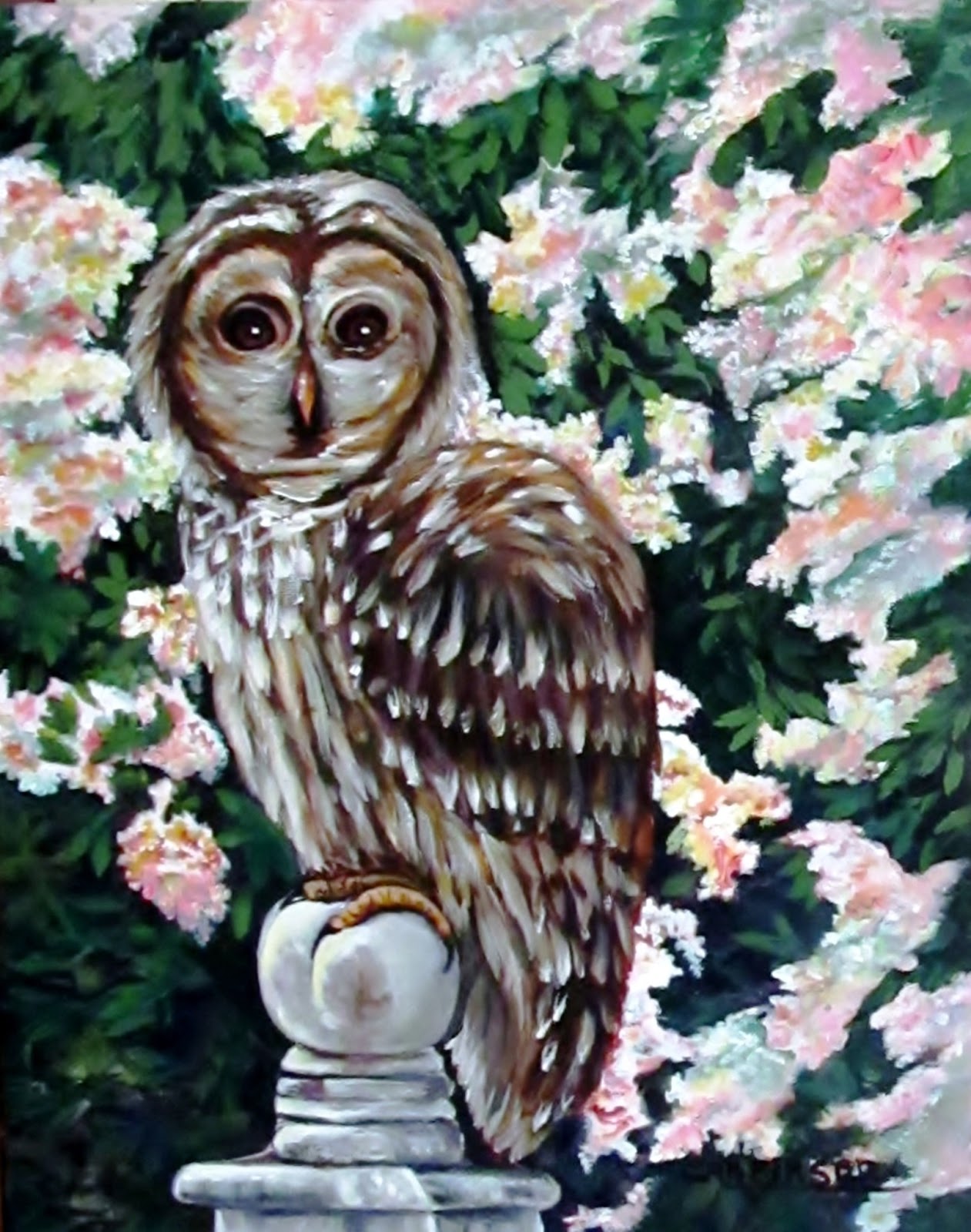
"The Pose" 16 x 20 Barred Owl acrylic on panel
My mother’s cupboards and drawers were neat and simple; partly because my parents had so little, and partly because she hated old things. Ironically, I developed a love for antiques and used items. I’ve always felt that old things carry the spirit and the life of those who went before.

This feeling was reinforced by an antique frame I purchased that held the photo of a woman with dark eyes. Every time I walked into the room where the picture was stored, those eyes bore down on me. There seemed to emanate a dark spirit of evil around that photograph. I couldn’t explain it, but I certainly felt it. Eventually I threw that old photo away, knowing that it was worth far more than the antique frame that held it.

See, I can throw things away on occasion.

"Playing Dress Up" 16 x 20 mixed media on canvas