Translate

Showing posts with label fish market. Show all posts

Friday, May 1, 2015

It’s All About Space

(The wide open spaces of the West -- original photo)
Space – there’s so much of it! We want to explore it, name it, and conquer it. Our curiosity knows no bounds when it comes to defining, understanding and controlling our vast universe.

Personal space makes us feel comfortable and safe. If someone invades that area or gets too close, we pull away. Space helps define the parameters we use in dealing with other people. We use different constraints with family members than we do with friends. The restrictions widen when we deal with strangers or other people socially or in a business setting.

In a crowded room or a queue of people, we may feel confined, but we deal with it. There are checks and balances constantly at play as we learn what is acceptable or tolerable. Sometimes there are no choices like on a crowded bus or waiting in line at the theater. This is when restraint and caution must help us counterbalance the situation.

"Fish Market" mixed media on canvas
Artists must control the space on their canvas and define its boundaries. Space can enhance distance and size, and help to explain shapes, objects and lines. To illustrate this point, a simple drawing of a tree is much easier to define when you focus on the space between the branches and in the background, not on the shapes in the foreground. The detail and the busyness can clutter your mind and vision. When you focus on the large and simple spaces and objects, clarity comes at once. Details should always come later.

Shadows may be defined, by analyzing the patterns of light on the ground. These shapes usually consist of circles or oval shapes between the leafy branches that are cast by the sunlight. Elongated shadows become shapes unto themselves as do the light spaces between them and surrounding them.
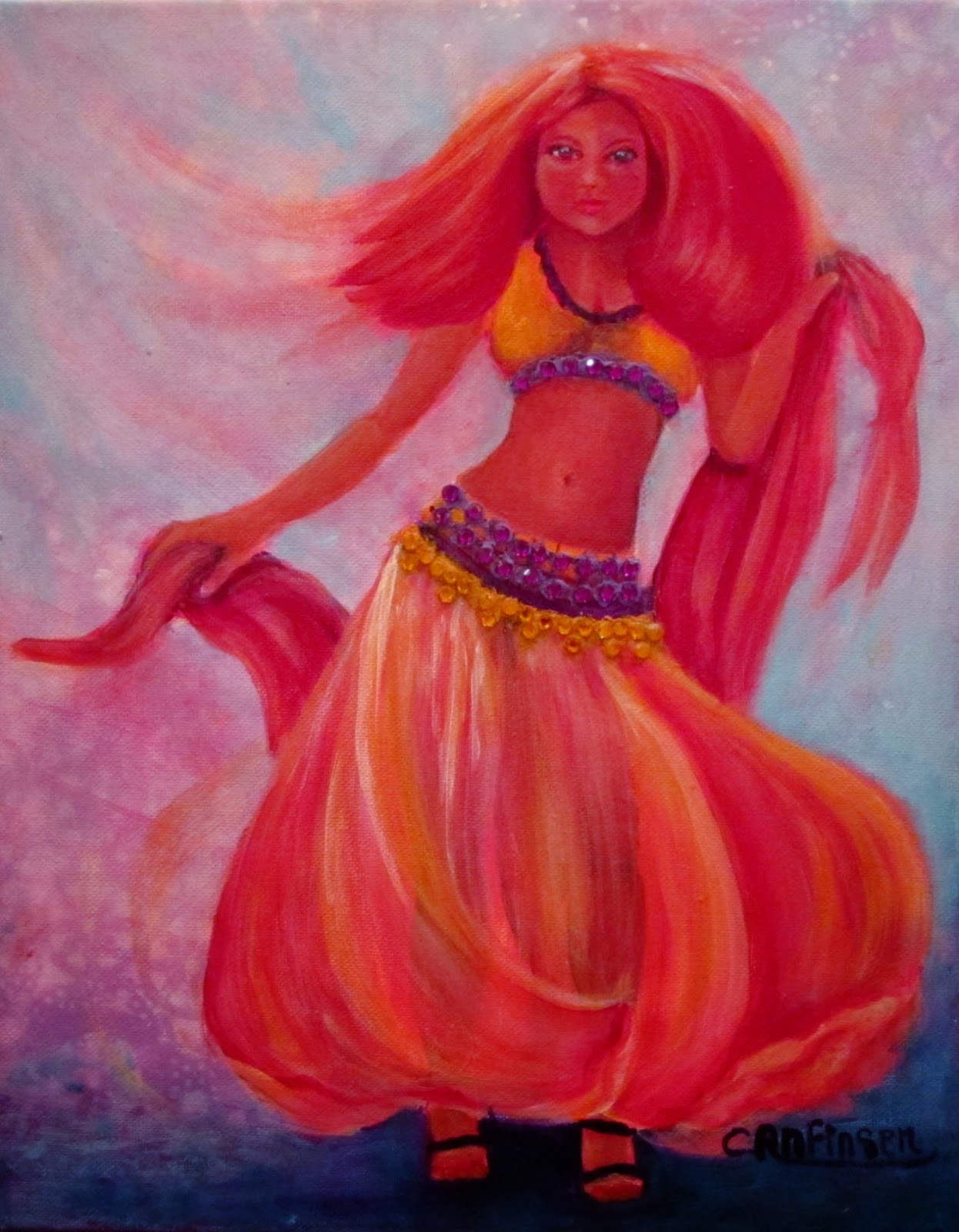
"Belly Dancer" 11x14 acrylic on canvas (with jewels)
When I created the “Belly Dancer’ I wanted her hair and costume to create movement. In order to achieve this, her hair had to move in the same direction as her hips, and her skirt had to swing in the opposite direction. Faded, extended color from both gives the feeling of motion. The space between her arms and around her body help to define that movement.

When my children were taking piano lessons, their teacher taught them about phrasing. Phrasing is like taking a breath between sentences or musical phrases. Phrasing helps to define the music in much the same way that space defines a painting.

Once your center of interest has been chosen, everything within the painting must draw the eyes to that point. The space on your canvas may also help you control eye movement. The adage “All roads lead to Rome” applies to the spaces, shapes and values of color on your map or canvas. “All roads lead to the center of interest.” If they do not, something is wrong with your composition.

(Belly Dancer - work-in-progress)
Gauge how your eyes travel and what they are drawn to. Too many colors and lines, or too much light may scatter your vision and allow your eyes to fly off the canvas. Fix it! There must be no distractions. Your composition must hold together and have continuity of purpose and direction.

White space on a page allows the reader’s eyes to breath or rest. In a painting, at some point, the viewer’s eyes must rest on the center of interest. That rest gives him or her pleasure, and keeps them from getting bored or wandering off to another painting that may better hold their interest.

A highway divides the "Great Salt Lake"

Saturday, March 16, 2013

What I Learned Climbing Trees and Playing Jump Rope


"Hey, Coconut Mon" acrylic on canvas
When I was a child, I loved to climb trees. I could look down on passersby, but they couldn’t see me. It gave me a great sense of power. I felt larger than life. Today, this concept is given a grown-up term called the “big picture.” This overview or perception is essential in planning and setting goals.

Many of the things I needed to know in life, I learned as a child; take jump rope. I gained more than building coordination. I learned how to merge. Do you notice how many people simply don’t know how to do this with discretion?


There are the bullies who drive into traffic like a bat out of you-know- what, always expecting that an opening will be waiting automatically. Sometimes they make it, causing people like you and me to stomp on our brakes or swerve into dangerous congestion. Or they slam on their own brakes and wait. By the time an opening appears, their car is at a standstill.

Then there are the turtles, the terrified ones who creep up onto the ramp, afraid of whizzing cars and trucks. They don’t have enough speed to merge in, and so they wait with a trail of cars behind them. These are the people who, when they were kids, either never played jump rope, or were never good at it.

They were the ones who stood and watched the rope go around and around, and when the time was right, they stood there as immobile as slugs. If they finally found courage to jump in, they were so out of sync that they tripped on the rope – game over.

"Cattle grazing with egrets" 11 x 14 oil on archival canvas
It’s all about rhythm. There are signs that alert a jumper when the time is right: the tapping of the rope on pavement, the height of the rope when it’s time to jump in. It’s all about gut feel and the rhythms of life; moving when the time is right and taking turns.

I call it tact. Some people naturally have it. They must have been jump rope pros! They seem to know when to talk and when to keep their mouths shut.  They sense when another person is tense or angry. They are in tune with other people’s feelings and the rhythms and patterns of human speech and emotion. Unlike their opposing counterparts who blurt out insulting remarks without thinking. Tacky!

"Window on Pine Island" 16 x 20 oil on wrapped canvas
These tactless souls are the ones who swerve in and out of traffic without regard for anyone else’s safety. They are the shoppers who push past others waiting in line, crashing into them like bumper cars. They are impatient. They think having to wait is for wimps. Anger propels them. They don’t have time for games unless they can win. “What’s in it for me?” is the question that prefaces every action. They are bulldozers in human form.

You find out a lot about people by waiting in lines and driving down the highway. You find out who knows when to merge and who doesn’t. And you discover discourteous people who refuse to move left, even when they can, to allow someone else to enter the highway. I swear these people never jumped rope.

"Fish Market" acrylic on 18 x 24 canvas
If I had my way, jump rope would be a part of every Drivers Ed. Class; maybe even part of college preparatory education or on-the-job training.  Who knows, there might be fewer accidents on the road and more teamwork on the job. But that’s just my opinion. What’s yours?

Wednesday, December 12, 2012

Don’t let Juried Competition turn You into a Coward


(My fellow-artist and friend, Grace, with her watercolor entry)
Entering your work in a juried competition can be intimidating, especially if you’re a self-taught artist. Almost everything you’ve drawn or painted has come from grueling trial and error, and done while comparing yourself to artists with several degrees tacked onto their names or who may have studied abroad.

Ironically, there are many successful self-taught artists. A degree doesn’t guarantee success nor does it immediately make you an artist. In either case, the same principles hold true: practice, practice, practice.

(Third Place in Juried Competition) "With These Hands -- Love" 16 x 20 OIL on canvas
One basic difference between them is that a solid art education provides a foundation that gives the artist an edge. Knowing why a painting works and understanding the building blocks of structure and execution is half the battle. In the end, success is determined by vision, skill, and persistence.

I’ve seen many discussions online about the value of juried competition. Is it worth the money, the time, and the possibility of rejection? The consensus seems to be that it’s rarely worth the money or the 35-40% commission charged for a sale. The value seems to be in promoting the name and the skill of the artist (assuming that they get in the show), and the benefits of adding a “win” to your resume. The odds of winning are somewhat better than winning a lottery, but not much.

(2nd Place Winner -- Juried Competition) "With These Hands -- Wonder" 16 x 20 OIL on canvas
Depending on the judge or juror of the show, your artwork is subject to their particular whims, likes and dislikes, and their own education and past influences. Rejection is somewhat subjective. Even in Art Leagues, I’ve found that the preferences and styles of each artist are effected by teachers in their past.

The thing that bugs me is that if we listened to these voices and followed their suggestions or objections rigidly, we’d all start dishing out artwork in the same dull way without innovation. There would be no Van Gogh’s or Salvador Dali’s; there would be no Thomas Hart Benton’s or Picasso’s.

I love what Andy Warhol said: “Art is what you can get away with!” If we’re always worried about conforming to the rules, or doing something in a particular way, art would become static.

"Fish Market" 18 x 20 Acrylic on canvas
For an artist to stand out, to be unique and to create his or her personal style then risks must be taken; experiments must be tried, rules must be broken. Aah, you say, but first you must know all the rules before they can be broken. Agreed, but the risk is that in sticking too closely to accepted forms and norms you may never get beyond the “copy cat” stage of accepted artistic behavior.

I’m a rebel in my heart of hearts. I’ve always defied fads and fashion. I’ve always created my own style because I couldn’t afford to follow current fashion. What I discovered, even in high school, was that I could create fashion trends by wearing what I had with confidence. Soon others would be wearing something similar.

"Broken" 11 x 14 mixed media on canvas SOLD (Prints available)
The same holds true for artists. Confidently create your own personal vision and you’re bound to be successful.


Saturday, July 28, 2012

Our Shrinking Economy – our Rising Debt


Everything is shrinking! Literally. My income, my stature, the size and quantity of the things I buy and what I can afford. Everything is shrinking but the price.

Like you, I’m paying more for less. My favorite things have gone from 8 oz to 7 oz to 6 oz or less in just a few months. A few packages stayed the same size, but the contents were less. I’m afraid It’s only the beginning!


I purchased some canvases the other day and instead of being .5 inches in depth, they’d shrunk to almost .25. Rather than fitting nicely into a frame or serving as a wrapped canvas painting, they leave gaps and spaces; they look cheap and skimpy.

Many artists are turning to treated hard board or plywood; still, framing is a difficult task. The prices for quality canvases have doubled while the sales price of a finished painting has remained the same. The cost of renting space has gone up to 40% commission. The artist receives 60% barely covering the cost for materials let alone time. Add to that cost a frame, and you see what I mean.

Is it worth it? I don’t know, but it’s what I do. Just when I think the economy is getting better, another one of my favorite businesses, restaurants, or products goes out of business. On the surface, things seem the same, but there’s an undercurrent of unrest. Everything is changing. Stores are being built as others are being boarded up. Hope rises in the midst of fear and failure.

We can only “keep on keeping on,” as my mother used to say. We put one foot in front of the other and hang on, despite the economic climate or the plight of those who risk everything and fail.

Hope is eternal the Bible says. We hope for better things, and we act as if they are possible. It’s how we survive. We hope for a better tomorrow as we wipe the tears of grief from our eyes and move on. What more can we do?


Two paintings featured today: “Sand Cranes at Twilight” and “Release” (with quote by Joseph Campbell) will be on display at Art for ACTS in downtown Fort Myers in August.


Featured Artist:
I’m going to start a new section called “Featured Artist.” There are so many wonderful artists and writers out there that deserve attention that I’m willing to share my space with them. Today, I feature: Ashish Das   If ever there was a second Picasso, he is it! I am amazed with his creative blend of cubism and abstraction. Enjoy the delightful and colorful work of Ashish. 


Tuesday, May 29, 2012

Back to Your Roots; an Exploration


"Fish Market" 18x22 acrylic on canvas


What do you think of when people say “roots:” that it’s time to recolor your hair? that your newly planted vegetable garden is bursting into life? Or do you think of your child’s stubbornness when he or she plants those tiny feet firmly on the ground and shouts “No!”


For many of us the word roots means family: the people who have gone before us (ancestors) and the people who will come after (descendants). A wonderful new program on the Public Broadcasting System (PBS) is called “Roots.” Produced and directed by Henry Louis Gates, Jr. the show “explores race, culture, and identity through the genealogies and family histories of famous people. The ‘who we are’ and ‘where we come from’ is at its core.”

The show is scheduled on Sunday nights at 8 p.m. EST. We have been enjoying it for several weeks at our house. It’s amazing to see that as we go back in time, we are all connected in some amazing ways. It touches my heart to see people find their roots, understand themselves better, and gain a new appreciation for those who have gone before. The show is emotional, surprising, and climactic. When the trail of family is exhausted, DNA evidence reveals additional information on country of origin.

"Innset Kirke" 11x14 oil on canvas  SOLD

My love for painting Norwegian scenes comes from my own Scandinavian roots in Sweden and Denmark, and my husband’s strong Norwegian ties as a direct descendant. His family comes from Stavanger and Skudeneshavn. Some of his ancestors were buried at the old Innset Kirke. His great, great grandfather was a lighthouse keeper for many years at Vikeholmen.

The family loves to tell the story of the beautiful nude young woman who would swim in the waters around the lighthouse. Eventually they were married. That’s one way to catch a husband!  I would love to get a hold of more information on the lighthouse and how long his great great grandfather cared for it.

Work-in-Progress -- Vikeholmen Lighthouse underpainting


I have two versions of the lighthouse that I’m going to paint. Of course, the original lighthouse is no longer there. An electronic machine has taken its place, but the area is still as beautiful as ever.

In Sweden, my great great grandmother baked pastries and sweets before sunrise and then sold the tasty treats on the city streets. She did this for many years.

Drawing for 2nd Vikeholmen Lighthouse painting 16x20 on canvas

One of her jobs as a young girl was to fill the vinegar jar with vinegar, a precious commodity, from a neighboring farm. Returning one day, she decided to shorten her walk by cutting through a pasture. Unfortunately, a bull ruled the grounds and decided to charge her. The vinegar jar was broken as she ran to climb over the fence. She received a sound scolding from her mother when she got home.

It’s fun to go back in time and research one’s family, if only for the stories. Better yet, gather the stories while your relatives are living. Their courage and strength in the face of difficulties is food for inspiration. Even if one generation fails you, there is always another one that may surprise and enlighten.

"Skudeneshavn, Norway" oil on 16x20 canvas  SOLD

The "old wooden village" above can be entered by land or water. Many festivals occur in the bay and people arrive by boat.

I hope you've enjoyed my completed African acrylic painting: “Fish Market,” my other Norwegian paintings, and my “works in progress.”

Tuesday, May 15, 2012

Art is the Priceless Expression of the Soul


Work in Progress -- acrylic drawing 18x24 canvas


What is the fine line that separates art from pornography? Can you feel it? Sense it? What is vulgar to one person may be beautiful to another. I was surprised and excited when I took my first drawing class with a live model. I blossomed! My linear ink/brush drawing won first prize in an art show.


I took my sketches and drawings; my prized paintings, to a family reunion and shared them with relatives. My excitement waned as shocked and appalled faces looked back at me. They were not only “not impressed,” they were disgusted.

Beauty is in the eye of the beholder. Obviously, my relatives had never had much exposure to art. What they saw and felt was shame for the exposure of the human form. I was crestfallen. Every emotion and skill I had discovered in myself was frowned on by those who knew me. My best was not good enough. I was viewed with disdain.

Did that deter me? Yes, for awhile until I rediscovered myself and the beauty of all God’s creations, including the human body.

Work in Progress -- "Fish Market--You Buy?"

During the transformation of the German people under the leadership of Hitler, Heinrich Heine made this observation: “Where books or art is burned, they will in the end, burn people.”

We must protect our freedom of expression. In China they cannot use the Internet freely or speak freely. Sometimes in government’s efforts to control and protect, they end up extinguishing freedom. Just like blowing on a lighted candle, they diminish the light of truth and the power of the individual to choose.

Work in Progress, 18x24 canvas, Fishmarket
Here are some of my favorite quotes by famous artists: Enjoy!

"When my daughter was about seven years old, she asked me one day what I did at work. I told her I worked at the college- that my job was to teach people how to draw. She stared back at me, incredulous, and said, "You mean they forget?"
Howard Ikemoto
The more horrifying this world becomes, the more art becomes abstract.
Paul Klee
"Good art is not what it looks like, but what it does to us."
Roy Adzak
"A painting is never finished - it simply stops in interesting places."
Paul Gardner
"A line is a dot that went for a walk."
Paul Klee
It took me four years to paint like Raphael, but a lifetime to paint like a child.
Pablo Picasso
Art washes from the soul the dust of everyday life.
Pablo Picasso
It takes a very long time to become young.
Pablo Picasso
There are painters who transform the sun into a yellow spot, but there are others who, thanks to their art and intelligence, transform a yellow spot into the sun.
Pablo Picasso
If people knew how hard I worked to get my mastery, it wouldn't seem so wonderful at all.
Michelangelo Buonarroti
"If you don't like something, change it. If you can't change it, change your
attitude. Don't complain."
Maya Angelou
An artist is not paid for his labor but for his vision."
James McNeill Whistler
"Every artist dips his brush in his own soul, and paints his own nature into his pictures."
Henry Ward Beecher
It has bothered me all my life that I do not paint like everybody else.
Henri Matisse
I do not literally paint that table, but the emotion it produces upon me.
Henri Matisse
I found I could say things with color and shapes that I couldn't say any other way-things I had no words for.
Georgia O'Keeffe
Art is not what you see, but what you make others see.
Georgia O'Keeffe
"The source of genius is imagination alone, the refinement of the senses that sees what others do not see, or sees them differently."
Eugene Delacroix
"I am an artist… I am here to live out loud."
Emile Zola
"Painting is easy for those that do not know how, but very difficult for those that do!"
Edgar Degas
"Art is not what you see, but what you make others see."
Edgar Degas
"No amount of skillful invention can replace the essential element of imagination."       Edward Hopper

"Hey, Coconut Mon" (part of my African series)


Thursday, March 29, 2012

”What’s Love got ta’ do, got ta’ do with it?”


Photo from contact in Uganda

 The words in the title are from Tina Turner’s greatest hit. “What’s love got to do with it?” Why, everything, Tina!

No matter what we give our heart or our time to, if we have the passion and the love, we’re bound to be successful. Why? Because what we love we give our devotion to; we give it our all.

Bert Sugar, prolific author and promoter of life and boxing, loved what he did. But that wasn’t always the case. Sugar started out as an attorney and then worked in various professions before he started doing what he loved: boxing. When he started writing about what he loved, and engaging in the technical aspects of the sport, his success soared. He died a few days ago doing what he loved.

Work in Progress -- Fish Market -- "You Buy?"

Successful artists or professionals have one thing in common: passion. Their love of what they do drives them to produce more and more of what they love. It skyrockets them to success, but not over night. The path to success requires blood, sweat and tears and the willingness to accept criticism, anger, and hatred; especially if your work has a political intent. One artist comes to mind: a Utah artist named Jon McNaughton.

The Los Angeles Times calls McNaughton’s work “junk” because they disagree with his ideas and his politics:

"Titled "One Nation under God," the earlier hack propaganda seems content to pretend that the United States is a Christian nation, with Jesus as the law-giver. (Weirdly, a figure identified as James Madison stands directly behind the Constitution, even though Madison famously rejected any religious sanction for government authority.) A professor of constitutional law who knows that America was instead founded as a secular nation, one where the freedom to practice any religion or no religion is fundamental, would probably blanch if he saw it.”

McNaughton’s response is a quote from Washington:

"I am persuaded, you will permit me to observe that the path of true piety is so plain as to require but little political direction. To this consideration we ought to ascribe the absence of any regulation, respecting religion." (from the Magna-Char ta (constitution) of our country.)

You may or may not agree with McNaughton or with the L.A. Times. But to say that McNaughton wasted paint and canvas and that his work is “junk” is an atrocity in my lowly opinion. He is a superb illustrator who is being “vilified” for differing with the political agenda of “some of the people,” but not all.

It is interesting to note that the L.A. Times and their ilk were fond of the urine soaked painting of Christ that received rave reviews by the "left."

"He Lives!" -- 16x20 mixed media
When you follow your heart and mind, your work and your opinions may not be popular. You may be labeled a “hack” and your product called “junk.” So were the works of Van Gogh and many of his contemporaries who dared to speak out and to create what they felt strongly about.

Do you have the courage to stand up for your beliefs, or will you succumb to popular opinion and the forces of power? Freedom in art and expression must never be suppressed, especially by government or the media that serves that government. The perfect example of this is in Iran, and Russia, and Venezuela, and in Cuba to name a few.

http://youtu.be/4KGlBHyVeYU

"Americana" 16x20 acrylic
America is the world’s last Bastian of freedom. What will you do to preserve and keep it alive?