Translate

Showing posts with label rough. Show all posts

Monday, October 24, 2016

Sea Glass – There’s Magic in the name and Romance in its History


What is sea glass?  Where is it found? Why do so many colors end up together in one location? What can you do with the beautiful gems you’ve found?

Before you get all excited about gathering some for yourself, be aware that many beaches restrict taking any glass away. And some of the best places to find glass are out of the way locations that may be difficult to reach.

The following site explains where this glass comes from and how long it takes to make the smooth rounded pieces that people seek.
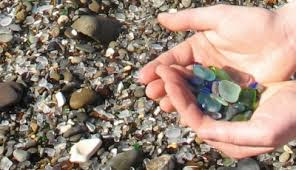

The Colors of Sea Glass
Where Do They Come From?

...Just where do the colors of beach glass come from? Sea Glass is simply old glass products that were thrown into the sea, but, "Sea Glass is JUST GLASS, like Diamonds are JUST ROCKS"©

It takes decades for broken glass to "become" sea glass.
If you think about it, the common colors of sea glass, Green, Brown & White are still in wide use today......Rarer colors of sea glass are pieces that the color has not been made or used commercially for many years.

“We have broken the colors into rarity categories, it is a general rule and not to be carved in stone (or glass!) as certain colors can be found more readily in some areas. For Example, lavender glass can be a rarity in some areas, yet abundant in Maine & Canada; but hardly ever found in the islands. Next time you're in an antique shop or flea market, look at the glass items and see if you haven't found a piece of glass this color!


“By The Sea Jewelry is proud to offer the finest Genuine Sea Glass Jewelry in just about every color of sea glass in the world! This glass knowledge is based on 28 years of collecting and decades of researching the origins of our glass.”

The rough and tumble journey back and forth in tide water creates rounded corners and a smooth surface. The colors become almost translucent. If you find some in a shop or from an artist, check it out carefully to make sure it is real sea glass and not fake. The color and clarity can give you clues.

Google has a wonderful search bar where you can find just about anything. They have a guide to show you where to find sea glass, a book on how to tell if it’s real, and items that are made from this precious glass. Remember that what makes it valuable is the origin of the original glass, and the years it took to tumble it into a smooth, clear stone.


GOOGLE LINK: All about Sea Glass

There is a difference between fresh water glass and sea glass that is made smooth and beautiful by the salt water. According to the following link, there are also legends attached to this fascinating wonder of the world. Sailors long ago thought that the blue ones were mermaid tears that spilled ashore.


For some more history and help with identification, go to:  Glass Beach Jewelry  

This remarkable gift from the sea can be yours for a price, unless you’re lucky enough to find one of those hidden coves where the tides have come and gone for hundreds of years. Many of these pieces will still be in a state of development. Their edges may be sharp; their size may be small, and their shape odd.

But if you persevere, you may find a colorful stone that possesses that clear see-through sparkle. If the color is rare and the size is large you may have the beginnings of a treasured necklace or the centerpiece of a priceless mosaic table.


Wednesday, April 1, 2015

Ever been called a Hard Head or a Chip off the Old Block?

"Moonlight Magic" 14x11 acrylic on canvas. (remember the weird undercoating? See what I wiped out?)
As unflattering as those terms are, being called a block head or worse simply indicates that you’re stubborn, unbending, and immovable; something an entrepreneur should never be. If you can’t negotiate, if you’re unwilling to give the customer the benefit of the doubt, your sales are likely to plummet.
Give and take is what it’s all about and sometimes you learn the hard way. A few weeks ago I failed to consider the dimensions of an object and focused only on weight. The omission cost me over half of my profits. It was my mistake. I owned it. The customer’s cost was the same regardless.
By failing to do a “test run” before setting price, I was the one who got shortchanged. UPS suggested I call the customer and see if they would meet me half way. To me that sounded dishonest and weak. It was like changing the price of a bargain in midstream. So I kept my word and my customer was satisfied.
If that decision means he will be a repeat customer, then I’ll be happy. If that means he will refer my shop to someone else, then I’ll have two happy customers. That’s the name of the game. Chalk it up to the cost of advertising, part of the learning curve in business or stupidity. The outcome is the same.
Sometimes people complain even when you bend over backwards to please them. Their bark is often worse than their bite. If you make them feel they are getting a good deal, their bluster may turn into satisfaction. Rub people “against the grain” and you’re likely to lose a loyal buyer.
Wood is not only utilitarian, it is rich and beautiful. Circular grain may tell us how long a tree has lived and what it has weathered. Identifying the differences in the bark can help us determine what kind of tree we’re dealing with.
"Window on Pine Island" 16x20 oil on canvas

Even though wood wears away in time, it stays the same even when it becomes thin and overused. I’d take a wooden bowl and cutting board any day over a plastic or fabricated one. I’d rather scrub them after use with antimicrobial soap than trade them in on new models. I treasure the dark sheen that comes from use and the way wood absorbs oil and water like a living breathing thing.
My youngest son made me a small piggy cutting board when he took shop in high school. I have used it for over 25 years. One day after listening to those hyper-germaphobics, I placed it in my dishwasher, without the heat, to sanitize it. When I opened the washer, the pig had split along every grain line. The heat of the water had weakened the wood and simply dried out its life. I miss that pig!
I still have a wooden bowl made of myrtle wood that came from Seattle, Washington. It was given to me by my first husband. Today we use it to serve hot popcorn. The oil in the corn keeps it dark and lovely. I will never (are you listening?) never put it in my dishwasher.


This woodcarving of a little girl came from an antique store in Ellicott, Maryland. I love that place! My daughter lived nearby and I was visiting her that summer. The wooden figure drew my heart, all the more for its primitiveness. I suspect a beginning carver crafted this piece for the very first time.
The carved inscription says ©Somerville. I did some research and traced it to Somerville, MA; there seems to be a lot of woodcarving action going on up there. I suspect one of the many students that come and go carved this at some time and the sculpture ended up in Ellicott, Maryland.


If you haven’t tried painting wood grain, give it a try. Watch it come alive under your brush. Its exquisite sheen and grain are unique to each piece, so you don’t need to worry about mistakes. 


Even wood piling on the seashore or faded wood fences may turn an ordinary scene into a masterpiece.

(SOLD) Prints available at http://carol-allen-anfinsen.artistwebsites.com