Translate

Showing posts with label shapes. Show all posts

Monday, October 24, 2016

Sea Glass – There’s Magic in the name and Romance in its History


What is sea glass?  Where is it found? Why do so many colors end up together in one location? What can you do with the beautiful gems you’ve found?

Before you get all excited about gathering some for yourself, be aware that many beaches restrict taking any glass away. And some of the best places to find glass are out of the way locations that may be difficult to reach.

The following site explains where this glass comes from and how long it takes to make the smooth rounded pieces that people seek.
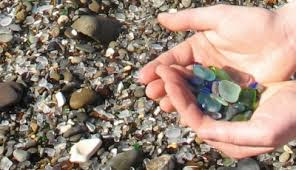

The Colors of Sea Glass
Where Do They Come From?

...Just where do the colors of beach glass come from? Sea Glass is simply old glass products that were thrown into the sea, but, "Sea Glass is JUST GLASS, like Diamonds are JUST ROCKS"©

It takes decades for broken glass to "become" sea glass.
If you think about it, the common colors of sea glass, Green, Brown & White are still in wide use today......Rarer colors of sea glass are pieces that the color has not been made or used commercially for many years.

“We have broken the colors into rarity categories, it is a general rule and not to be carved in stone (or glass!) as certain colors can be found more readily in some areas. For Example, lavender glass can be a rarity in some areas, yet abundant in Maine & Canada; but hardly ever found in the islands. Next time you're in an antique shop or flea market, look at the glass items and see if you haven't found a piece of glass this color!


“By The Sea Jewelry is proud to offer the finest Genuine Sea Glass Jewelry in just about every color of sea glass in the world! This glass knowledge is based on 28 years of collecting and decades of researching the origins of our glass.”

The rough and tumble journey back and forth in tide water creates rounded corners and a smooth surface. The colors become almost translucent. If you find some in a shop or from an artist, check it out carefully to make sure it is real sea glass and not fake. The color and clarity can give you clues.

Google has a wonderful search bar where you can find just about anything. They have a guide to show you where to find sea glass, a book on how to tell if it’s real, and items that are made from this precious glass. Remember that what makes it valuable is the origin of the original glass, and the years it took to tumble it into a smooth, clear stone.


GOOGLE LINK: All about Sea Glass

There is a difference between fresh water glass and sea glass that is made smooth and beautiful by the salt water. According to the following link, there are also legends attached to this fascinating wonder of the world. Sailors long ago thought that the blue ones were mermaid tears that spilled ashore.


For some more history and help with identification, go to:  Glass Beach Jewelry  

This remarkable gift from the sea can be yours for a price, unless you’re lucky enough to find one of those hidden coves where the tides have come and gone for hundreds of years. Many of these pieces will still be in a state of development. Their edges may be sharp; their size may be small, and their shape odd.

But if you persevere, you may find a colorful stone that possesses that clear see-through sparkle. If the color is rare and the size is large you may have the beginnings of a treasured necklace or the centerpiece of a priceless mosaic table.


Wednesday, June 29, 2016

Contrast Reveals Truth and Clarifies what’s Important


Thinking back to grade school, the kids who stand out in my mind, are not the popular or good looking ones whose faces I have long since forgotten, but the ones who were different. Even in memory, I can see them clearly. Back then, I felt their pain and even imagined that I could feel their awkwardness and aloneness.

My sense of fair play demanded that I do something about it. I decided to befriend each of them in turns. I got permission from my mother to walk home with Gail to play for about an hour and then walk back home.

My parents were poor by most standards. At the time, we lived in an upstairs apartment over my grandmother’s home. My dad didn’t own a car. Each day, he walked to and from the Caterpillar Tractor store where he repaired and maintained rental machinery. In our small town, income levels were low, and most people lived simply.

Gail, on the other hand, had a house and a yard with a swing in it. Dirty gray stucco that hadn’t been painted in years gave the house a somber look. There were no flowers or shrubs. When we finally made our way inside, I was shocked at the barren rooms.

We looked through the cupboards for something to eat, but the shelves were bare. A dry piece of cake with mildew sat on the counter top. Gail’s parents were not at home and the house gave off an empty lonely vibe. There were no toys to play with except the swing outside so we ended up playing outdoors.

When I got back home our small apartment seemed like a castle. Cheerful colors welcomed me and the sound of my mother's singing while she cooked made me smile. The simple soup and bread we had for supper seemed like a feast after the barren offerings of Gail’s existence.

The contrast between our homes re-defined the word “poor” for me. Gail's home expressed a poverty of spirit and a shortage of amenities. I would never again view myself or my family as lacking in anything.

Over the next few weeks I went home with Alice, a student who had a visible disability. She was a polio victim as a toddler; as a result, her left arm and leg were shorter. Alice limped in a funny hop bounce way that made her arms bob with each step. Everyone made fun of her, except me.

She had six other brothers and sisters. It was obvious from the moment I stepped inside their large old fashioned home that she was loved. There were games, giggles, and a relaxed easy-going ambiance that made time fly. Alice’s life was already full. No wonder she was able to handle the nasty remarks from her peers. The wisecracks didn't shake her world.

Lorraine was a bed wetter who sometimes had accidents in class, especially when she was listening to a story. In the silence of the room her accidents sounded like raindrops on our wooden floor. The janitor was quietly invited to our room and mopped up without noise or distraction. The teacher (my grandfather), continued the story without dropping a beat. The intrusion went unnoticed.

Lorraine was embarrassed, of course, but she never said a word. If she could have stopped wetting her pants, she would have. Most of her classmates felt sorry for her. A few twittered and teased, but most accepted her as she was.

Diane was taller than most girls her age which made her feel ugly and conspicuous. She hunched her shoulders in a grotesque slump to make herself appear shorter. Eventually her posture became permanently cemented for life.

Diane was funny, friendly and likable. It was easy to overlook her rounded shoulders once you got to know her. I was posture conscious. My grandfather had encouraged his granddaughters to walk with books on their heads and their backs straight so Diane’s rounded stance was a constant irritant to me. Her mother never said a word about it knowing it would make her feel even more self-conscious. Her unsightly hump made me want to stand even straighter.

When you are different from others life can be cruel. My heart goes out to those children who are bullied or made fun of because they stand out.

In a painting, contrast defines and highlights the center of interest. The differences in shape, value and color makes the objects jump out at you: dark against light, round against rectangular, bright against dull. A composition becomes interesting or impressionable because of these contrasts.


It’s too bad we don’t view people in the same way. The ones who catch our eye, or are unique would be seen as beautiful rather than nonconforming or odd. The differences would be viewed in a new way; much like a highlight or an unusual shape catches our attention and pulls us into a painting.

"Raccoons at Sunrise" (the last drink before bedtime), 20 x 16 acrylic on canvas

Tuesday, March 22, 2016

There is Art and then there is Art

FINAL "Egrets and Mangroves" 14 x 18 acrylic on canvas; original in barn wood frame
Because the appreciation of art is subjective and personal, it is difficult to define what is and what isn’t. There are standards and elements that may be judged in one way or another; but here again, the perspective of the judge is also a personal opinion call.

I admire people who experiment and risk all in their creative journey. Sometimes you don’t know what will work unless you give it a try. In art and fashion I hate the claim that “One size fits all.” They never do! That one size may drown a small person or embarrass those who are too large.

Painting styles and techniques are never the same either. New artists may copy their teacher or the masters until they discover what works best for them. But you never will if you don't explore on your own the possibilities.


One such experimenter was Charley Harper, Illustrator. Some of his bird artwork was presented on Antiques Roadshow in Iowa a few weeks ago. The owner was amazed that at auction the suggested going price was between $12,000 to $24,000 each. 

According to the Roadshow expert, Harper’s work is a “hot” item. His style blends in well with today’s contemporary straight lines and patterns. On Charley’s professional web site we learn that:

“Charley Harper's unique minimalist approach is unmistakable. From his groundbreaking mid-century illustrations for Ford Times Magazine and Golden Books and his impeccably composed posters for the National Parks and other wildlife organizations, to his whimsical serigraph and giclée prints, Charley Harper's art is a beloved treasure and an inspiration to an entire generation of artists and designers.”


In a style Harper called "minimal realism", Charley Harper captures the essence of his subjects with the fewest possible visual elements. When asked to describe his unique visual style, Charley responded:

"When I look at a wildlife or nature subject, I don't see the feathers in the wings, I just count the wings. I see exciting shapes, color combinations, patterns, textures, fascinating behavior and endless possibilities for making interesting pictures.

"I regard the picture as an ecosystem in which all the elements are interrelated, interdependent, perfectly balanced, without trimming or unutilized parts; and herein lays the lure of the painting; in a world of chaos, the picture is one small rectangle in which the artist can create an ordered universe."

He contrasted his nature-oriented artwork with the realism of John James Audubon, drawing influence from Cubism, Minimalism, Einsteinium physics and countless other developments in Modern art and science. His style distilled and simplified complex organisms and natural subjects, yet they are often arranged in a complex fashion. On the subject of his simplified forms, Harper noted:

"I don't think there was much resistance to the way I simplified things. I think everybody understood that. Some people liked it and others didn't care for it. There's some who want to count all the feathers in the wings and then others who never think about counting the feathers, like me."

The results are bold, colorful, and often whimsical. The designer Todd Oldham wrote of Harper, "Charley's inspired yet accurate color sense is undeniable, and when combined with the precision he exacts on rendering only the most important details, one is always left with a sense of awe."


Charley, on numerous examples, also went outside the medium of graphic art and included short prose poems for the artwork he made. We can learn so much from Harper's life and illustrations. Whatever you decide to do as you develop your artistic style, enjoy it and love what you do!  (I decided to add my tiger painting below as it's a similar composition as Charley's but in a far different style)

"Namesake" 24 x 18 acrylic on canvas


Saturday, August 29, 2015

Abstract Realism – Yes, you can do it!


"Moonshines" acrylic on 18x24 canvas (abstract realism)
There’s tremendous freedom in doing an abstract painting. To do them well is the greatest challenge. What attracts the viewer? The colors, shapes, values, and most especially the mood. How does the painting make you feel?

Some abstract paintings are stark and limiting. Others may distort shapes or simplify images. According to Sue St. John, author of Journeys to Abstraction “The choices are vast and nothing is wrong. Abstract art can be incredibly liberating.”
Think of abstract art as fluid. Allow your brush to intuitively follow your imagination and mood. Take an idea, a theme, a feeling and express it in liquid motion. Keep in mind that an abstract artist is expressing “concepts” rather than exact depictions.


Abstract realism combines the best of both depending on what you choose to emphasize. Shapes and colors may be in the abstract with one part of the painting rendered true to life as the focal point. The reverse is also possible. Take a realistic background and an abstract center of interest. Inspiration is all around you.

I have an artist friend who gets inspired by fabrics. She can turn a small element of design into a full-blown abstract painting.
Look for shapes and patterns in your environment: the way light and shadow play out and create designs, structures, and lines. The world is full of texture, color and form. Examine how they work together and how they make you feel.

"My Trail of Tears" mixed-media on canvas

To advance a theme or emphasize a point, some artists incorporate symbols into their artwork. They are interesting. They provide additional information. For example, if the artist’s vision is “new birth” or change, a butterfly would help signify this metamorphous.

Many symbols are already familiar such as the circle (infinity, cycle of life, wholeness); the Egyptian Ankh which symbolizes the harmony between the physical and the spiritual worlds. Pentagrams (five-sided stars) represent the four elements of earth, wind, water and fire and how they are bound together with the fifth element of spirit.
The study of symbols alone would provide you with an astounding number of paintings and the basis for combining realism with abstraction. This should not only release you from preconceived notions about earth and life, but inspire you with countless stories and designs that are unique and personal. Above all, have fun!


"Moonlight Magic" 11x14 mixed media, layered acrylics

The following link should provide you with some great ideas. I’ve also included a quote by well-known artist Sherrie McGraw:

“A painting is more than the subject matter or the story it might depict. Good painting carries an undercurrent of beauty that expresses something beyond subject matter, beyond the tangible reality. It is this level of seeing that makes a painting a living thing, something that speaks even centuries after the artist is gone.”

Tuesday, July 30, 2013

Two Minute Sketches Push you to the Brink


If you want to become adept at drawing people or doing portraits, “quick studies” offer a way to focus on what’s important. 
If you’ve never done it, now is the time to start!

Beginning with gesture and motion, focusing on the way a person’s body leans and moves is critical if you want your images to look vibrant and alive rather than just plastic replicas of stick people or flat uninteresting copies. Gesture is what makes each image unique. Exaggerating those gestures makes for a more interesting pose.


Once gesture and movement are identified, then form comes easily. The form makes the figure three-dimensional. Here the weight of the image and the likeness are developed. Completing your gesture sketches with more fully developed drawings of form gives you a foundation on which to build a likeness and imaginative scenes with complex characters.


Practice makes perfect. Some of my sketches are out of proportion. As I become better, the proportions should become more natural. Sometimes I have to slow my drawing hand down to the same level as my brain. I’m hoping my brain will soon catch up to my hand.

C-CURVE (backwards)


S-CURVE Gesture
Portrait studies can be done in the same way. These quick studies force you to see shapes and values before getting into the details. Unless the foundation is solid, the details will still look flat or cubist. If that’s what you want, great! But if likeness and a portrait is your goal, your details need to be placed on accurate solid forms.


Notice the slant of the shoulders
My favorite online teacher is Stan Prokopenko or “Proko.” Here is one of his videos. Practice along with Stan and check out his other videos. If you’re new to portraits or the figure, you need all the help you can get!


TIPS: Use soft vine charcoal for smooth lines. Make certain you have extra sharpened sticks nearby (they dull quickly). Also use inexpensive drawing paper. The perfect size is 9x12. If you use a larger size as I did below, and try to cram more drawings in on one page, your proportions will end up way off and you'll run out of space to draw.


Online Contest Winner -- First Place for "Hearts Afire"

Online Contest Winner Second Place -- Title: "A Joyful Heart"
Pastel 9x12 on Bristol