Translate

Showing posts with label beaches. Show all posts

Monday, October 24, 2016

Sea Glass – There’s Magic in the name and Romance in its History


What is sea glass?  Where is it found? Why do so many colors end up together in one location? What can you do with the beautiful gems you’ve found?

Before you get all excited about gathering some for yourself, be aware that many beaches restrict taking any glass away. And some of the best places to find glass are out of the way locations that may be difficult to reach.

The following site explains where this glass comes from and how long it takes to make the smooth rounded pieces that people seek.
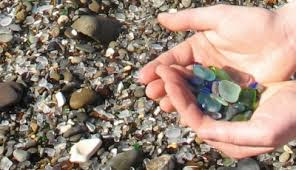

The Colors of Sea Glass
Where Do They Come From?

...Just where do the colors of beach glass come from? Sea Glass is simply old glass products that were thrown into the sea, but, "Sea Glass is JUST GLASS, like Diamonds are JUST ROCKS"©

It takes decades for broken glass to "become" sea glass.
If you think about it, the common colors of sea glass, Green, Brown & White are still in wide use today......Rarer colors of sea glass are pieces that the color has not been made or used commercially for many years.

“We have broken the colors into rarity categories, it is a general rule and not to be carved in stone (or glass!) as certain colors can be found more readily in some areas. For Example, lavender glass can be a rarity in some areas, yet abundant in Maine & Canada; but hardly ever found in the islands. Next time you're in an antique shop or flea market, look at the glass items and see if you haven't found a piece of glass this color!


“By The Sea Jewelry is proud to offer the finest Genuine Sea Glass Jewelry in just about every color of sea glass in the world! This glass knowledge is based on 28 years of collecting and decades of researching the origins of our glass.”

The rough and tumble journey back and forth in tide water creates rounded corners and a smooth surface. The colors become almost translucent. If you find some in a shop or from an artist, check it out carefully to make sure it is real sea glass and not fake. The color and clarity can give you clues.

Google has a wonderful search bar where you can find just about anything. They have a guide to show you where to find sea glass, a book on how to tell if it’s real, and items that are made from this precious glass. Remember that what makes it valuable is the origin of the original glass, and the years it took to tumble it into a smooth, clear stone.


GOOGLE LINK: All about Sea Glass

There is a difference between fresh water glass and sea glass that is made smooth and beautiful by the salt water. According to the following link, there are also legends attached to this fascinating wonder of the world. Sailors long ago thought that the blue ones were mermaid tears that spilled ashore.


For some more history and help with identification, go to:  Glass Beach Jewelry  

This remarkable gift from the sea can be yours for a price, unless you’re lucky enough to find one of those hidden coves where the tides have come and gone for hundreds of years. Many of these pieces will still be in a state of development. Their edges may be sharp; their size may be small, and their shape odd.

But if you persevere, you may find a colorful stone that possesses that clear see-through sparkle. If the color is rare and the size is large you may have the beginnings of a treasured necklace or the centerpiece of a priceless mosaic table.


Saturday, November 30, 2013

“A Change is as good as a rest,” or so they say

"Arabesque" oil on canvas
Sometimes we don’t realize the traps we set for ourselves on a daily basis. We get caught up in minutiae, and use every excuse in the book to stay put; feet firmly planted in the ruts we’ve dug. Let’s face it; the chores at home never end. Soon they begin to grind and irritate us. Not a good prescription for progress or creativity!

Thanksgiving Day I left the confines of home with my husband heading north toward other family members in the area. As was our tradition, we made Thanksgiving reservations at a restaurant located mid-point between our two separate locations.

A morning chill turned temperate, and the warmth of the sun made our road trip bright and pleasant. Our once Northern blood has thinned from years of living in Southern climes, and we were wrapped in sweaters dressed for any outcome unable to tolerate even the slightest drop in temperature.

"Pelican at Rest" oil on canvas
I realized too late that I’d forgotten the camera. When we drove over our first bridge across the inland portion of the Caloosahatchee River I remembered. There’s nothing like an expanse of tropical blue water against brilliant green trees and variegated grasses to make you regret being unable to capture a photo memory.

When we got closer to our destination, I was even more dismayed. The Gulf waters were blue-green and crystal clear near the shoreline. We crossed two bridges to reach our destination of St. Armand’s Circle on the ocean side of Sarasota. Seagulls fluttered overhead and pelicans dive-bombed for fish. On the underside of the bridges where palm trees, sandy beaches and lounge chairs beckoned, fishermen cast their baited lines into the water.

"Seashells by the Seashore" acrylic on canvas
Our reservation was at the Columbia Restaurant, a famous old chain popular for Cuban food. Our traditional dinner had a distinctive Cuban flair, it was both exotic and delicious. The stuffing was the best I have ever eaten and the gravy was exceptional! Not only were the mashed potatoes fluffy and white, they were tasty. A sweet potato dish was topped with sugary, buttered pecans. I longed for more, but my aching stomach kept me from asking for seconds.

When dinner was over, I had a pumpkin flan instead of the traditional pumpkin pie. The rest of my family had a generous wedge of scrumptious key lime. Unlike its cousins, this key lime was made from scratch using fresh limes. It was heavy, tart, and succulent. “So this is how a key lime pie is supposed to taste?” I thought to myself.

"St. Armand's Beach" taken two years ago
As we moaned and groaned and loosened our belts, I couldn’t help but miss the faces that weren’t there; the ones of my own family members, especially my children who reside in the distant corners of the United States. I hoped they’d had a lovely time with their families. Time and distance has taken a toll on our closeness as has the divorce that first tore us apart. 

I know many of you are in the same boat. We can only make the best of what happens to us and move on. If nothing else, my excursion on the road with its breathtaking views, and photo-ready snapshots gave me a much needed journey out of myself and into this wondrous world we live in!
"Canals at St. Armand's" taken two years ago

Tuesday, June 4, 2013

Tides by Any Other Name Would Smell as Stinky!

"Window on Pine Island" 16x20 wrapped oil on canvas
What is coarse, toxic, sweeps up marine life in its wake and kills? If you guessed a broom, we're done here. If you answered pollution, you're close. If you said red tides, you're dead on. Never heard of these menacing algae? Let me introduce you.

Every summer at the height of tourist season, a tangle of brownish algae and dead fish cascades onto the Gulf Coast's pristine beaches and the stink is overwhelming; as my mother used to say, "Enough to gag a maggot." What makes these algae such a menace? They produce one of the deadliest toxins known to man.

(original photo of Pine Island)
These harmful algal blooms or HABS wreak havoc on local fishing industries to the tune of $82 million each year. The toxins affect the central nervous system of fish, killing them in vast numbers; limiting the quantities of fresh fish that fisheries depend on. Toxins also may poison shellfish like clams, oysters, and mussels, and make the humans who eat them sick.

These red tide masses affect marine ecosystems in a number of ways. Dense blooms can block sunlight that benefit good algae and sea grasses needed for food. Wildlife and marine mammals like seabirds, manatees, turtles and dolphins may not only get sick, they may die. Hundreds of manatees died as a result of Red Tide in 2012. Humans may suffer severe respiratory or skin ailments. In addition to that, red tides are downright unsightly.

My first reaction to walking on the beach after a red tide wash up was repulsion. Hundreds of putrid dead fish trapped in strange-looking seaweed covered the white sand driving me and many other tourists back to our hotels. Like them, I wanted to know what this stuff was, what it did, and how we could stop it.

Red tides are composed of microscopic algae known as dinoflagellates; their scientific name: karenia brevis. The algal cells are asexual. They produce simply by dividing. To complicate matters, each cell is capable of movement via two flagella that propels them through the water. There is no brainwork involved in this confluence or joining of forces. They drift with the water's ebb and flow, bumping together to form large clumps or "blooms" as their numbers increase.

What makes dinoflagellates different from other microscopic algae? At least two things: their rapid growth and their toxicity both of which raise more questions than answers. Why do these organisms suddenly explode into a massive growing binge? What triggers this growth and why does it produce toxins in some algae and not in others?

Biologists and scientists believe pollution of our waterways may be the leading factor. Pesticides, fertilizers and chemicals are washed into surrounding rivers and lakes and eventually find their way into the sea. At the mouth of these inlets and tributaries, red tides get their first burst of growth which certainly points to pollution as the cause.

But there's a catch: red tides are not a new phenomenon. Fish kills from deadly algae were recorded in 1840 and as long ago as the Spanish explorers who wrote about them in their logs. After years of red tides research, there is still no conclusive evidence or link to pollution. Like many quirks of nature, the trigger may be from natural causes or a series of events that are little understood.


The Fish and Wildlife Research Institute (FWRI) in Florida conducts Red Tide Reports on a regular basis during critical growing periods. Using satellite imagery, high levels of chlorophyll are monitored for possible resurgence of red tides. With the help of modern technology, experts record the size, rate of growth, and location of these HABS.

FWRI works in partnership with the National Oceanic and Atmospheric Administration (NOAA) under the supervision of the U.S. Department of Commerce. NOAA's goal is to "provide the tools to prevent, control, or mitigate the occurrence of HABS." Because red algae can be found in almost any waterway, research labs are positioned worldwide.

(I want to paint this beautiful Fuschia)
If you would like information about red tides in your own locale, go to http://www.noaa.gov.
What is the missing component that explains why red tides grow faster and wilder during certain times of the year? Is pollution the cause as some suggest? Or is it increased water temperature that naturally encourages the growth of most algae? Until the mystery is solved, Gulf residents and vacationers around the globe must continue to endure the irritation, the blight and the stink of red tides.

Do you have a "stinky" problem in your neck of the woods? Please share it with us.

Friday, July 9, 2010

New Painting—“Beach Buddies”

Beaches are creative and colorful: the marvelous sunsets; the sparkle of sunlight on tropical waters; the irresistible froth of waves flapping onto shifting sands. And besides, beaches are fun to paint.

I had intended to paint this photo; and I may yet. It’s a picture of my husband’s granddaughter and her little brother. I loved the glow of sunlight on the water. The figures are almost silhouette like; the colors mostly gray. Instead, I decided to use a photo submitted by one of my contest winners. The figures were actually sitting on the grass rather than on a sandy beach, but I loved the affection they shared.

I first laid in my drawing with burnt umber acrylic on a 16x20 canvas, and then added a few acrylic washes to suggest plains, spaces, and color. When the paint was dry, I wiped a thin linseed oil and turpenoid coat over the top, and then wiped it again with a dry paper towel.

The prep work made the canvas ready to accept my oil paint topcoat. This first layer of oil paint further defined my drawing and added some color; though, some of it may be covered up by subsequent layers.

With oils, it is the layering process that gives the painting depth, shape and form. As I’ve told you before, it is a refining process; working from beneath to the foreground, until I’m satisfied with the details and the overall feeling and statement of the painting. At this point, the colors are too bright, too flat.

In my next blog, I’ll introduce the next “painting in progress:” part of my “With These Hands” series. The painting will feature a young black girl as she prepares to shoot a basketball. The painting will be titled: “With These Hands—Hope.”

To see other paintings in my “With These Hands” series, please go to my online gallery:
http://carol-allen-anfinsen.artistwebsites.com/