Translate

Showing posts with label master. Show all posts

Saturday, November 22, 2014

Know the Territory and Use Benchmarks to Map your Progress

"Sea Swirls" 24x18 acrylic on canvas
If you live around water or near the ocean, you’re probably familiar with channel markers. They warn you about shallow water and keep your boat in safe passage until you reach the deeper water. Sometimes these signposts protect wildlife such as manatees. Every year many of these creatures are killed or scarred for life by boat rudders and propellers.

In life and in business, there are also markers of achievement and professionalism. You often hear motivational speakers talk about the importance of “channeling your mind and your energies” to achieve success. The term “harnessing” your mind was used in much the same way to encourage previous generations to aspire to great heights.


Beginners are impatient to “get to the top.” They often take risks to get their work out there and to get noticed before they have mastered basic techniques. Those who have made it often say “don’t play it safe.” They recommend breaking rules and boundaries in order to draw attention. But it’s one thing to take risks, and quite another to go beyond the guiding principles that have already been proven for success.

“But don’t achievers push beyond the boundaries in order to stand out,” you may ask? “Do you always do the safe and predictable thing or do you gamble on your gut instincts?”


Most educators advise “Until you know and understand the territory and the essentials follow the recommended procedures until you’ve mastered them.” After that, you’re on your own. Only you will know when that time comes.

In the weather business, forecasters use benchmarks to compare past turbulence with current patterns. For instance, in November of 1976, they had a “long drawn out winter,” similar to what is happening today around the country. A benchmark is a standard used to measure activity and progress.


Professionals can use benchmarks to track their own personal improvement. Self confidence and instinct increase when you tackle difficult projects and complete them to your own satisfaction. Others you respect may also provide insight and suggestions that add to your level of skill and mastery.

Observing how “others have done it” over the years can serve as an example. Even copying to learn is a great lesson in self-mastery and enlightenment. The masters can give you a blueprint for success. If you study their early paintings and compare them to later works, you’ll see how they nailed down the rules first and then they were ready to fly!
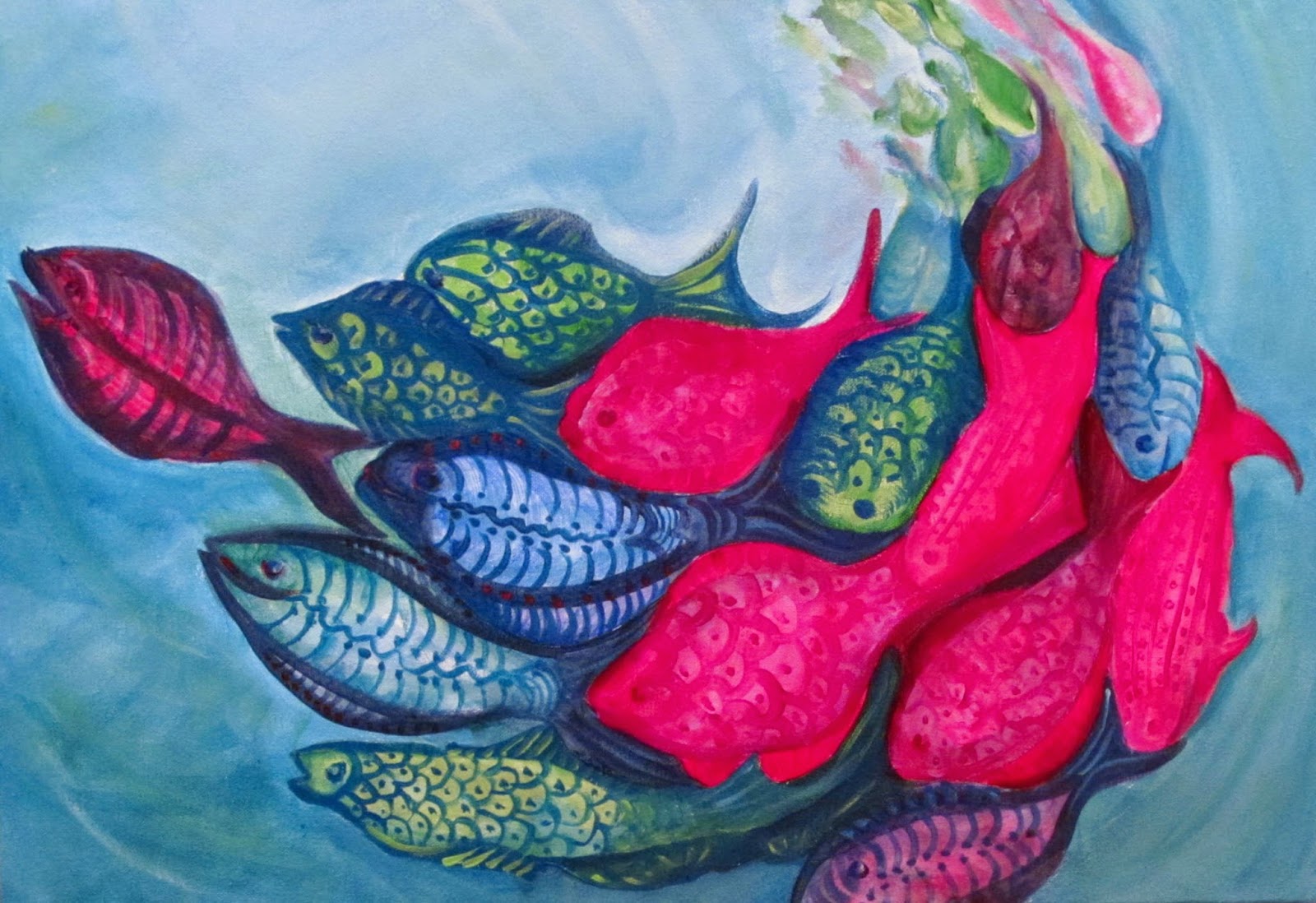
"Sea Swirls #2" work-in-progress
Until you know the subject and the fundamentals stay within the tried and true methods. Once you’ve mastered them, you own them. They are yours to stretch, push, manipulate, and wow.
"Sea Swirls #1" work-in-progress

Tuesday, March 5, 2013

From Tentative to Bold – Going Pro


"Sandhill Cranes at Twilight" 24 x 30 acrylic on canvas, in gold frame with black liner
It happens gradually that transition between learning a skill and mastering it. One day you realize you’ve mastered a color mixture or a technique. You’re painting a face or a landscape with confidence and with fewer brush strokes. You’ve gone pro.

It happened to me while painting a leaf. In the beginning I’d try to mimic what I saw unsuccessfully. There was usually too much paint on my brush and only a gut feeling of what to do. My mind didn’t seem to be engaged. That may be a good thing once you’ve mastered a skill or technique, but in the beginning concentration and execution take thought. As the T.V. artist, Jenkins’ said to his students: “Don’t rush the brush.”

"Maestro" Work-in-Progress 9 x 12 pastel on Bristol
Now I find myself painting intuitively and skillfully. Instead of adding veins on the leaves as an afterthought, I leave lighter line areas untouched, forcing the creation of realistic veins without having to paint them. This was an eye opener. I could do this with other things: the smile lines on a child’s face, creases in an older man’s forehead. Instead of painting hard lines which often age a younger face, I could place shadow next to the highlight for a softer looking crease.

These simple revelations come to all of us as we practice our trade. The more you do something, more ways open up to do the same thing in a more efficient and realistic way. I found myself telling a few other artists how to paint portraits. I remember thinking: “wow, so now you’re the expert?”

"Maestro" 9 x 12 Pastel on Bristol
We all have self doubts. But once we cross that threshold of confidence and skill, there’s no going back. The next step is to start acting and thinking like a professional. In the beginning we worry about pricing. We see every mistake we ever made on a canvas, and wonder who would buy it? We price our efforts low and even feel somewhat guilty in trying to sell our wares.

Oh, go on – I know you've felt this way, too. After a few sales and some commissioned work, we begin to see our own work the way others see it. We value our skill and our talents. I use a simple rule of thumb. Width times length equals value; i.e. 16 x 20 = $320 add price of frame, etc. A good asking price is $350.

"Brown Thrasher" 16 x  20 acrylic on canvas
As your skills increase and your name becomes known, the prices go up. Always factor in the cost of the frame and the percentage a show or gallery charges for showing your work (30-40%) and price accordingly.


Once you cross over from beginner to Professional, don’t let anything hold you back.