Translate

Showing posts with label manatees. Show all posts

Saturday, November 22, 2014

Know the Territory and Use Benchmarks to Map your Progress

"Sea Swirls" 24x18 acrylic on canvas
If you live around water or near the ocean, you’re probably familiar with channel markers. They warn you about shallow water and keep your boat in safe passage until you reach the deeper water. Sometimes these signposts protect wildlife such as manatees. Every year many of these creatures are killed or scarred for life by boat rudders and propellers.

In life and in business, there are also markers of achievement and professionalism. You often hear motivational speakers talk about the importance of “channeling your mind and your energies” to achieve success. The term “harnessing” your mind was used in much the same way to encourage previous generations to aspire to great heights.


Beginners are impatient to “get to the top.” They often take risks to get their work out there and to get noticed before they have mastered basic techniques. Those who have made it often say “don’t play it safe.” They recommend breaking rules and boundaries in order to draw attention. But it’s one thing to take risks, and quite another to go beyond the guiding principles that have already been proven for success.

“But don’t achievers push beyond the boundaries in order to stand out,” you may ask? “Do you always do the safe and predictable thing or do you gamble on your gut instincts?”


Most educators advise “Until you know and understand the territory and the essentials follow the recommended procedures until you’ve mastered them.” After that, you’re on your own. Only you will know when that time comes.

In the weather business, forecasters use benchmarks to compare past turbulence with current patterns. For instance, in November of 1976, they had a “long drawn out winter,” similar to what is happening today around the country. A benchmark is a standard used to measure activity and progress.


Professionals can use benchmarks to track their own personal improvement. Self confidence and instinct increase when you tackle difficult projects and complete them to your own satisfaction. Others you respect may also provide insight and suggestions that add to your level of skill and mastery.

Observing how “others have done it” over the years can serve as an example. Even copying to learn is a great lesson in self-mastery and enlightenment. The masters can give you a blueprint for success. If you study their early paintings and compare them to later works, you’ll see how they nailed down the rules first and then they were ready to fly!
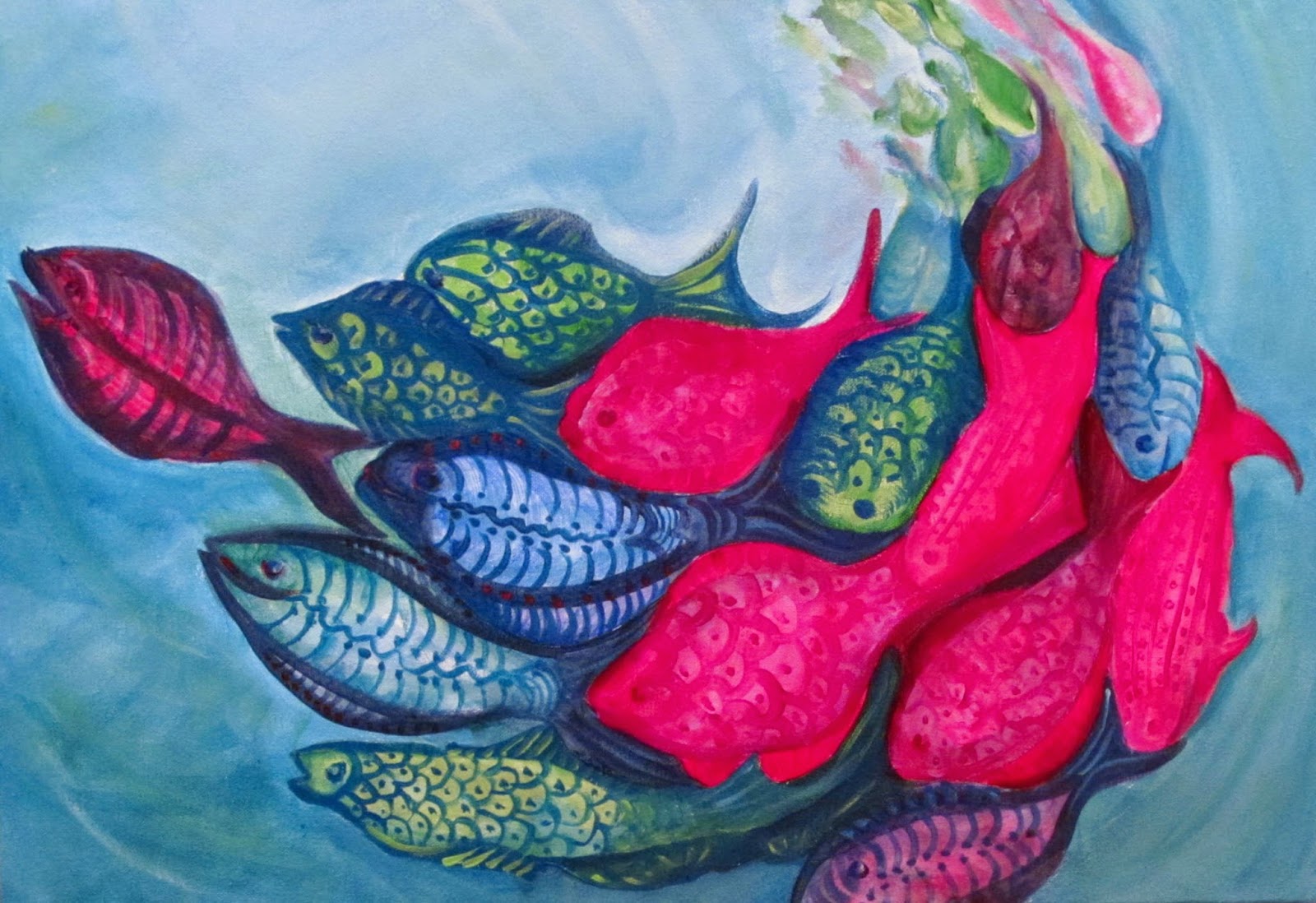
"Sea Swirls #2" work-in-progress
Until you know the subject and the fundamentals stay within the tried and true methods. Once you’ve mastered them, you own them. They are yours to stretch, push, manipulate, and wow.
"Sea Swirls #1" work-in-progress

Tuesday, June 4, 2013

Tides by Any Other Name Would Smell as Stinky!

"Window on Pine Island" 16x20 wrapped oil on canvas
What is coarse, toxic, sweeps up marine life in its wake and kills? If you guessed a broom, we're done here. If you answered pollution, you're close. If you said red tides, you're dead on. Never heard of these menacing algae? Let me introduce you.

Every summer at the height of tourist season, a tangle of brownish algae and dead fish cascades onto the Gulf Coast's pristine beaches and the stink is overwhelming; as my mother used to say, "Enough to gag a maggot." What makes these algae such a menace? They produce one of the deadliest toxins known to man.

(original photo of Pine Island)
These harmful algal blooms or HABS wreak havoc on local fishing industries to the tune of $82 million each year. The toxins affect the central nervous system of fish, killing them in vast numbers; limiting the quantities of fresh fish that fisheries depend on. Toxins also may poison shellfish like clams, oysters, and mussels, and make the humans who eat them sick.

These red tide masses affect marine ecosystems in a number of ways. Dense blooms can block sunlight that benefit good algae and sea grasses needed for food. Wildlife and marine mammals like seabirds, manatees, turtles and dolphins may not only get sick, they may die. Hundreds of manatees died as a result of Red Tide in 2012. Humans may suffer severe respiratory or skin ailments. In addition to that, red tides are downright unsightly.

My first reaction to walking on the beach after a red tide wash up was repulsion. Hundreds of putrid dead fish trapped in strange-looking seaweed covered the white sand driving me and many other tourists back to our hotels. Like them, I wanted to know what this stuff was, what it did, and how we could stop it.

Red tides are composed of microscopic algae known as dinoflagellates; their scientific name: karenia brevis. The algal cells are asexual. They produce simply by dividing. To complicate matters, each cell is capable of movement via two flagella that propels them through the water. There is no brainwork involved in this confluence or joining of forces. They drift with the water's ebb and flow, bumping together to form large clumps or "blooms" as their numbers increase.

What makes dinoflagellates different from other microscopic algae? At least two things: their rapid growth and their toxicity both of which raise more questions than answers. Why do these organisms suddenly explode into a massive growing binge? What triggers this growth and why does it produce toxins in some algae and not in others?

Biologists and scientists believe pollution of our waterways may be the leading factor. Pesticides, fertilizers and chemicals are washed into surrounding rivers and lakes and eventually find their way into the sea. At the mouth of these inlets and tributaries, red tides get their first burst of growth which certainly points to pollution as the cause.

But there's a catch: red tides are not a new phenomenon. Fish kills from deadly algae were recorded in 1840 and as long ago as the Spanish explorers who wrote about them in their logs. After years of red tides research, there is still no conclusive evidence or link to pollution. Like many quirks of nature, the trigger may be from natural causes or a series of events that are little understood.


The Fish and Wildlife Research Institute (FWRI) in Florida conducts Red Tide Reports on a regular basis during critical growing periods. Using satellite imagery, high levels of chlorophyll are monitored for possible resurgence of red tides. With the help of modern technology, experts record the size, rate of growth, and location of these HABS.

FWRI works in partnership with the National Oceanic and Atmospheric Administration (NOAA) under the supervision of the U.S. Department of Commerce. NOAA's goal is to "provide the tools to prevent, control, or mitigate the occurrence of HABS." Because red algae can be found in almost any waterway, research labs are positioned worldwide.

(I want to paint this beautiful Fuschia)
If you would like information about red tides in your own locale, go to http://www.noaa.gov.
What is the missing component that explains why red tides grow faster and wilder during certain times of the year? Is pollution the cause as some suggest? Or is it increased water temperature that naturally encourages the growth of most algae? Until the mystery is solved, Gulf residents and vacationers around the globe must continue to endure the irritation, the blight and the stink of red tides.

Do you have a "stinky" problem in your neck of the woods? Please share it with us.

Saturday, January 26, 2013

Never Leave Home without your Camera


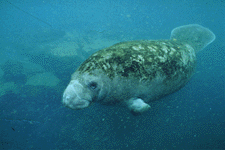
 Winter in Florida means a chance to see Manatees. They swim up the Orange River where warm water flows from the huge Florida Power & Light plant (FPL). A lovely park has been erected in their honor and thousands of residents and tourists flock there when the temperatures plunge to see these wonderful creatures.


At first glance, they look like humongous baked potatoes. Further scrutiny reveals a flat elongated tail and two dorsal fins closer to the snout. On females, a teat is located in the dorsal area where suckling’s feed after birth.

Manatees can stay submerged for long periods of time, so people wait expectantly for one to lift its large snout above water for a gulp of air. 

They can also be seen swimming up river leaving gentle swirls of water in their wake. A small patch of exposed back may crest the water as they move. Spotting an actual manatee swimming upstream brings squeals of delight from the crowd.


I’ve seen some beautiful paintings of these aquatic mammals, but I’ve never had the desire to paint them. On the other hand, I witnessed a flock of white pelicans that took my breath away, but I had no camera. These I would love to paint. I’m told that there are swans in Florida, but I’ve never seen one.

An artist should never be without a camera. If you’re like me, the times you have your camera, nothing happens. On the days you leave your camera home, wildlife is everywhere! I’m opposed to painting from photographs of others unless I have their explicit permission.

Final painting: "Bella Bellissimo" acrylic on 16 x 20 canvas
I have followers on Facebook from different countries. I was given permission to use their personal photos as they are not photographers or artists. I have done this for my India Rising Series, and for my African Series. When you can’t travel yourself, it’s the next best thing to being there.

Original photo of Bella
(I tried to make her look happier!)
If you use online photos or the artwork of others for inspiration, make certain you turn that painting into something uniquely yours. Change the pose. Change the color or composition. Don’t outright copy anything. If you do, you’re breaking the law.

I visited an artist blog recently where the author complained that someone had taken a photo of her painting and copied it authentically. If that were a writer, they could be charged with plagiarism. Copying old masters and declaring that you did is one thing. Stealing the ideas or paintings of someone else is downright criminal. If a person can’t fly by the seat of their own pants – they shouldn’t fly at all.

First drawing of Bella