Translate

Showing posts with label movement. Show all posts

Friday, May 1, 2015

It’s All About Space

(The wide open spaces of the West -- original photo)
Space – there’s so much of it! We want to explore it, name it, and conquer it. Our curiosity knows no bounds when it comes to defining, understanding and controlling our vast universe.

Personal space makes us feel comfortable and safe. If someone invades that area or gets too close, we pull away. Space helps define the parameters we use in dealing with other people. We use different constraints with family members than we do with friends. The restrictions widen when we deal with strangers or other people socially or in a business setting.

In a crowded room or a queue of people, we may feel confined, but we deal with it. There are checks and balances constantly at play as we learn what is acceptable or tolerable. Sometimes there are no choices like on a crowded bus or waiting in line at the theater. This is when restraint and caution must help us counterbalance the situation.

"Fish Market" mixed media on canvas
Artists must control the space on their canvas and define its boundaries. Space can enhance distance and size, and help to explain shapes, objects and lines. To illustrate this point, a simple drawing of a tree is much easier to define when you focus on the space between the branches and in the background, not on the shapes in the foreground. The detail and the busyness can clutter your mind and vision. When you focus on the large and simple spaces and objects, clarity comes at once. Details should always come later.

Shadows may be defined, by analyzing the patterns of light on the ground. These shapes usually consist of circles or oval shapes between the leafy branches that are cast by the sunlight. Elongated shadows become shapes unto themselves as do the light spaces between them and surrounding them.
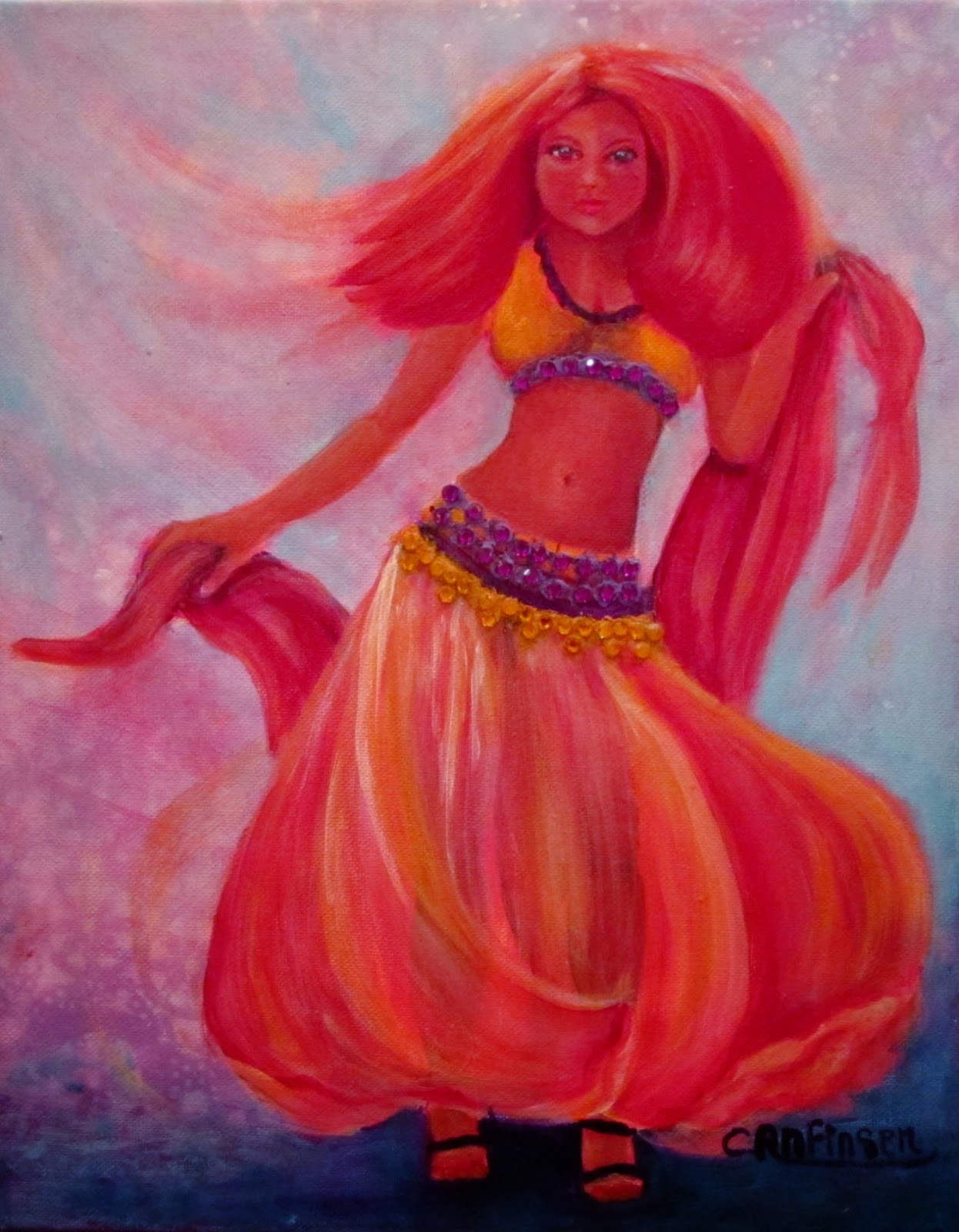
"Belly Dancer" 11x14 acrylic on canvas (with jewels)
When I created the “Belly Dancer’ I wanted her hair and costume to create movement. In order to achieve this, her hair had to move in the same direction as her hips, and her skirt had to swing in the opposite direction. Faded, extended color from both gives the feeling of motion. The space between her arms and around her body help to define that movement.

When my children were taking piano lessons, their teacher taught them about phrasing. Phrasing is like taking a breath between sentences or musical phrases. Phrasing helps to define the music in much the same way that space defines a painting.

Once your center of interest has been chosen, everything within the painting must draw the eyes to that point. The space on your canvas may also help you control eye movement. The adage “All roads lead to Rome” applies to the spaces, shapes and values of color on your map or canvas. “All roads lead to the center of interest.” If they do not, something is wrong with your composition.

(Belly Dancer - work-in-progress)
Gauge how your eyes travel and what they are drawn to. Too many colors and lines, or too much light may scatter your vision and allow your eyes to fly off the canvas. Fix it! There must be no distractions. Your composition must hold together and have continuity of purpose and direction.

White space on a page allows the reader’s eyes to breath or rest. In a painting, at some point, the viewer’s eyes must rest on the center of interest. That rest gives him or her pleasure, and keeps them from getting bored or wandering off to another painting that may better hold their interest.

A highway divides the "Great Salt Lake"

Monday, March 2, 2015

Elbow Grease Puts a Shine on and Turns Your Worries into Profits

"Reggae Night" acrylic on canvas
Today was a very good day for me. I sold a vintage light fixture on my Etsy Shop Anfinsen Art, https://www.etsy.com/people/AnfinsenArt, and one of my paintings “Reggae Night” was given “SR” (Special Recognition) in an online contest that will be on display the entire month of March. If you’d like to see the categories and winners go to:


(Vintage Tiffany-style chandelier)
We all need a little pat on the back now and then. Most of the time we put the hard work in and seldom see the payback. When we do it makes everything worthwhile.

I met a new artist this week. She is currently doing murals down in Key West. Her brother was working there, too, but plans on returning to the Caribbean. Mia showed me her work via her Smart Phone – Beautiful!

I shared an idea with her about incorporating jewels on a painting. I told her women in my art league discouraged the practice because then it would become more craft than painting.


Mia showed me a mermaid she had just created on a mural. Wherever the scales intersected on the tail, a small pearl accented the connection. Stunning! Her attitude is anything goes! I think that’s what I’m seeing out there also. If people kept doing the same things they were taught, soon all paintings would look alike and eventually be dull and boring. Daring to be different or to think outside the canvas is what Andy Warhol and Salvador Dali did and hundreds of other artists who were at first criticized and later embraced.

Keep pounding out the paintings people! Grind your tired fingers to the bone. Some day your efforts will be praised and purchased! Currently I’m working on one of my “boudoir” paintings. After all the work I’ve put into it I’m still not pleased. Seems too “static” for me; I prefer to have movement and action going on. I’m between painting over the canvas and doing something totally different with it.

"Sea Breeze" acrylic on canvas (The brush led me -- see the movement?)
Even though this decision has set me back a few weeks, I’m willing to live with it. When painting and creating (or whatever it is you do) becomes work, something is wrong! When the brush leads you, sparks are flying.

"Sea Swirls" acrylic on canvas (Notice the movement and 3-D scales?)
You may enjoy this music by “Jewel” about two painters who grow old together and are still painting:


Tuesday, January 8, 2013

Adding Zing to Your Composition

(Alert; horizontal and vertical lines) "Anhinga in Paradise" 16 x 20 acrylic on canvas

Since the composition of an artwork is critical to the overall success of a painting, I’m adding a few more helpful tips. There are essentially three basic types of composition; each creating a different effect: Sedate, Alert, and Dynamic. Your choice will determine how your audience feels when they view your painting.

Sedate compositions focus on horizontal planes and lines; typical of pastoral scenes and calm seas. This type of composition lends a certain peace and stillness to the composition

(Sedate; horizontal lines) "Seashells by the Seashore" acrylic on panel 8 x 10
.Alert compositions arouse our emotions and stimulate energy through predominantly vertical lines amidst horizontal planes. Waves on a wild sea, for instance create a tremendous amount of energy contrasting with the receding smooth outflow of water. Mountains erupting from horizontal planes of farmland create push and pull contrast and energy.

(Alert; diagonal, vertical lines) "Prayer Circles" 18 x 24 acrylic on canvas

Dynamic compositions go a step further, creating interest, unease, and energy through diagonal lines and shapes. This can be done in many ways, including bending sails in the wind, making a surreal painting of leaning buildings, or simply bending grasses and flowers heavy with blooms.

(Dynamic diagonal lines and imposing shapes) "India Rising -- the Lost" 18 x 24 mixed media

Tips for enhancing the integrity of your painting:
Preserve the authenticity of your brush strokes. When applying paint: put it down, leave it be. Deliberate brush strokes give your painting a feeling of authority and professionalism.

Don’t skimp on paint. Beginners often paint timidly; applying too little paint until there are few indications that the paint was applied with a brush at all. Use enough paint so that your painting benefits from the full color and light of the pigment used. 

(Horizontal, vertical, & diagonal lines) "An Open Book" 16 x 20 mixed media SOLD (prints available)
Style determines color and line preferences and how you apply paint. Some artists like a smooth finish, especially on portraits. Others like to see color separation and brush work. The more you work with different types of paint and techniques; you’ll find the method that suits your style and taste.