Translate

Showing posts with label space. Show all posts

Friday, May 1, 2015

It’s All About Space

(The wide open spaces of the West -- original photo)
Space – there’s so much of it! We want to explore it, name it, and conquer it. Our curiosity knows no bounds when it comes to defining, understanding and controlling our vast universe.

Personal space makes us feel comfortable and safe. If someone invades that area or gets too close, we pull away. Space helps define the parameters we use in dealing with other people. We use different constraints with family members than we do with friends. The restrictions widen when we deal with strangers or other people socially or in a business setting.

In a crowded room or a queue of people, we may feel confined, but we deal with it. There are checks and balances constantly at play as we learn what is acceptable or tolerable. Sometimes there are no choices like on a crowded bus or waiting in line at the theater. This is when restraint and caution must help us counterbalance the situation.

"Fish Market" mixed media on canvas
Artists must control the space on their canvas and define its boundaries. Space can enhance distance and size, and help to explain shapes, objects and lines. To illustrate this point, a simple drawing of a tree is much easier to define when you focus on the space between the branches and in the background, not on the shapes in the foreground. The detail and the busyness can clutter your mind and vision. When you focus on the large and simple spaces and objects, clarity comes at once. Details should always come later.

Shadows may be defined, by analyzing the patterns of light on the ground. These shapes usually consist of circles or oval shapes between the leafy branches that are cast by the sunlight. Elongated shadows become shapes unto themselves as do the light spaces between them and surrounding them.
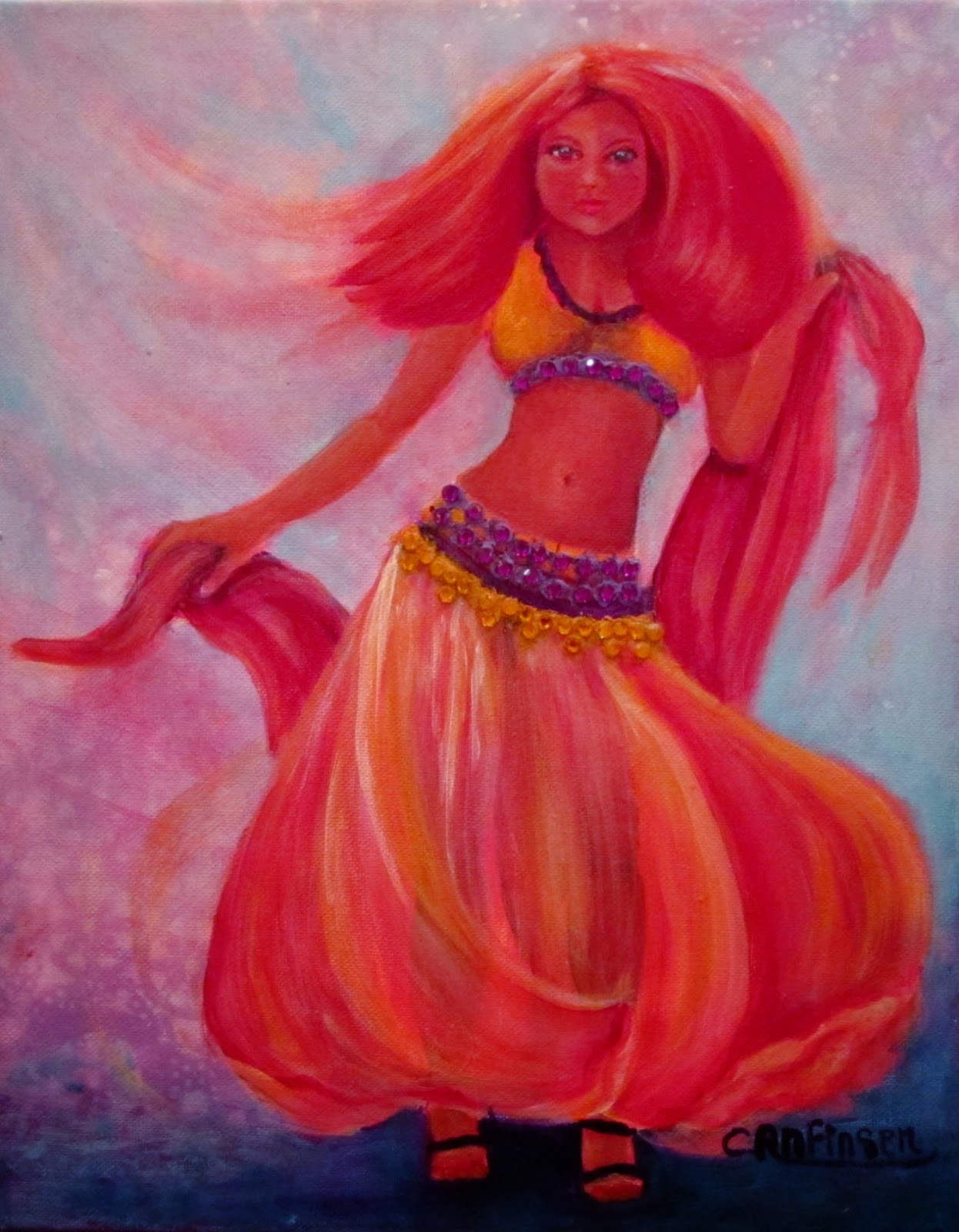
"Belly Dancer" 11x14 acrylic on canvas (with jewels)
When I created the “Belly Dancer’ I wanted her hair and costume to create movement. In order to achieve this, her hair had to move in the same direction as her hips, and her skirt had to swing in the opposite direction. Faded, extended color from both gives the feeling of motion. The space between her arms and around her body help to define that movement.

When my children were taking piano lessons, their teacher taught them about phrasing. Phrasing is like taking a breath between sentences or musical phrases. Phrasing helps to define the music in much the same way that space defines a painting.

Once your center of interest has been chosen, everything within the painting must draw the eyes to that point. The space on your canvas may also help you control eye movement. The adage “All roads lead to Rome” applies to the spaces, shapes and values of color on your map or canvas. “All roads lead to the center of interest.” If they do not, something is wrong with your composition.

(Belly Dancer - work-in-progress)
Gauge how your eyes travel and what they are drawn to. Too many colors and lines, or too much light may scatter your vision and allow your eyes to fly off the canvas. Fix it! There must be no distractions. Your composition must hold together and have continuity of purpose and direction.

White space on a page allows the reader’s eyes to breath or rest. In a painting, at some point, the viewer’s eyes must rest on the center of interest. That rest gives him or her pleasure, and keeps them from getting bored or wandering off to another painting that may better hold their interest.

A highway divides the "Great Salt Lake"

Saturday, March 14, 2015

Put a Stop to Wheedling Behavior that Robs You of Time and Space

Martin House.  Birds spar for a room in this busy hotel! They fly in
in March and stay until May. I love to watch them.
Do you always get the short end of the stick? Do you shortchange yourself in a negotiation? Do you sabotage your own needs in order to keep the peace?

Heaven forbid there should be a rift in your relationships! But cowardice-to-confront does not make the problem go away. There’s never a good time for a dust up or a scuffle. If you’ve allowed someone else to take the reins in your life, you may be headed for disaster rather than the destination of your dreams. Sometimes you must put your foot down and stand up for what you need, even if there are those who may feel alienated.

Let the person who has power over you own their own problem. You are an artist, a professional, an entrepreneur who must do certain things each day to be successful. When you take back the reins, you also take the power away from those who are used to manipulation or anger to get what they want. Remember, it is their anger not yours. Let it go! Respect goes both ways. 

Allocation gives you control over your circumstances. By parceling out units of time to the priorities in your life, an erratic schedule based on pressure and emotion can be tamed and placed in logical sequence. So that instead of crashing into each other, your activities and interactions bend and flow.
 The “new you” will feel empowered rather than powerless. No more crashes and jump starts. You’ll transition from one project or event to the other. You’ll know where you’re going and how much time it will take. These organizational skills will help you plot a course from one day to the next.
Mimosa Tree in bloom (I should have captured
it sooner!)


If this sounds a little too perfect, be patient. Once your trajectory is on track and is repeated over and over again, it will become a habit. Experts conclude that it takes approximately one month to form a new habit. This varies from person to person because “old habits die hard.” But don’t give up. If you are willing to take control of your life and your success, the awkwardness of building a new life for yourself will soon become a reality.

Mimosa "bush" is more like it!

Sunday, December 14, 2014

What Every Woman Wants: Baubles, Bangles and Beads -- or is it?

"A Joyful Heart" pastel on bristol board, matted and ready to frame
I may be the odd woman out, but jewelry is not my cup of tea. Topping an outfit off with a smashing pair of handmade earrings is more my style. Gaudy and expensive jewelry is not.

I prefer an understated look. I was never into ruffles which make me feel silly. I prefer simple classic lines that enhance my comfort and put me more in touch with the person I am.

We all have different tastes, likes and dislikes. We are each uniquely created. In the same way that our fingerprints and eyes are not alike, so our preferences in food, music and clothing vary. The same goes for artwork. None of us will ever see the same thing. One painting may draw us, the other may repel. That’s how the “power of the purse” works, and why certain things appeal to a broad spectrum of people while another is less popular.

"Tansy's Pride" pastel on bristol board; matted and ready to frame
The buying public is also fickle. Discrimination is often based on current trends and popular opinion. Someone once said “We are a nation of sheep.” In most instances we are.

Still, there are ways for an artist to move past that shallowness. We can acquire a “universal” appeal that extends beyond the bounds of personality, culture, and tradition. Certain subjects have broad appeal such as family, love, hope, fun, dancing, merriment, shared experiences, and familiar landmarks. I’m sure there are many many more.

A mother and child will usually arouse warm sentiments. A child learning or experiencing something new for the very first time is another appealing delight. Animals and especially pets touch a soft spot within almost everyone. Suffering, pain and sorrow strike a chord that vibrates the very soul. Any action whether joy, hate or anger that captures the human condition can be related to by many people.

"Broken" mixed media on canvas SOLD, but prints available
The skill of an artist in relating these universal truths to others in a way that is visually exciting and moving can make the experience have even more impact. Familiar shapes and hues arranged in such a way as to lead the viewer on an eye-opening or emotional journey is another way of revealing our shared humanity.

When the common things that surround us are portrayed, others can relate. Illustrate the simple beauties of the earth and in the eyes of the viewer their value is elevated and appreciated. Patterns and textures that replicate nature’s vast chromatic surface add another layer of “simpatico” that reaches out to others.

Wise use of space or sparseness of color may also emphasize loneliness, emptiness, or baroness in a way that detail and color could not; emotions that most of us associate with loss, devastation, and tragedy which we all experience at some point in our lives.

The more universal appeal your artwork contains, the greater the chances that you’ll be successful.
"With these Hands -- Hope" oil over acrylic under painting

Sunday, November 16, 2014

Light Reveals Truth, Darkness Provides a Contrast

"Hibiscus Glory" 16x20 mixed media SOLD; prints available
I was intrigued by a recent study about people’s fears. It was done broadly (worldwide) to see if there were any differences in race or culture. The conclusion was that what people fear most, no matter who they are or where they come from, is darkness.

I wondered if fear was a part of us at birth or if it’s simply human nature to fear what we do not understand or that which is unknown? For whatever reason, the study concluded that most people, most children all around the world fear darkness.


As a Christian, this set my spiritual wheels turning. Scripture declares that every person “that comes into the world” is born with the light of Christ in his heart. (John 1:9 KJV) It would only make sense then that coming from our creator God “trailing clouds of glory,” as Wordsworth put it, we would be afraid of the dark which has always represented evil.


Believers hunger and thirst for light in much the same way that all living things reach for the light. A seedling pushes through the dark earth in search of the life-giving light of the sun that will nourish it and feed it as it grows. Even the lowest of animal forms seeks out light for warmth. On any given morning in Florida, my sidewalk is filled with lizards that crawl out of their dark havens to warm themselves in the light.

Snakes slither from their dark holes in much the same way. They become intoxicated and lethargic as they drink in the warmth of the sun seemingly blinded by the brightness. You can walk right by them and they barely notice.


Darkness is often used as a reference to evil, and good is portrayed as light. Darkness can also be seductive and intriguing. It is more difficult to ignore sin and temptation in the darkness. We are deceived into thinking that darkness somehow hides or “covers” our sin.

Light reveals and exposes truth and evil. No wonder we run from the light when we feel guilty or “bad.” No wonder people, especially children, fear darkness because it leads us into the unknown and may cause us to do bad things.


Darkness also has its own beauty: a starlit sky, the moon glowing through wisps of clouds, the skylights of a city sprinkled across the landscape. Darkness provides contrast. In a painting it’s all about light. The tiniest glow of light against a dark canvas looks even brighter. If the whole composition were light, the objects would appear flat and uninteresting. It is the contrast in color and intensity that gives a painting life.


How an artist handles the play between light and darkness, shadow and changes in value tells you a lot about his or her style. Some creatives like subtle changes and soft values. Others passionately splash color boldly and provide luminous eye-popping light that defines shape and creates depth. In this way darkness can define space and provide a backdrop for light making it glow with luminescence. 

The subject of the composition and its treatment determines whether evil is present or perceived. The color red may also indicate evil if the images are coarse and vulgar. A red rose may also appear holy and beautiful if the petals are delicate and soft. Treatment has as much to do with how evil is perceived as darkness itself.


Study the Masters and see how they contrast light against darkness. Analyze your own reaction to it to see if the painting registers somber, illuminating, inspiring or degrading. Your response indicates the power of darkness to reveal the essence of goodness or of light.


Wednesday, September 10, 2014

What do Artistic People create and why do they do it?

"Home at Last" 16 x 20 acrylic on canvas
As an artist, I’ve thought a lot about that question. What is it that makes me create and why do I do it? Perhaps my answers will also be yours:

An artist wants to share what touches him or her visually and emotionally, and may find it difficult to impart these feelings in any other way.

Artists have a driving passion to put down on paper or canvas the experiences in their hearts and souls that would either cause them to explode in joyful ecstasy or painful agony if not expressed. Artists and writers often share these same passions, but articulate them through different mediums.

We all have a need for intimacy, some people more than others. When someone views an artist’s work it is like inviting them to share an intimate moment of our personality and perspective on life.

"First Daffodil" 16 x 20 acrylic on canvas; model Kayla Dahm
An artist may create a mini-story, a glimpse into the human soul, a taste of the human condition, or they may take us on a wonderful adventure either through realism or exciting plains of color and movement.

The viewer may virtually walk the terrain of uncharted territory, explore the shape and form of facial structure, and fathom in a new way the miracle of life, the struggle of humanity, or the joy of rebirth.

By altering line, angle and space through color, light and shadow, an artist controls the mood and mind of the viewer and leads them on an intimate journey around the canvas and back again to the focal point or center of interest.

Viewers are rarely aware of the invisible companion who leads them from one point to another as the story unfolds. When the onlooker experiences pleasure, happiness, or darkness the artist has done his or her job.

“So this is what old age brings?” an observer may comment on seeing an unfulfilled wastrel lamenting over his fateful actions.

"Reggae Night" acrylic on canvas
“That’s exactly how I felt when I was dancing,” says another, as they sway in their mind and remember the cadence of drums, sand, and the smells and sounds of the Caribbean. As an artist, you brushed this scene onto canvas using your own fond memories where they lingered playfully in your mind waiting for you to give them the breath of life.

Fulfillment happens when the artwork is finished not when it’s viewed, commented on, or sold. As artists we rarely get to see or know the experience of the viewer, or whether they perceived our art in the same way as we created it. 

Once we have “put it all out there,” we have done our part. The rest is up to chance, fate, or destiny. For some of us, it is a blessing from God for which we are eternally grateful and joyful.

"Blending In" 11 x 14 acrylic on panel (The feathers replicate the petals, which is how I
saw this scene and painted it.)

Tuesday, December 31, 2013

A Christmas Wedding takes my Holiday Plans into Overdrive

"Saguaro Cactus"
My tail is dragging; how about yours? Sooo hard to get back to work after the holidays; and, of course, another celebration is looming ahead.

I’ve been on the fly, literally. We had company on Christmas day, and the next morning, we flew out for my grandson’s wedding in Phoenix, Arizona. I had jet lag the whole time we were there. Couldn’t sleep in the full-sized bed (no tossing and turning allowed!) and kept awake by strange and unfamiliar noises.

A fallen cactus, petrifying; illustrates how pourus they are

On the return flight, Sunday, I simply couldn’t keep my eyes open. I spent the whole flight bobbing my head and snapping my neck whenever my mouth began to sag. Our flight had a layover in Indianapolis and left an hour late because of a freezing rain. The warmth that greeted us when we stepped off the plane in Fort Myers was a huge welcome home.
"Joshua Tree" and desert terrain
I once lived in Phoenix, so I was eager to return and find out what I’d missed. Couldn’t believe the changes that had taken place! The city had gone from a sleepy, Mexican hacienda-like atmosphere to a thriving metropolis with super highways and luxury accommodations. Still, the desert’s resounding voice spoke volumes about constancy, permanency, and the wisdom of the ages.

Saguaro cacti, the sentinels of the desert, reminded us of our eternal nature and the timeless quality of our existence. I photographed Joshua Trees, prickly pear cactus, and the unusual vegetation and trees that grow in spite of the intense heat of summer. For we Floridians, the evening temperatures seemed frigid; plunging from a daytime high of 74 and then back to 46 degrees overnight.


My fourth child was born in Phoenix. This was her first time back since she was three years old. One of our family pleasures was to take walks on the desert floor in late January and February when the cacti were in bloom. Colorful splotches of pink, yellow, and red were masterfully dotted over the terrain with a Master’s brush. The sand underfoot became a velvet cover of green that would burn off by mid March.


There is magic in the desert. Silence is broken only by the chirp of a bird or the monotone humming of bees. There is space. The vastness of the land spreads endlessly before you and as far as the eye can see making you feel small and insignificant in return; a good place to put your life in perspective. Problems seem minuscule in comparison.


I wish we’d spent more time there. When I made the reservations, I was thinking in “wedding” terms only. Now I wish we had stuffed in a few extra days for sightseeing and pleasure. As always, hind sight is more valuable than making snap judgments. I hope your holidays were well spent and enjoyed. In the meantime, Happy New Year everyone!
"another Joshua Tree"

"prickly pear" cactus

Site of a family hike; all the way up to the rock ridges and the top!