Translate

Showing posts with label portrait. Show all posts

Wednesday, November 11, 2015

Information Overload – Opinion, Hype or T.M.I.?

(This is Peaches, and I'm going to paint her portrait)
I have read and written about the book “Grapes of Wrath” by John Steinbeck at least four times. After the first reading, I was captured by that generation and the “Great Depression” era. Since that time, I’ve read both fiction and nonfiction books on that time period. 

After my first experience, a high school student at my church was bewailing the fact that “Grapes of Wrath” was required reading that year. She called it a filthy book, and said that the language was coarse and trashy. She didn’t understand why she had to read that kind of a book, anyway.

Her remarks prompted my second reading of Steinbeck’s novel. What on earth was she talking about? I didn’t remember any bad language. The book had inspired me and aroused my sympathy for the plight of the hungry and poor.

As I flipped through the pages, I was stunned. Sure enough, there were enough four-letter words on every page to make a sailor blush. Why had I not recalled such “filth” on my first reading? Perhaps because I was so caught up in the lives of the characters and their very real story.

By the time I finished the book, I loved it even more. So much so that I quickly forgot the student who disdained reading it and her remarks. The whole book is full of symbolism about life, about the roles of men and women in society, and the desperation that comes when everything you ever depended upon is gone.

When the husbands and fathers were jobless and down on their luck, they leaned heavily on their women who gave them strength and propped up their sagging egos. The mothers succored their children, managed to find things for them to eat, and gave their families hope. They were the backbone of society.

(Work in Progress "Peaches 'n Cream") The drawing and first layers of acrylic paint.
In the final chapter, the loose ends are connected in the cycle of life. A woman loses her baby because of poor nutrition. Broken and unresponsive, she wanders away from her family. Her breasts are engorged with milk, and she doesn’t know what to do or where to turn. At wits end, she comes across a man on the ground at her feet who is dying from hunger. Many men went without food so that their women and children could eat.

The forlorn woman lays down beside him and gives him her milk-swollen breast; the only sustenance she has to offer. By this we know that not only will he live, but that they both will survive to witness another day’s struggle.

"Bella Bellissimo" 16 x 20 acrylic on canvas (SOLD), but prints available.
Steinbeck recreates the Garden of Eden showing the dependence of male and female on each other, and in society’s ongoing battle for life, liberty and the pursuit of happiness.

Great literature and great art cannot be picked apart by focusing on that which is taken out of context. Without the whole there is no meaning nor purpose. How and what you remember when the last chapter is read is the measure of a book. It will rise and fall not on a useless hunting and pecking exercise, but on how well it is judged through the eyes of history and truth.
"Winston" Portrait of a Westie (SOLD) prints available. (mixed media)

Monday, October 12, 2015

Give your Idea Context, and People will Get it

"Self-Portrait" 11 x 14 Pastel on paper, textured
Nir Eyal the author of “Hooked” How to Build Habit-forming Products discussed the importance of putting things in context. He tells the story of world-class violinist Joshua Bell who decided to play a free impromptu concert in the Washington D.C. Subway Station.

If you’ve ever bumped into someone and you know you’ve seen them before, but you can’t remember where, this is what Bell was up against. Bell regularly sells out venues in Kennedy Center and Carnegie Hall for $100 per ticket. But in the D.C. subway, he was someone people may or may not have known, and he was playing out of context.


Joshua Bell’s incredible music fell on deaf ears. In the eyes of passersby with a built-in agenda and time constraints to catch a subway, he was no better nor worse than the fiddle players who leave a hat or a violin case on the ground for gratuities of pity or generosity. Almost nobody knew they were walking past one of the most talented musicians in the world.

Eyal excuses the people by saying: “The mind takes shortcuts informed by our surroundings to make quick and sometimes erroneous judgments.”

That’s why when you have something important to say, or you want to make an impact with your product or artwork, put yourself and your image in context. Each painting tells a story. A poor composition will lead people on to another painting, your article won't be read, and your product may not be sold if they are not relevant to participants.

Exposure is good. Many remarkable musicians and artists do free concerts in the park, or show their artwork for a good cause. Tell your story in pictures, in dance, and in words. Tell your audience what you’re going to talk about or do, show them later in action, and then summarize what you’ve shown them or told them about.

Put your life and your words in context. Make it relevant by drawing your viewers (or listeners) into your story and by giving them a reason to get involved. Think of audience interaction as a circle. The venue, the excitement starts with you. The story or the heart of your composition takes people and leads them through your scene. When participants complete their journey, you are waiting for them again to thank them for coming and inviting them to return.

The circle signifies completion. Not all roads lead to Rome as in the past, but the experience will leave a positive impression that may lead to future sales. As Joshua Bell discovered, it’s better to put your work in context (the proper setting) than to take people by surprise in a strange environment.

Of course, if you’re a complete unknown, entertaining people in a receptive corner of your world may be advantageous. Just be sure that your “debut” doesn’t get trumped by too many distractions.
"Baby Elephant" Palm Frond Mask from Queen Palm
The before is below. I was sure I could see a baby elephant in this woody find of nature.


Tuesday, July 2, 2013

Make Time your Friend not your Enemy

"Release" 24 x 30 mixed media
(Currently I'm adding two panels on each side and turning this into a triptych.)
Get a group of people together and their number one concern is time or the lack thereof. Their problem isn’t a lack of ideas. It isn’t money, although, this is a restricting factor. What worries small business owners the most is time. Every decision that is made is concerned with time: what it’s worth, how to set priorities, where to focus it for optimal growth. Marketing alone requires enormous amounts of time, and making product requires time. Without a product, there is nothing to sell.

(Sketch on panel)
A novice once asked me for detailed information on what it cost me to do a painting. He divided it into parts: supplies, paints, canvas, tools, and time spent in the actual painting. This picayunish breakdown was designed to belittle me and other artist’s work with little regard to the years it takes to perfect a skill or the knowledge required to assimilate what one sees and interpret it on canvas.

I gave him a simple mathematical tool he could use to consider basic costs: Multiply the size of the painting (i.e. 24 x 30), add any overhead costs the artist may have incurred (leased space / gallery, a model, etc.), and add the cost of a frame. This exercise at least gives you a basis from which to judge. Add into the equation, the artist’s background and notoriety and the worth of a painting is much easier to appreciate.


To reduce a painting to a dime-store print or a knock off which has been photographed on canvas and then given a few swipes of paint is an insult. This is not a serious buyer, but a person who hopes to get something for nothing. Walk away!


"1st panel on left" Will require many layers of paint to complete.
Some people get overwhelmed when they see the big picture and understand all the work that is required to become successful. If this is you, try to slow down and take one piece at a time. A child doesn’t learn how to walk all at once. Neither does success come without a series of mini-steps and hurdles to overcome.

Focus on one thing at a time:
  • Prioritize your work list in order of importance
  • Do as much as is humanly possible in your 24 hour day
  • Don’t neglect your health or there will be no business
  • Small increments of time are better than nothing
  • Use down time for planning, organizing your thoughts, and creatively solving problems.
When your body is at rest, your mind can take over. I mentally paint even when I’m not at the canvas. Sometimes I solve problems in this way. At other times, an idea completely changes and moves in another direction. By the time I’m able to actually work at the canvas, I can move ahead quickly with confidence. Use your time wisely and it can be an asset not a liability.


"Bella Bellissiomo" 16 x 20 Acrylic on canvas
Currently on display at the SWF Coop Gallery at Coconut Point

Two other paintings are on display at this Gallery: "Hey, Coconut Man" and "With These Hands -- Hope"


Saturday, January 26, 2013

Never Leave Home without your Camera


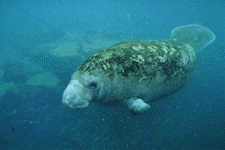
 Winter in Florida means a chance to see Manatees. They swim up the Orange River where warm water flows from the huge Florida Power & Light plant (FPL). A lovely park has been erected in their honor and thousands of residents and tourists flock there when the temperatures plunge to see these wonderful creatures.


At first glance, they look like humongous baked potatoes. Further scrutiny reveals a flat elongated tail and two dorsal fins closer to the snout. On females, a teat is located in the dorsal area where suckling’s feed after birth.

Manatees can stay submerged for long periods of time, so people wait expectantly for one to lift its large snout above water for a gulp of air. 

They can also be seen swimming up river leaving gentle swirls of water in their wake. A small patch of exposed back may crest the water as they move. Spotting an actual manatee swimming upstream brings squeals of delight from the crowd.


I’ve seen some beautiful paintings of these aquatic mammals, but I’ve never had the desire to paint them. On the other hand, I witnessed a flock of white pelicans that took my breath away, but I had no camera. These I would love to paint. I’m told that there are swans in Florida, but I’ve never seen one.

An artist should never be without a camera. If you’re like me, the times you have your camera, nothing happens. On the days you leave your camera home, wildlife is everywhere! I’m opposed to painting from photographs of others unless I have their explicit permission.

Final painting: "Bella Bellissimo" acrylic on 16 x 20 canvas
I have followers on Facebook from different countries. I was given permission to use their personal photos as they are not photographers or artists. I have done this for my India Rising Series, and for my African Series. When you can’t travel yourself, it’s the next best thing to being there.

Original photo of Bella
(I tried to make her look happier!)
If you use online photos or the artwork of others for inspiration, make certain you turn that painting into something uniquely yours. Change the pose. Change the color or composition. Don’t outright copy anything. If you do, you’re breaking the law.

I visited an artist blog recently where the author complained that someone had taken a photo of her painting and copied it authentically. If that were a writer, they could be charged with plagiarism. Copying old masters and declaring that you did is one thing. Stealing the ideas or paintings of someone else is downright criminal. If a person can’t fly by the seat of their own pants – they shouldn’t fly at all.

First drawing of Bella