Translate

Showing posts with label Innocence. Show all posts

Wednesday, August 5, 2015

There’s more to Skin than Color; Watch your Emotions Betray you

"Day Dreams" 11x14 oil on canvas
Some people are more brittle than others. They can’t endure stress and they get their feelings hurt easily. We speak of them as “thin skinned” and overly sensitive. These internal stressors are played out on their faces. These types usually wear their “hearts on their sleeves.”

On a physical level, some persons actually do have skin that is more elastic and stretchable than others. Perhaps they are more able to roll with the punches and adapt to change. For whatever reasons, some of us were born rigid and inflexible, and others from the start are more laid back and easier to live with.
"Broken Hearted" 9x12 pastel on bristol; matted and ready to frame
We can also misinterpret someone’s “body language.” I’ve seen so-called experts try to decipher what someone was feeling or thinking and sometimes even they are baffled or they get it wrong. Just because someone has a long face or are down-in-the-mouth, doesn’t mean “it’s all about you.”

They may actually be down about themselves and feeling insecure. So many factors play into our emotions: work, family, friends, news, money, a crisis, an illness or fear that it's senseless for us to take personal responsibility for someone else’s mood swings or unhappiness.

For many years, I functioned in “zombie” mode which had a disastrous affect on my ability to experience emotion. I was trying to “keep it altogether” and in the process, turned off my emotions all together in order to avoid outbursts and confrontations. This zombie mode kept me safe, but it certainly didn’t solve any problems.
"Moody Blues" 18x14 oil on canvas
Once I began counseling, it was like the floodgates opened and from then on I couldn’t keep my mouth shut. Abuse is abuse and I realized that I had a right to be treated with respect. I couldn’t sit by and allow someone else’s negative insults and putdowns to tear down my confidence and self-esteem. Once the door was open to my inner life and my own self-respect, there was no turning back.

Paintings that tell a story (and most of them do) usually portray some kind of emotion. I like to ask myself “What was the artist trying to say? What is the person portrayed feeling? How do the colors chosen feed into that emotion? Appreciating an artist’s perception of the world and its people is just the first step in discovering more about the beauty and skill that goes into a composition.

(Work in Progress -- "#Hopeful in India" 24x18 acrylic on canvas)
Even the softness or absence of line indicates subtleties expressed, or the hush of deep emotion. Broad swathes of color intensify and exaggerate either anger or exuberance. That’s why each painting can speak to us in a real way and affect us deeply if we allow ourselves to explore the technique used, the color, the subject matter and overall presentation.

According to recent studies, “the six basic emotions – angry, happy, sad, fearful, surprised and disgusted – do not begin to cover the range of feelings we convey with our facial expressions. Using new computer software to observe and record people’s faces, scientists mapped no fewer than 21 emotional states, including apparently contradictory examples such as "happily disgusted" and "sadly angry". Unless I missed it, there is one other emotion that law enforcement may recognize: guilt.

Check this out for yourself: 21 Emotions on Faces
(Work in Progress -- "Queen of Diamonds" 20x20 mixed media on canvas)

Saturday, June 7, 2014

The Presence of Good and Evil

"Painting of Judas Iscariot"
If you are like me, you form a strong opinion after meeting someone for the first time. Unfortunately, our impressions are not always accurate, yet we remember these fleeting feelings for longer than we care to admit. These vague notions may affect our dealings with that person even after we get to know them better.

I’m embarrassed to say that my first introduction to a person is sometimes shallow and in total disregard for their true character and nature. Once I get to know them on a personal level, I’m surprised that I allowed superficial values to interfere with our relationship.

Another painting of Judas
Each person gives off an aura that we can feel. If we judge them on appearances, we may miss the totality of their personality. I remember after my mother’s passing, I sometimes felt her presence when I walked into a room long after she was gone.

This aura either creates an instant bonding between two people or it does not. What we are and who we are can be felt by others. Our lives have an impact on the people we love and associate with while the presence of strangers may project either good or evil.

Have you ever felt the dark awareness that you were being watched or followed? Did the hair rise on your arm? Did fear hit you in the pit of your stomach? Whether you can see them or not is beside the point. Their presence was felt. 

Children are good at measuring evil and feeling when it is near. At the same time, they are innocent and may not listen to their own feelings but yield to authority without making any protest. That's why it's so important that we protect them.

Gut instinct is there to protect us. It is developed through experience. It's trying to tell us something about our environment. Traditionally, women have downgraded these feelings more than any other gender. They have been taught to “play nice” and to disregard angry or negative feelings. Thankfully, this style of femininity is changing. The deep and instinctual reactions we experience are there to keep us safe from harm or abuse. We should trust them!
Another artist's version of Judas
Men seem to be keener at recognizing a threat. They are built physically and emotionally to retaliate when confronted. We hear about the “dumbing down” of America. There is also an effort to emasculate males. Mothers are over protecting their sons and teaching them to back down rather than to stand up for one’s self.

While this sounds good in the short term, the long term results may have devastating effects on the family and the nation. If people lack the courage and skill to defend themselves or their loved ones, they become victims. If people cower in fear, they can be overtaken. If goodness is no longer strong it caves in to evil, and what kind of world would that create?

Over the centuries, artists have painted these opposition forces. Their artwork has provided a stark contrast between light and darkness, good and evil. Their portraits portray the struggle each person faces from within. Their choices illustrate the physical transformation of the flesh as it succumbs to wickedness.
In contrast, here is a face without guile, a face radiating from "A Joyful Heart" 9 x 12 pastel on Bristol
If you doubt that change, check out the police online files and see the alteration of a person’s face who has gone down the road of addiction. Signs of aging rapidly increase, teeth loosen from gums, hair falls out, wrinkles appear even in the young, the heart is weakened and hardened. 

The famous paintings of Judas in this blog depict the presence of sorrow, shame and evil. The portrait above reflects goodness and happiness.

Tuesday, April 1, 2014

Innocence Lost -- a Long Ago Glimpse into the Past

"Day Dreams" 11 x 14 oil on canvas, Prints available
I came from a small town where doors were left unlocked, people waved and chatted over fences, and children were allowed to roam the streets at will. In winter, I walked a few miles across town to ice skate, returning in the dark of night, never worrying about the shadows or the fruits of my overzealous imagination.

My innocence was shattered one evening at the movie theater. The woman who sat next to me called my attention to a stranger’s arm that dangled over the back of his seat.

“You’d better watch him,” she said in a hateful tone. “You never know what they’ll do.” She pulled her purse close to her, keeping it a safe distance from the stranger’s limp hand.

To this day, I don’t remember the movie. I was terrified the whole time, checking the foreigner’s hand, making sure he didn’t touch me. Had he done something to the woman, I wondered?  Was she upset because he was different; an Iranian student, a foreigner to our town?

"Blond Boy" 11 x 14 oil on canvas, prints available
It was dark when I left the theater. I usually skipped home, knowing my mother would have supper waiting. Attending a movie and walking home alone at night had never bothered me before; but that evening, everything changed.

I heard footsteps clicking behind me. When I turned, it was the man in the theater. Fear overtook me, the fear born of one woman’s hatred and my own insecurity. I walked as fast as I could. When I quickened my pace, he quickened his, or so it seemed.

I reached the safety of home several yards ahead of him. He took no notice, but continued his nightly walk, likely returning to his own apartment. But if he had gained on me, what then? Prejudice breeds fear.

So does the influx of strangers and the changing dynamics of a diverse and growing population. That year a baby sitter returning home from a job was murdered on her own front porch and time stopped. Our safe structured world was shattered.  People started locking doors. Parents were more cautious about letting their children go out at night. Our town changed. The whole world changed.

(Illustration of "Cooper" from "Madison Morgan,
when dog's blog")
The culprit was a young man, a troublemaker who had recently come to live with his aunt and uncle.  Bouncing from one home to another, he finally landed in a place that offered hope and love. He hadn’t meant to kill her. 

He only wanted to talk to her, perhaps kiss her, but her frightened screams wouldn’t stop. He covered her mouth a little too long, and then it was too late. He fled in fear. The town not only mourned the girl, but the sad young man who never had a chance.

Foreigners, who first drew suspicion, breathed a sigh of relief and went back to minding their own business. Others covered up their misplaced blame with excuses, and life was never the same.

Perhaps your home town was much like mine. Society has, indeed, changed. Now our children and grandchildren are no longer safe in their front yards. Walking to school is risky. Parents prefer driving their children to school rather than sending them on the bus. The roadways are crowded. The traffic outside the school grounds is backed up for blocks. The innocence of yesteryear is gone forever.

If you are interested in having a portrait done from a photograph, contact the artist for details and an estimate. http://carol-allen-anfinsen.artistwebsites.com

"First Daffodil" 16 x 20 mixed media on canvas


Wednesday, December 11, 2013

What’s not to Love – or Hate?

A glimpse of my December art show at Arts for Act gallery in downtown Fort Myers.
Yes, I’m one of those sappy people who watched Sound of Music to hear once again the familiar and wonderful songs of long ago and to watch Carrie Underwood’s take on a timeless classic.

What I was not prepared for was the avalanche of hatred aimed not only at her, but at her faith after the showing. Was the criticism aimed at her performance? No. It was simply a barrage of anger leveled at her Christian faith and her belief in the Bible; cheap shot in my opinion.

Are these the same hate mongers who demand free speech for themselves, but wish to deny it to others? Are they the ones who yell racism and discrimination whenever it suits their political agenda with little evidence to back it up. A ploy designed to stir up trouble?

More of my paintings on the brick wall in the interior office (sorry for the lamp glare!).
Where does this kind of hatred come from? Envy? Self-loathing? An empty soul? Christianity is a religion of love: “Love thy neighbor as yourself,” “Love your enemies,” “Do good to those who despitefully use you,” "judge not," "forgive and you shall be forgiven," and on and on.

Christians are sinners who are striving to do better. They are given ugly labels they do not deserve. They are only human. Why is it that when they stumble or reveal their vulnerability they are laughed at or worse called a “hypocrite” for making a mistake? The mockers defile them with crude language while their own behavior would make a sailor blush.

My paintings along the back wall of Arts for Act Arcade Gallery downtown Fort Myers -- entire month of December!
I’ve always cheered for the underdog, but when did we start putting vulgar language and crude behavior on a pedestal? Since when was innocence a negative and raunchiness applauded? Our “ship of state” is sinking into the mud, and I for one am saddened by our descent into degradation.

I think that’s why I paint portraits of children and enjoy painting scenes that children will find funny or inspiring. I like their fresh perspective, their trusting and simple belief in goodness and their frank and open dialogue. If someone is unpleasant or mean, they’re not afraid to tell it like it is. They see through the outward trappings of poverty and color into the heart. They can spot evil and avoid people who give off negative vibes.

"Beach Buddies II" mixed media on canvas
We should encourage this goodness before it becomes tainted by peer pressure and adult provocation and perversion. These are our children. They are our future. Do we want a world where hate rules and crude behavior becomes the norm? Where will we find inspiration or beauty in such a place? How will we survive if the passion to deface and destroy becomes the norm as it was in Rome?

"First Daffodil" acrylic on canvas

Tuesday, November 19, 2013

Tired of being practical, plain and passive? Want to shake things up?


This illustration became a poster when I saw the funny side!

Are you a conformist or a rebel? Do you like to “fit in” or "shake things up?” Your personality type will determine the answer. Your individual style affects what kind of situations you end up in and the choices you make. Your distinct approach to life and how you see the world are a direct result of your personality.

Watch a few children play together and you’ll soon see their personalities emerge. One may be aggressive and controlling, while another assumes the role of peacemaker. One child may sit passively watching events unfold before his eyes without engaging while another seems oblivious to the chaos around him.

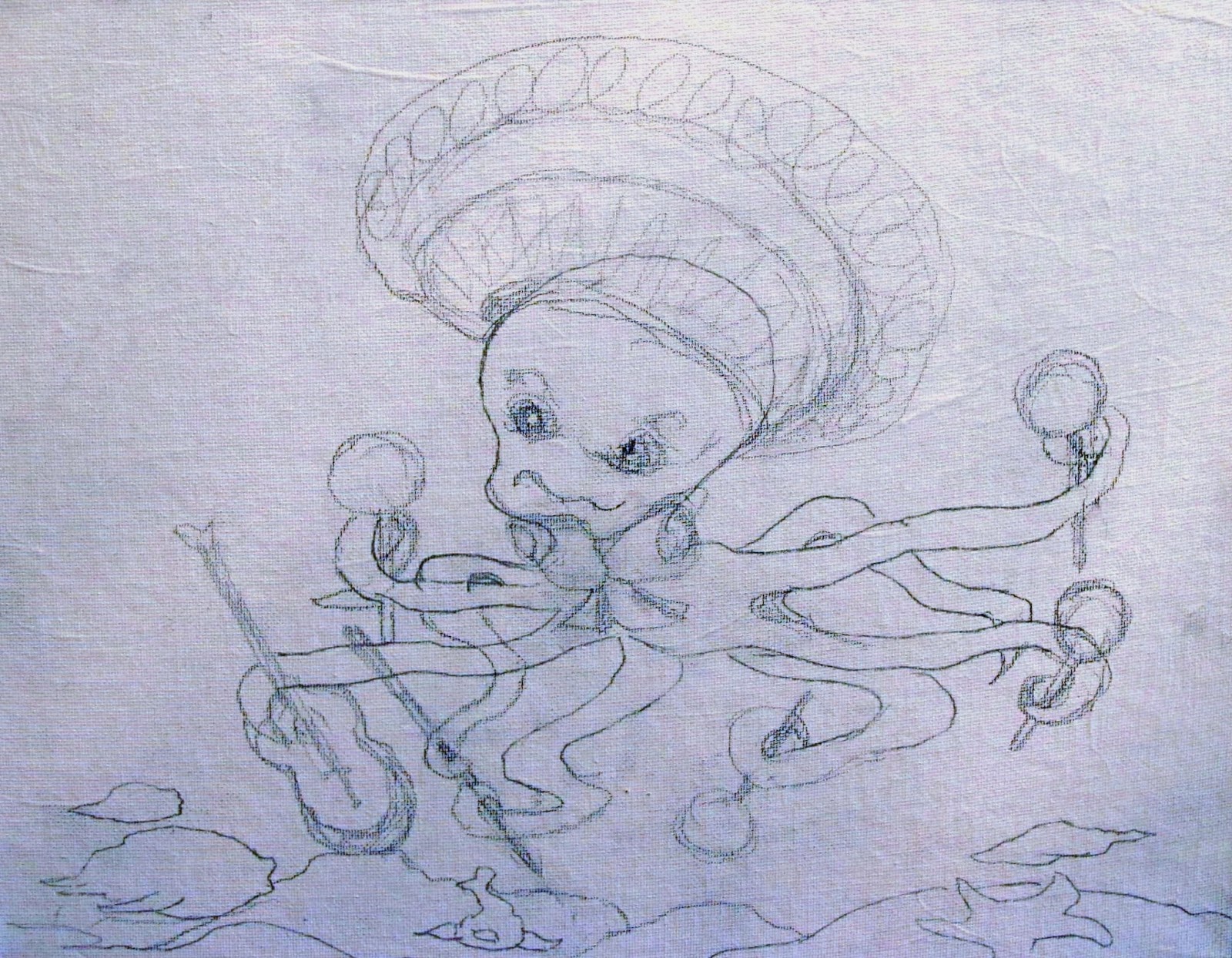
Next in my "Neptunes" Series "Octoband" 1st drawing on panel
Watch that last child as he or she lives in his own world conjuring up stories and situations in his mind and playing them out verbally or in imaginary play. This personality may become a writer, an artist, a philosopher or a scientist. His or her ability to detach and separate and his courage to stand apart becomes the skill set needed for dreams and discoveries.

I’ve always adored children’s games of pretend. In an instant they can become a pirate, a princess, a spy or a soldier. A child’s thoughts can transport him to different planets, faraway lands, or make-believe places. Depending on personality type, a child can become a conquering hero or a benevolent guardian; a powerful sorcerer or a humble apprentice. Children literally become what they can imagine.

Work in Progress: I put some acrylic washes down to suggest color and form
Adults should pay attention to this skill and learn to tap into their inner child. I’m not talking about maturity versus immaturity. I’m talking about the essence of childhood which is innocence. Seeing things with fresh new eyes each day and marveling at the wonder and beauty that surrounds us.

Adults get so caught up in their adult responsibilities and activities that they become rooted to the mundane and predictable. Think outside the box. Pursue your dreams with a fresh unleashed approach. Instead of being passive, plain, and predictable – shake things up! 

Try unwinding by doing the same boring things in a different way. Find a new route to work. Enjoy the scenery for a change. Don’t work through lunch! Read a good book instead or listen to some music. Get off by yourself, if possible, away from the jangling of interruptions and small talk. See yourself as capable and in control. Savor the moment!

"Flamenco Flamingo" a playful drawing created as I mused on how a
flamingo is built and how they move.

Wednesday, June 5, 2013

To Coin a Phrase: It's the Children, Stupid!

"First Daffodil" 16x20 acrylic on canvas (now showing at Coconut Point SW FL Co-op Gallery)
Somewhere between childhood and adulthood, we lose our imagination. We bump into reality. We scrape our knees on expectations. We feel the slap of human adversity. Oh, that we could capture the awe of discovery as children do.

My three-year-old granddaughter mailed me a picture of a "person." The only recognizable parts were the round ball for the head and a robe for the body. Her mother wrote the caption: "This person is starting to grow feathers and turn into an owl." Sure enough, there were scribbles (feathers) where arms should be, and the eyes were round saucers with dots.

"With these Hands -- Hope" 16x20 oil on acrylic under painting
Children have a lot to teach us about letting go and about suspending belief, if only for a moment. They teach us to ask questions like: what if? Why? and How? Great thinkers and leaders of the past asked those questions, and today we reap the benefits. Spiritual leaders of the past asked similar questions and their answers renewed faith and restored hope in times of suffering.

For a short time, children are pure and undefiled. They are suspended in time, sheltered by a birthing cocoon. As Wordsworth penned, "they come trailing clouds of glory from God who is their home." If more parents recognized this fleeting, fragile period of blessedness, they might be more respectful of the life placed in their care. They might be more gentle, more tolerant, more forgiving of the crying infant flailing about in a new body in a strange new world; an infant "trailing clouds of glory" from its creator.

"Day Dreams" 11x14 oil on canvas
One of my favorite photos of my oldest son and daughter is titled: "The burial of an ant." The children are playing in the sand, and they spy an ant lying on its back. Recognizing the ant is dead, they proceed to cover it with sand. Their sadness over the death of one little ant made me smile. My lessons on respect for life had sunk in. Payoff, I guess, for all those baby birds we rescued, the stray dogs and cats we took in, my refusal to kill a mouse in our house that drove me scrambling up a chair for protection. If there was another way, harming any living thing was the last resort. In our house, we all became experts at trapping stray mice or lizards in a glass jar and depositing them outside.

"India Rising -- The Lost" 18x24 mixed media on canvas
This respect for life seems to be slipping away in our society. More people are using violence or murder as a means to solve problems. If they can't fix a relationship, or if it's inconvenient, they eliminate it. If someone gets in their way, slows them down, or makes life difficult, they wipe them out. Even greed plays a part in our society's lack of respect for the rights of others.

Children bring us back to basics. They force us to examine what's really important in life. Their wonder in discovery, their appreciation of simple things, their willingness to believe, simply because we tell them so is a remarkable testament of their faith and trust.

"Mother and Child" brush drawing in oil on panel; monochrome

Wednesday, March 27, 2013

Innocence lost -- Gone were the Good Old Days


"He Lives" 16 x 20 acrylic on canvas
I came from a small town where doors were left unlocked, people waved and chatted over fences, and children were allowed to roam the streets at will. In winter, I walked a few miles across town to ice skate, returning in the dark of night, never worrying about the shadows or the fruits of my overzealous imagination.

My innocence was shattered one evening at a movie theater. The woman who sat next to me called my attention to a stranger’s arm that dangled over the back of his seat.


 “You’d better watch him,” she said in a hateful tone. “You never know what they’ll do.” She pulled her purse close to her, keeping it a safe distance from the stranger’s limp hand.

To this day, I don’t remember the movie. I was terrified the whole time, checking the foreigner’s hand, making sure he didn’t touch me. Had he done something to the woman, I wondered?  Was she upset because he was different; an Iranian student, a foreigner to our town?

It was dark when I left the theater. I usually skipped home, knowing my mother would have supper waiting. Attending a movie, walking home alone at night had never bothered me before; but that evening, everything changed.


 I heard footsteps clicking behind me. When I turned, it was the man in the theater. Fear overtook me, the fear born of one woman’s hatred and my own insecurity. I walked as fast as I could. When I quickened my pace, he quickened his, or so it seemed.

I reached the safety of home several yards ahead of him. He took no notice, but continued his nightly walk, likely returning to his own apartment. But if he had gained on me, what then? Prejudice breeds fear.

So does the influx of strangers and the changing dynamics of a diverse and growing population. That year a baby sitter returning home from a job was murdered on her own front porch and time stopped. Our safe structured world was shattered.  People started locking doors. Parents were more cautious about letting their children go out at night. Our town changed. The whole world changed.


The culprit was a young man, a troublemaker who had recently come to live with his aunt and uncle.  Bouncing from one home to another, he finally landed in a place that offered hope and love. He hadn’t meant to killer her. He only wanted to talk to her, perhaps kiss her, but her frightened screams wouldn’t stop. He covered her mouth a little too long, and then it was too late. He fled in fear.

The town not only mourned the girl, but the sad young man who never had a chance. Foreigners, who first drew suspicion, breathed a sigh of relief and went back to minding their own business. Others covered up their misplaced blame with excuses, and life was never the same.