Translate

Showing posts with label imagination. Show all posts

Saturday, January 23, 2016

Tools and Technology are an Artist’s Best Friends

FINAL "Stir Fry" 16 x 20 Oil on Canvas -- framed.
I am a risk taker. I like to experiment. Sometimes I get lucky, and sometimes I’m disappointed. I stretch my skills and challenge myself to try different techniques and colors that enliven my palette. There is a certain light or glow I seek that emanates from my paintings. Until I have achieved that look and feel, I am not satisfied.

Using tools to build-up texture that ends up showing through may give you an unusual under painting over which you can layer, wipe off, or touch up with soft color, highlights or added lines.
(Underpainting; notice plastic rake tracks, swirls of color, mounds, etc.)
An artist from Australia, Robert Bosler, suggests that “how you apply paint (your technique) becomes a tool. There are refining techniques and empowering techniques.” Samples of both are at a link below for YouTube.

Tools of the trade for an artist can be digital or as simple as a plastic rake or a handful of tissue paper. 

I enlarge my drawings or photos on my PC to the size of my canvas. This allows me to block in the large items and saves me from always having to draw or transpose detail. Using my paint brush as a drawing tool, I can easily change or add to my composition. The details can be added later.

(This is the final result over that last underpainting--flipped
to portrait position.)
A novice once asked me for information on what it cost me to do a painting. He divided it into parts: supplies, paints, canvas, tools and time spent in the actual painting? 

This picayunish breakdown was designed to belittle me and other artist’s work with little regard to the years it takes to perfect a skill or the knowledge required to assimilate what one sees and to interpret it on canvas.

I gave him a simple mathematical tool to determine costs: Multiply the width of the painting by the length, add any overhead costs the artist may have (leased space / gallery, etc.), add in the cost of a frame or other embellishments. Include in this equation, the artist’s background and notoriety and the worth of a painting is much easier to understand and appreciate. This exercise at least gave him a basis from which to judge.

Reducing a painting to a dime-store print or knock off which has been photographed on canvas and then given a few swipes of paint is an insult. This is not a serious buyer, but a person who wants something for nothing. Walk away!

Common artist tools.
Beginning artists get overwhelmed when they see the big picture and know all the work that must be done to be successful. If this is you, try to slow down and take one piece at a time. A child doesn’t learn how to walk all at once. Neither does success come without a series of mini-steps and hurdles.

Focus on one thing at a time: 
  • Prioritize your work list in order
    of importance 
  • Do as much as is humanly possible
    in your 24 hour day
  • Don’t neglect your health or there
    will be no business
  • Small increments of time are better
    than nothing 
    Use down time for planning, organizing your thoughts, and creatively solving problems. When your body is at rest, your mind can take over.

I mentally paint even when I’m not at the canvas. I solve problems in this way. At other times, an idea completely changes and moves in another direction. By the time I’m able to actually work at the canvas, I can move ahead quickly with confidence.

(The palette knife -- a favorite tool!)
Use your time wisely and it can be an asset not a liability. Experiment or you will never get your career off the ground. Don’t hesitate to try new tools or new mediums. You’ll never find your own niche until you do!
(Scrapers, spatulas, sponges, odd-ball tools in a handy bucket)

In addition to your home and kitchen, here is a fun place to look for unusual tools.

American Science & Surplus Catalog   http://www.sciplus.com/

Here is Robert Bosler’s demonstration

A Second video demonstrates how to add texture to giclees

Sunday, November 22, 2015

Maximize your Imagination and Capture Ideas Wherever you Find Them

(Sumo Wrestlers between rounds)
I used to wonder where the wild critters came from in fantasy and horror movies. Now I know. They are inspired by the real world and a vivid imagination.

When I am out walking with my husband, he sees leaves, trees, and flowers, while I see strange creatures waiting for me up ahead or hiding in the shadows; shapes of animals that would seem very comfortable on the pages of a Dr. Seuss book or a in a Jurassic Park flick.

I can't help myself! I see faces and budding cartoon characters in the plush shadows of carpet and in the loops of shag rugs. I always say I'm going to create a painting from one of them some day, but the images are quickly forgotten. Why? Because I forget to jot them down.

Well this time, I decided to hold myself to my promise. A shag throw rug was my canvas, and in it I saw a large Japanese face; but not just any face, a cubist shaped face that only a mother could love. 

I saw vivid and bold colors in orange reds and browns with accents of blue and green. I knew I wanted Japanese lettering, and I took it a step further and imagined the words of a recipe scrawled across this abstract scenario.


After sketching a very quick rough idea of what I wanted, I began to do my research. I ended up with a Sumo Wrestler for a model because I had clearly seen his ebony "topknot" right there in my shag carpet.


I am still putting the pieces of this composition together. What I didn't know at the time was why a recipe, and why a Sumo Wrestler?  Then a lightbulb went on in my head! The title of my painting would be "Stir-Fry." It paired nicely with what wrestlers do as they twist and turn their bodies together and slam them down on the matt.

Now if I can just see my vision clearly enough to paint what I desire. For me, ideas are the fun part of creating. I can see what I want in my head, but sometimes my skill level hasn't quite reached that pinnacle of perfection. I hope in the next few weeks you will enjoy this creative ride with me!

炒め
Yasai Itame

Ingredients
1 Tbsp vegetable oil
1/4 tsp garlic, minced
1/4 tsp ginger, minced
5 oz (150g) pork, thinly sliced and cut small
7oz (200g) cabbage
4oz (120g) bean sprouts
1/2 carrot
1/2 onion
1/2 green pepper
1/4 -1/2 tsp salt
Pepper
2 tsp soy sauce

Instructions
1.    Cut cabbage into 2" squares, and cut carrot, onion, and green pepper into thin slices.
2.   Put oil, garlic, and ginger in a wok, and heat at medium heat. After the wok is hot, add pork and fry for a couple of minutes, stirring until brown.
3.  Add vegetables, turn to high heat, and cook stirring constantly until vegetables wilt (but do not over cook).
4.   Add salt, pepper, soy sauce to taste, mix, and remove from heat to serve.


Making Japanese Stir-Fry 


Tuesday, May 12, 2015

Puppetry is Living Artistry that Moves and Breathes Under the Master’s Touch


Long before Jim Henson came on the scene with his Muppets, I was putting on puppet shows for my parents. I used a box for a stage with fold down curtains so there was an “opening curtain” and the “closing finale.” A flashlight served as my stage light.

My colorful characters were drawn and colored on paper and then glued onto Popsicle sticks. I could remain hidden below the stage and pop-up my characters for their lines, which I spoke by distorting my voice when needed.

My indulgent parents listened to my made up stories and the retelling of fairy tales and applauded enthusiastically at the end. Years later, when my own daughter asked for a puppet theater, I was delighted. Ironically, today we’re both artists; she the graduate and me a self-taught tutored student learning by the seat of my pants.

Little did I know then that the things I did as a child foreshadowed my interest in the arts and my creative bent for writing script and creating character? Painting came later out of necessity and my abundant passion and imagination.

Today I am honoring the magnificent puppet master, the late Jim Henson, for the joy he brought to so many during his lifetime and his continued legacy. His career spanned several generations and his joy in creating unique and humorous characters made us all laugh.

JIM HENSON
 A Biography

Jim Henson— a television pioneer, an innovator in puppetry, technology and visual arts, and a performer—literally brought to life some of the most memorable characters ever—including the world’s most famous frog, Kermit. Henson’s impact on entertainment, education and culture continues to this day.

Born September 24, 1936 in Greenville, Mississippi, Henson spent his early years in Leland, Miss. Throughout his youth, Jim had an interest in art and, later, television. When he was in the fifth grade, the Henson family moved to Maryland. There he, often with his older brother Paul, experimented with a variety of artistic techniques—experiments which eventually led Henson to the very latest visual media, television.

In 1954, while still in high school, Henson began his television career performing puppets on a local Washington, DC Saturday morning program on WTOP-TV. The following year, as a freshman at the University of Maryland, he was given his own twice-daily, five-minute show, Sam and Friends, on the local NBC affiliate, WRC-TV. Henson along with his assistant, fellow University of Maryland student and future wife, Jane Nebel, introduced many Muppet mainstays—music, humor and innovative technical tricks (such as eliminating the puppet stage and using the television itself as the proscenium).

Perhaps most memorably, the show featured an early version of Kermit the Frog. The success of Sam and Friends led to guest appearances on such national network programs as The Steve Allen Show, The Jack Paar Show and The Today Show. Henson also began making hundreds of humorous commercials for sponsors throughout the country.

Having established a group of talented collaborators, he continued to pursue his career in puppetry and film making. Between 1964 and 1969, Jim produced several experimental films including the award-winning Time Piece, Youth ‘68, and The Cube. In 1969, Henson unveiled a family of characters to populate Sesame Street, the groundbreaking children’s show made for public television. These characters—Ernie and Bert, Oscar the Grouch, Grover, Cookie Monster and Big Bird among them—continue to entertain and educate today.

Sesame Street demonstrated the Muppets’ undeniable appeal to children, but Henson strongly believed these characters could entertain a much wider family audience. After years of trying to sell the idea for The Muppet Show in the U.S., Henson finally received backing from a London-based television producer, Lord Lew Grade. In 1975 production began, and in 1976 the world was introduced to a new family of unforgettable characters, such as Miss Piggy, Fozzie Bear, Animal, The Great Gonzo and Rizzo the Rat, among others.

Hosted by Kermit the Frog, and accompanied by the musical meanderings of Doctor Teeth and the Electric Mayhem Band, the Muppets were joined each week by an international pantheon of guest stars, from Gene Kelly and Rudolph Nureyev to Steve Martin and John Cleese. The success of The Muppet Show led to Hollywood, where the Muppets starred in six feature films: The Muppet Movie, The Great Muppet Caper, The Muppets Take Manhattan, The Muppet Christmas Carol, Muppet Treasure Island and Muppets From Space.

During the 1980s, in addition to making Muppet movies, Henson brought two remarkably original fantasy films to the big screen, The Dark Crystal and Labyrinth. These films challenged Henson to create new kinds of three-dimensional characters with advanced movement abilities. The multi-talented staff that helped create these two films formed the basis for what is now known as Jim Henson’s Creature Shop, and it continues to set industry standards in animatronics, performance and performance technology. His accomplishments don’t end there, but my words must.

On May 16, 1990, after a brief illness, Jim Henson died in New York City. With his keen ability for drawing together a strong team of performers, artists, and collaborators who shared his vision and creativity, Henson ensured that his work and unique creative vision would continue. Through The Jim Henson Company, his work continues to captivate and entertain a global audience.

My teenage sons idolized Emerson, Lake and Palmer’s version of “Bohemian Rhapsody.” Here is the Muppet’s version. Fantastic!


Tuesday, November 19, 2013

Tired of being practical, plain and passive? Want to shake things up?


This illustration became a poster when I saw the funny side!

Are you a conformist or a rebel? Do you like to “fit in” or "shake things up?” Your personality type will determine the answer. Your individual style affects what kind of situations you end up in and the choices you make. Your distinct approach to life and how you see the world are a direct result of your personality.

Watch a few children play together and you’ll soon see their personalities emerge. One may be aggressive and controlling, while another assumes the role of peacemaker. One child may sit passively watching events unfold before his eyes without engaging while another seems oblivious to the chaos around him.

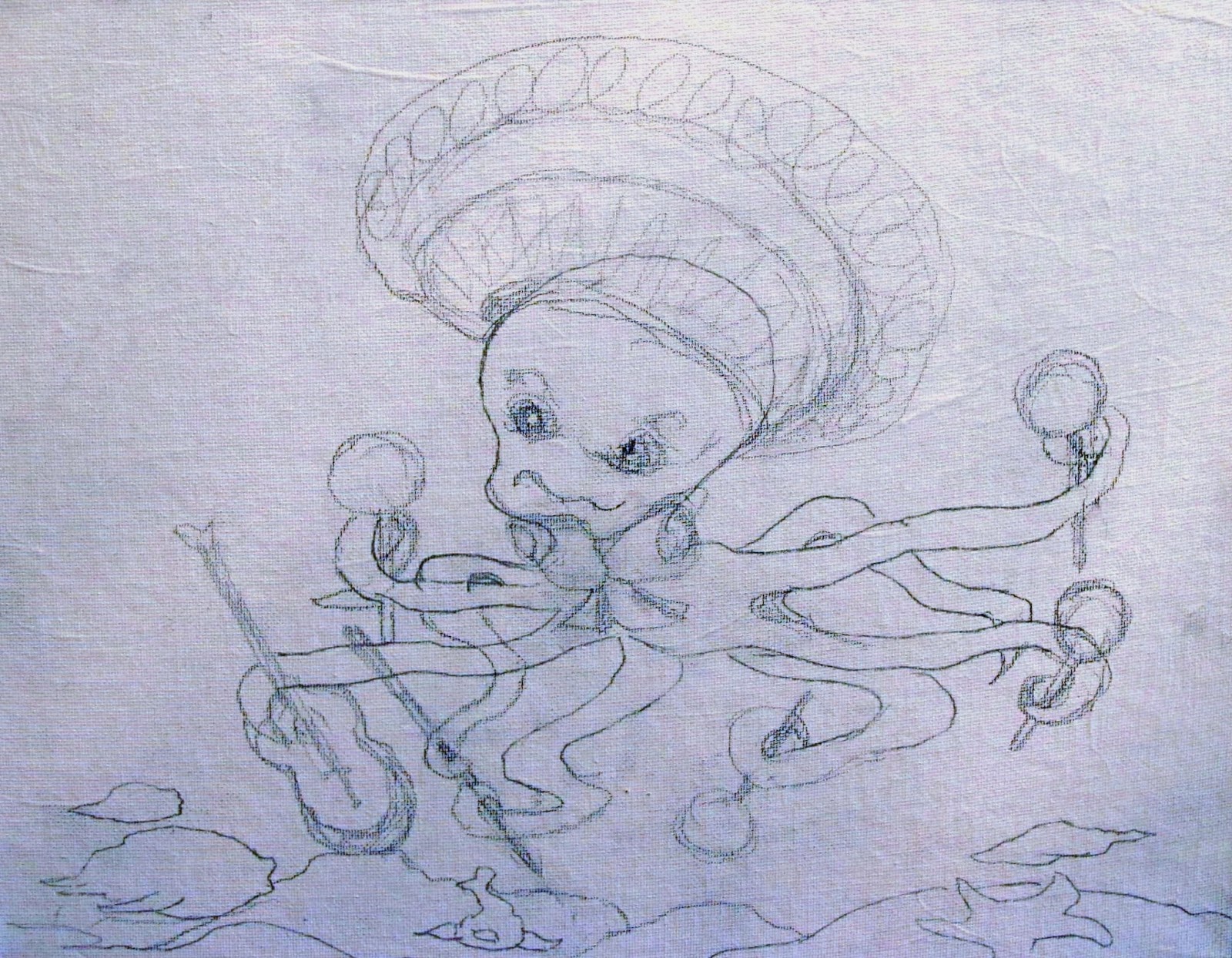
Next in my "Neptunes" Series "Octoband" 1st drawing on panel
Watch that last child as he or she lives in his own world conjuring up stories and situations in his mind and playing them out verbally or in imaginary play. This personality may become a writer, an artist, a philosopher or a scientist. His or her ability to detach and separate and his courage to stand apart becomes the skill set needed for dreams and discoveries.

I’ve always adored children’s games of pretend. In an instant they can become a pirate, a princess, a spy or a soldier. A child’s thoughts can transport him to different planets, faraway lands, or make-believe places. Depending on personality type, a child can become a conquering hero or a benevolent guardian; a powerful sorcerer or a humble apprentice. Children literally become what they can imagine.

Work in Progress: I put some acrylic washes down to suggest color and form
Adults should pay attention to this skill and learn to tap into their inner child. I’m not talking about maturity versus immaturity. I’m talking about the essence of childhood which is innocence. Seeing things with fresh new eyes each day and marveling at the wonder and beauty that surrounds us.

Adults get so caught up in their adult responsibilities and activities that they become rooted to the mundane and predictable. Think outside the box. Pursue your dreams with a fresh unleashed approach. Instead of being passive, plain, and predictable – shake things up! 

Try unwinding by doing the same boring things in a different way. Find a new route to work. Enjoy the scenery for a change. Don’t work through lunch! Read a good book instead or listen to some music. Get off by yourself, if possible, away from the jangling of interruptions and small talk. See yourself as capable and in control. Savor the moment!

"Flamenco Flamingo" a playful drawing created as I mused on how a
flamingo is built and how they move.

Tuesday, October 15, 2013

Artist’s and Writer’s Block (Repeat of a blog from 3+ years ago)

(Photo from a friend in Uganda)
If you're a creative person, it's inevitable that at some point in your career or avocation you're going to bump up against a blank wall. The feeling can be frightening, even devastating, but it doesn't have to keep you down.

Over the years I've discovered a few things that may trigger these events. I'll share some of my thoughts with you, knowing that your trigger's may also be different from mine. For whatever it's worth, here are my top four:

(Putting the drawing in place)
  1. Fatigue and lack of sleep. I know, it sounds simplistic, but you can't create in a sleepless fog. When your tail is draggin' so is your mind. Your perspective gets out of whack, and life seems sadder, badder, and meaner. When you wake up refreshed, you're ready to tackle almost anything. Get your Zzz's.

  2. Depression. This is a real deep-down feeling of helplessness and worthlessness. This baby will pull you into a downward spiral that has no end. Mild depression is a part of life's ups and downs, but clinical depression can drag you into a dark abyss where life has no meaning. Get help!  If the cause is a bad marriage or an abusive relationship, get out!

  3. Low self-esteem. A few negative words or harsh criticism can throw you for a loop. We can say "sticks and stones," and believe that words can never hurt us, but they do. Bullies can knock the wind out of your creative sails. Personal failure can push you flat on your back. The only answer is to grab hold of a power bigger than yourself and get up again. Quit worrying about what other people think. Your opinion of yourself is the only one that matters.

  4. Lack of exposure. Sometimes we need to shake things up a little. Get out and experience life. Change the scene. Surprise yourself -- do something new. Try something you've never done before. I'm not suggesting going overboard and getting yourself into trouble. I'm only saying get out of the house. Go somewhere different. Try to see the world with a new perspective. Get some fresh air!
"Hey, Coconut Man" mixed media on canvas
I remember my first art show after letting my skills and brushes lie dormant for many years. I was terrified. How would people react to my artwork? How would they view my lame attempts to restore those lost years when my own self-esteem was slumping?

I muttered a prayer, something like "Oh, Lord what am I doing? What if I look like a fool?" A warm feeling and an encouraging thought came to me: "Give it a try--you might be surprised."
On that simple note, I displayed my paintings. I know some of them were pretty awful, but not all. Two women, I swear they were angels in disguise, bought one of my paintings right off. That sale gave me the confidence and the courage I needed to keep on keeping on.

"Twirling" Charcoal sketch (Drawing quick sketches releases my imagination.)
And there you have it: my secret formula for getting out of a "funk."  Next time you can't think and your mind's a blank, start writing, start painting anyway; anything--anything at all. Pretty soon the blood will get moving and you'll push right past that blank wall. Of course, a little prayer never hurts!
(Below is my favorite sketch "Siesta" done purely from imagination)


Saturday, April 27, 2013

Strike a Match, Burn a Candle, Light up the World


"Moonshines" 18x24 mixed media on canvas
Ideas are fragile. They come and go. If you don’t lock them down, they can disappear forever.

I used to keep a small notebook in my car for jotting down ideas driving to and from work. The only problem was, I could only write while I was sitting at a stoplight. So I thought I’d get a recorder and verbalize my thoughts, only I’m not a verbal person. I have to digest ideas and chew on them before writing them down in order to give them expression.

Fleeting thoughts are sometimes incoherent, nonsensical gibberish; but the gems within may grow and multiply, whereas the losers fester for awhile and then dead-end into Never Never Land.
"First Daffodil" 16x20 acrylic on canvas
When I lived alone, I burned candles in the bath, in my bedroom, and anywhere else I needed a glimmer of hope and light. Even with dinner, I’d fix myself something special and light a candle to make the dining experience last. 

Then one day, I became dangerous. I struck a match in the bathroom and the tip of it broke off landing on my nightgown. The flames were frightening. Luckily the sink was near enough to douse myself with water and put the flames out.

I decided either I was getting flighty or the matches were being manufactured differently from before. A few days later, I struck a match in the bedroom to light my bedtime candle, and again the match tip broke off landing on my dresser scarf. The flames ignited instantly, swallowing up everything in sight before I could smother it with a wet towel.

From that point on, I eliminated candles and matches from my bath and boudoir routine. Whether it was the cheapness of the match sticks or my own clumsiness made no difference. I couldn’t afford to burn myself up over anything as silly as a candle.

That experience has come back to haunt me again and again. How fragile and unpredictable that tiny light became once it was ignited. Ideas are like that. They shine but for a moment and then like gossamer wings they fly away unless we kindle the flames that brought them in the first place.

Where do my ideas come from? Some are inspired by past experiences. Others by books I’ve read or movies I’ve seen, or simply by the way light shines on a certain object in a new way.

Nature also inspires me. When a roseate spoonbill comes in for a landing, it looks like it's almost sitting. I couldn't resist the humor of putting one in harness in a parasail; hence, "parasailing spoonbill!"

I have a vivid imagination and always think I see something different in my ordinary surroundings: an ugly face created by the scar of a cut limb or the bark of a tree, a small bush that looks like a huge spider; I’m weird, I know. Artists do see things differently. We see in shapes and color and because of this, the ordinary turns into the grotesque, the scary, or the fantastic in a blink.
Some of my ideas are so clear I can see them come to life in my mind. Others are mere hints or suggestions that require coaxing and fuel to keep them going. Like the end of a lighted match, I never know where my ideas will end up.

Tuesday, February 26, 2013

Paint Yourself a Hot Cup of Coffee and Enjoy the Brew


My Grandson owns a coffee shop online and one in the Great Northwest called “Café Solace.”  The beans are from Costa Rica, and there are many choices and blends that are absolutely delicious!  On a recent trip there, Bryce took a photo of the coffee beans above. I was so enchanted by the color and the variation of shapes; I envisioned a painting in the works.

“You paint it,” grandma, “and I’ll put it in my shop,” he challenged. And so my “in-progress” painting began.

Most ideas come from random things like this: a photo that catches our eye, a scene outdoors that takes our breath away, an emotional sequence of events that stays with us long after the event is forgotten by everyone else.

"First preliminary paint drawing -- work-in-progress"
Some ideas come to us in dreams; others through the gift of a vivid imagination. I’ve shared with you before my fascination with my bathroom floor and the varied shapes and images created from dripping water and bare feet. Some of these have actually ended up as parts of paintings.

Memories from childhood also inspire many paintings, especially when paired with the children we encounter in our own lives. I wish I could live long enough to paint all the cherubic faces I’ve observed and admired over the years.

"Moonshines" mixed-media on 18 x 24 canvas
Inspiration can also come from others. I’ve run a few contests on my blog with the offering of a print as the prize. Although there’s no money to be made, a contest draws audience hence potential buyers. In addition, the entrants have already given the artist permission to use their material, so anything submitted is fair game. Several adorable paintings and potential paintings have come from this source.

Contests serve a purpose, but they usually have a price. Sometimes they cost you more than you get in return. On the other hand, you get to know some wonderful people and oftentimes make lasting friendships. If you regularly have contests, make the competition challenging and fun and the prizes nominal. In that way, people will have fun and you won’t have a great outlay of cash. Are any of you game to name the work-in-progress below?

"Work-in-Progress -- Acrylic on 20 x 20 canvas
Newsletters and, of course, blogs reach out to people in a way that advertising can’t. I must admit, I haven’t focused on a newsletter, thinking my blog may serve that purpose. I find the interaction and participation in many online artist sites has been the biggest boost to getting noticed.

Above all, have fun doing what you’re doing. If you don’t enjoy slapping paint around and honing your skills in a competition against yourself, you should hang up your brush. In order to bring joy to others, you must bring joy to your work.

Here’s a link to my grandson’s online Coffee shop: http://www.cafesolacecoffee.com

Friday, September 21, 2012

Finding your lost imagination


 “Use it or lose it” is an expression we’re all familiar with. We don’t always associate it with imagination, but it’s certainly true. We’re born with curiosity and imagination, but somewhere between adolescence and adulthood, we lose it.

Unless we allow ourselves to dream and fantasize throughout our lives, we risk becoming stodgy and stale; heaven forbid! A plunge into the realms of literature is a sure cure.

One of my favorite reads is the “The Little Prince” by Antoine De Saint-Exupery. Don’t let the 1943 copyright put you off. This classic still rings as true today as it did when it was written.

“Like a spoon full of sugar,” the pages melt on your tongue exuding words that recapture childhood fancy and wisdom. Once again, you become a child. You think like a child. You see like a child. Your observations become acutely aware of the foibles that being a “grown up” entails.

The simple drawings are lessons in and of themselves: “I showed the grown-ups my masterpiece," the little prince said, "and I asked them if my drawing scared them.” They answered, “Why be scared of a hat?”


“My drawing was not a picture of a hat. It was a picture of a boa constrictor digesting an elephant. Then I drew the inside of the boa constrictor, so the grown-ups could understand. They always need explanations….they advised me to put away my drawings and apply myself to geography, history, arithmetic, and grammar. That is why I abandoned, at the age if six, a magnificent career as an artist.”


My favorite part of the whole story is when the little prince meets a fox. He has never seen a fox before. “Come play with me,” the little prince proposed. “I’m feeling so sad.”

“I can’t play with you,” the fox said. “I’m not tamed.”

“What does tamed mean?”

“It’s something that’s been too often neglected,” said the fox. “It means, ‘to create ties’…”

“‘To create ties?’”

“That’s right,” the fox said. “For me you’re only a little boy just like a hundred thousand other little boys. And I have no need of you. And you have no need of me, either. For you I’m only a fox like a hundred thousand other foxes. But if you tame me, we’ll need each other. You’ll be the only boy in the world for me. I’ll be the only fox in the world for you…”


By the time you finish reading this book, you're a child again on the brink of discovery. You become wise beyond your years. You grasp the meaning of relationships and the importance of simple things. You see things through the eyes of a child and your imagination is set free!

The next time you get stuck on empty and your creative juices are sluggish and slow, pick up a favorite book or a classic and restart your engines. For me it’s like a mini-vacation that inspires and refreshes. My perspective is altered; my enthusiasm is fired up, and I’m ready to meet the world head on.

Featured Artist
Lyn Olsen is a self-taught artist whose style is impressionistic and whose focus is on marine life, nature, and contemporary paintings. A link is posted below with a painting called “Silver Sailing.”


Friday, June 1, 2012

Are You a Neat Freak or do You Thrive in Organized Clutter?


"Kelly's Rose" oil on board 12x16


I used to pride myself on being organized. I had to be with six children! I prepared meal plans so I wouldn’t have to think about “what’s for dinner?” A monthly meal plan gave me an edge. Shopping smart and planning ahead kept our meals on time and within budget.


Over time, I did give up on having our home look like “Better Homes and Gardens.” I learned to tolerate a lived in look; cleaning only once a week. I ignored what happened in between because I valued my time, and it was impossible for me to do anything more.

I became an avid list maker. I found that once I put it on a list, I could forget about it. The worry and the guilt were “out of sight and out of mind.” It cleared my head. I looked at my list at the start of each day and checked off my priorities. No worry. No fuss.

"Hibiscus Glory" Oil on 16x20 canvas  SOLD

Of course, there was always the unexpected pushing some items to another day. For the most part, these lists kept me in line. I took classes, I was a free-lance writer, and I was active in my church and community. I have found over the years that too much neatness can kill creativity
.
I’m not knocking organization. I’m just saying that organized clutter, for me, is the best way to manage stress and to meet deadlines. Take my desk. It’s never clean. There are small piles (organized piles) everywhere. Each one represents a different project. When someone comes to visit, I arrange the piles in orderly fashion, but they stay! Like fingertip files, I know where to look when I need something.

"Jack's Roses" oil on canvas  SOLD

My guest room/art room is the same way. I have organized piles on the bed, in the closet, and behind the door. The difference between the desk and my art room is that everything disappears and is moved to another area for the duration of guests when necessary.

My palette is no different. To another painter, it may seem sloppy and disorganized. But to me, I know exactly what I need and want at any given moment. When I use acrylics, I put out only the paint I think I’ll need for a specific purpose or it dries out. With oils, I’ll put out more paint. I don’t organize my palette as well as some artists do. I place light colors on one side and medium to dark on the other; that's it.

By the time I’m through painting for the day, there is no definition left, anyway.  I mix and match. I take swipes of different colors, mixing on the canvas when appropriate. I have watched other artists paint; their “neatness” is amazing. Their clothing or cover-ups, their arms and faces are clean. During their painting session, they wipe their palette of residue and to separate piles of paint. Neat. Neat. Neat.

"He Lives"  oil on 16x20 wrapped canvas

When I’m through painting, I may have splotches of color on my nose, my arm, and my clothes.  I lose myself in painting. My imagination soars when I’m unfettered by rules and restrictions from the “how to” experts.

Some people may see a big mess, a desk in disarray or an unworkable palette. I see organized clutter ready to be turned into something magnificent and memorable.