Translate

Showing posts with label India. Show all posts

Wednesday, July 27, 2016

Symbolism in True Form is meant to Jar

India Rising Series -- "The Lost" acrylic on canvas
Definition: Symbolism was a late nineteenth-century art movement of French, Russian and Belgian origin in poetry and other arts. In literature, the style originates with the 1857 publication of Charles Baudelaire's Les Fleurs du mal.

“Symbolism developed new and often abstract means to express psychological truth and the idea that behind the physical world lay a spiritual reality. The emphasis is on expressing emotions, feelings, ideas, and subjectivity rather than realism.

“The work of symbolists is personal and expresses their own ideologies, particularly the belief in the artist's power to reveal truth. Symbolists take the ineffable, such as dreams and visions, and give it form.”
Michelangelo's "Finger of God"
In her book “Experimental Painting; Inspirational approaches to mixed media art” Lisa L. Cyr writes: “When one is free from inhibitions and preset expectations, the door opens for that spark of brilliance and magic to come through. Spontaneously and without effort, a highly imaginative world known only to the artist begins to reveal itself.”

Many symbolists combine "religious mysticism, the perverse, the erotic, and the decadent. Their subject matter is typically characterized by an interest in the occult, the morbid, the dream world, melancholy, evil, and death.”


Here are a few recognized symbolist painters and visual artists, which include Gustave Moreau, Gustav Klimt, Mikalojus Konstantinas Čiurlionis, Jacek Malczewski, Odilon Redon, Pierre Puvis de Chavannes, Henri Fantin-Latour, Gaston Bussière, Edvard Munch, Félicien Rops, and Jan Toorop.


Color and the way it affects mood is often used to create a message or sharp response in the viewer, but we’ll discuss color in another blog. Today artists are free to use alternative styles by combining conventional approaches with innovation. There has been a modern day revolution of sorts in the way art is created and presented.


The artist Cyr, quoted earlier, calls this inventive approach “reinterpret, reinvent, and redefine.”


Below are some helpful Youtube videos.

 Jake Baddeley - Symbolist painter  


 The Symbolist Paintings


Sometimes Impressionism and Symbolism overlap

Friday, October 16, 2015

Are you Uninhibited or Style Conscious?

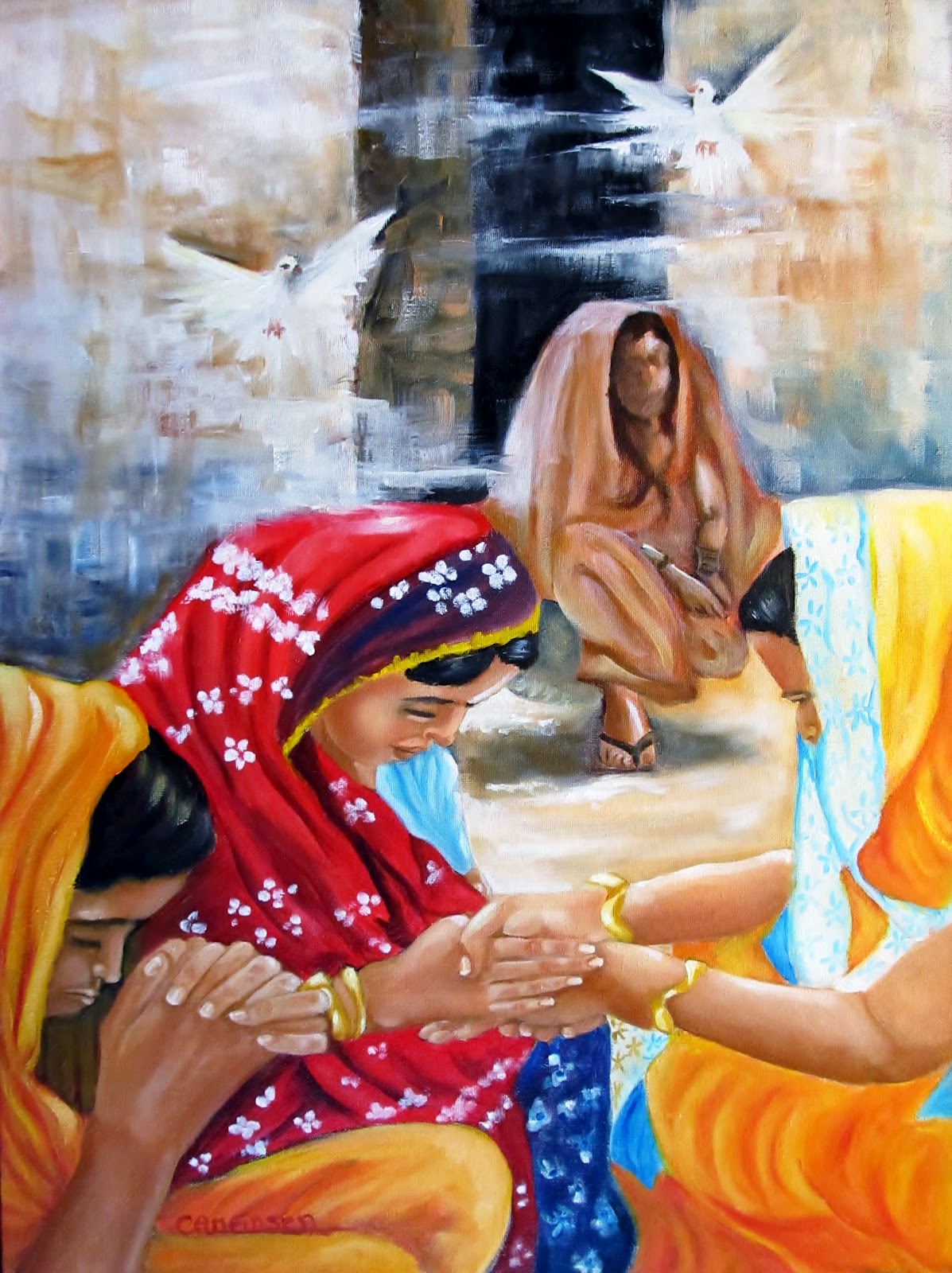
"Prayer Circles" Acrylic on 24 x 18 canvas
We always wonder if our personal artwork presents a style that is unique and recognizable by others. The answer is yes. Even though your style may be imperfect and perhaps full of “beginner’s” mistakes or careless errors, your style is evident in almost every painting.

Art Biz Coach, Alyson Stanfield, describes it this way: “Style is a characteristic or group of characteristics that we can identify as constant, recurring, coherent, etc. that is identified with an individual.”

And from the late Robert Genn: “Each artist’s uniqueness and individualism brings endless variations. The dynamism invites the “keeping-in-mind-God” to play a part in the work’s evolution, enriching the process. The job becomes an intellectual as well as a technical and emotional exercise. The idea is to stretch your brain so your act of art is your very own.

There are also designated types of art that differentiate themselves, one from another. For instance, impressionism, realism, surrealism, expressionism, painterly, folksy, primitive, abstraction, etc. Most of us learned about these different genres in school. But within each category, there are definitive components such as the compositional elements, the brush strokes; are they flamboyant and wide, or detailed and soft?


"#hopeful in India" Acrylic, 24 x 18 canvas
And what about color? The hues and values chosen and the way they have been applied are all recognizable; even the lines and shapes and how they’re rendered are unique to each artist. Your style is a combination of the mediums, techniques, and subject matter you choose. It’s the extra things you do to distinguish your work from other artists.

As you gain experience, your work evolves. Your colors become more sophisticated. The composition more interesting and leading. Increased subtleties and innuendo begin to tone down the brasher elements and enhance the message. The painting becomes a soft-spoken message from your heart that is both appealing and convincing.

You the artist become an expert at playful seduction and illusion. There are often multiple messages that beckon and coalesce into one cohesive center of interest. You begin to sense where and when intensity is needed to mirror your own passion. You triumph when this melding of heart and soul on canvas are transfixed in the viewer’s mind long after they have left the scene.

Some may be riveted in place, studying the twists and turns of your color and vision. This may not happen overnight. This evolution of style is like giving birth. The process may be long and hard, but you know it will eventually happen. The struggle to overcome and to achieve has been done before by all those who profess to be artists.


"Fish Market" Acrylic on 24 x 18 canvas
Is it worth the intensity of emotion and the grief of failure? Is climbing to the top of Mount Everest ever worth the risks? Only those who reach the top may feel exultation. The building blocks you leave behind (those crass unfinished canvases, those embarrassing compositions and tacky mistakes) litter the highways and byways of your history and become the building blocks of your destiny. It is not over until you lay down the brush and either give up or give in to the overwhelming hold artistry has on you.

Sunday, August 16, 2015

Censorship is a Dirty Word in a Free Society - - a Way of Life under Tyranny

"India Rising -- the Lost" oil on acrylic background
Artists like to talk about passion and freedom of expression, but what if your hands were tied, literally. What if every brush stroke, each swathe of color, and every word you spoke was censored and shaped for you by the ruling body, the government or the proletariat?

How would you like to serve jail time or worse for breaking the rules or being accused of sabotage or treason? In many countries this is what happens to those who dare to speak out against their leaders through their work. They face suppression, ridicule, subordination and sometimes exile.

According to the National Art Education Association (NAEA) “The freedom to create and to experience works of art is essential to our democracy. At present this freedom is under attack. Private groups and public leaders in various parts of the nation are attempting to remove certain artworks from public display, to censor exhibitions, to label particular works as “controversial”, and to identify some artworks and artists as “objectionable”. These actions arise from a view that censorship is needed in order to avoid the subversion of politics and the corruption of morals.


“Moreover, it is not only artworks that are being subjected to efforts at suppression. These efforts are related to a larger pattern of pressure being brought against education, the press, film, and television. It is important to note that even when such efforts do not actually suppress particular types of expression, they cast a shadow of fear which leads to voluntary curtailment of expression by those who seek to avoid controversy. The arts cannot thrive in such a climate of fear.

“Freedom of expression is guaranteed by the Constitution. This freedom of expression includes both verbal expression—speech and writing; and non-verbal expression, which includes the “language” of the various arts. Free communication is essential to the preservation of a free society and a creative culture.
"Prayer Circles" oil on acrylic background
“Now, as always in our history, artworks—literature, theatre, painting, sculpture, music, and dance, are among our most effective instruments of freedom. They are powerful means for making available ideas, feelings, and social growth, the envisioning of new possibilities for humankind, solutions to problems, and the improvement of human life.

 “On the other hand, suppression of ideas and of artistic expression leads to conformity, the limiting of diversity of expression to a narrow range of "acceptable" forms, and the stifling of freedom."

The NAEA’s declaration continues:
“As art educators in a free society, we confirm the following:
    • Freedom of expression in the arts must be preserved.
    • The individual has the right to accept or reject any work of art for himself or herself personally, but does not have the right to suppress those works of art to which he or she may object or those artists with whom he or she does not agree.
    • The free individual and the free society do not need a censor to tell what should be acceptable or unacceptable, and should not tolerate such censorship. All censorship is contrary to democratic principles.
    • It is the duty of the art educator to confront students with a diversity of art experiences and to enable students to think critically. The art educator need not like or endorse all images, ideologies, and artists he or she makes available to students, but should allow the individual student to choose from among widely conflicting images, opinions, and ideologies. While some works of art may indeed be banal and trivial, and some works may be repugnant and unacceptable to some individuals, the art educator should insist upon the right of every individual to freely express and create in his or her own way and to experience, accept, or reject any particular work of art. 
    • The art educator should impress upon students the vital importance of freedom of expression as a basic premise in the free democratic society and urge students to guard against any efforts to limit or curtail that freedom.”

Adoption: Adopted by the National Art Education Association Board of Directors Motion #17, September, 1991


Communist countries, dictatorships, or religious or police states regularly interfere with the rights of free expression and seek to enforce their dogma on all avenues of expression.


Freedom is not just a fancy word ….it is a precious gift that must be preserved, respected, and fought for at all costs. Check out the link below for famous Middle-Eastern painters.


Friday, May 8, 2015

Mud Pies, Pottery and Mankind’s Passion to Create

"India Rising -- the Lost"  24x18 acrylic on canvas (based on legend)
Why I didn’t go into pottery, I’ll never know. As a child I loved puttering with clay. Its sensual pliable warmth gave me my first thirsting for creativity. 

In grade school, a classmate and I made some clay figures. Our teacher gave us two empty cubby holes to use, and we fashioned a home for our two families that even included two dogs and a cat.
Our imaginations went wild as we moved our stubby people from place to place. We spoke for them, barked and meowed for them, and created furniture for them to use for meals, sleeping and being together. Our primitive characters came alive under our fingertips and tutelage.

I did some research and discovered the “Daily Mail” and in their “Science & Technology Section” an article on the history of clay works:

“Prehistoric pottery shows that man mastered clay 17,500 years ago - before we settled and became farmers.” That means man actually made animal figures artistically before there is a record of clay being used for functional purposes.

  • “Finds prove that man mastered pottery 17,500 years ago
  • “Pottery may have been invented - and forgotten - several times in human history
  • “Later, technology was used for carving animals - NOT for making cooking vessels
  • “Discovery came from before time when humans settled down into farming communities”

“Earlier theories have held that the invention of pottery happened during the period about 10,000 years ago when humans moved from being hunter-gathers to farmers.

“But our ancestors didn't use the technique to make pots - instead, they created ceramic animals using clays baked in ovens.

“The finds - along with other recent discoveries in China - have forced scientists to rethink the history of pottery. It's now thought that the use of ceramics was invented - and forgotten - several times during history by different societies.

“The new find in modern-day Croatia is evidence of a community of prehistoric artists and craftspeople who ‘invented’ ceramics during the last Ice Age – thousands of years before pottery became commonplace.” As an artist, I find this positively amazing!

"Hey, Coconut, Mon!"  16 x 20 mixed media on canvas
And from the late Robert Genn:

The Big Picture
“In life, in art, a major problem is failing to see the big picture. Individual parts may be just fine but the overall doesn't get off the ground. Together with your individual sensitivity and your own vision, what you're looking for is strength, pattern and character. We're talking art here: 
  • “Go a long way back; I mean a long way--into the other room. 
  • “Small room?--look at it through binoculars--backwards.
  • “Look at it in a mirror.
  • “Half close your eyes and look at it. 
  • “Half close your eyes and work on it. 
  • “If you're working from a slide, throw the projector out of focus and find the compositional faults. 
  • “If you're working from a color photo, run it through a black-and-white photocopier and find the faults. 
  • “If you're working from your head, try holding pieces of toned paper here and there to see improvements by adding color.
  •  “If you're working on location, don't let yourself be tyrannized by the scene. Keep asking, "What could be?
  • “If you're working on location, look through the viewfinder of a camera without taking the picture.” 

 “It's easier to get the big picture in a little picture, so think of your big picture as a little picture and your big picture will fly.”  Well said!


Below:  "Prayer Circles" acrylic on canvas


Wednesday, May 14, 2014

Is that Tired Feeling really Boredom?

(work-in-progress "Tickles from God" a rainy day painting)
There are times in our lives when we feel drained, empty, and fatigued like we have nothing else to give. Instead of slacking off, what we may need is a new project. Once we’re slapping on the paint, everything else seems small and insignificant.

Do what you love, take time for yourself, and your engines start running again; full speed ahead. Just when you think you’re tired and overworked, you may actually be bored and need to shake things up a bit. That’s what my latest work-in-progress did for me. I was having trouble finishing my rain painting: “Tickles from God,” and I needed something more difficult and exciting.

I enjoy painting close ups, not only of people, but of nature. Flowers, fruit, leaves, birds and animals call out to my wild side and put me in touch with the earth. Like an itch that needs to be scratched, I long to walk barefoot again without wincing in pain. I want to dig a hole in my garden and bury a new plant that will add a bright touch of color in an obscure spot.

"Lady in Waiting" 14 x 11 oil on canvas (SOLD)
Prints available

I want to get my hands dirty. I want to feel the warmth of the soil under my fingernails. Of course, since I moved to Florida I’m a tad squeamish about the lizards, snakes and spiders. Having almost died from the bite of an eight legged brown recluse, I now wear garden gloves and the sensations are muted. Still the experience provides me with an impetus to get back to nature and painting.
My latest work-in-progress titled: “Namesake” came to me in a moment of reverie thinking about the beautiful lilies in Minnesota. Tiger lilies have always been my favorite perennial, and the thought of combining the flowers with a tiger was irresistible.
(work-in-progress: "Namesake" will add tiger lilies)


Other ideas churning around in my head have to do with the wonderful henna paintings Indian women do on their bodies before marriage. These intricate drawings are not permanent, but they adorn the wearer with Lacy motifs that exaggerate the beauty of a woman’s body and the fragile lace of the wedding dress. 


Artists are using these same techniques to embellish images with colorful designs that add an abstract quality to the finished piece. Female cancer patients are adorning their shaven heads with these patterns which just goes to show you that "bald can be beautiful!"


I hope you enjoy these videos:


Saturday, March 22, 2014

Finding your own way in a crowded marketplace

"Reggae Night" acrylic on canvas
In case you haven't noticed, I took some time off from painting this past year. I did a few fun things, personal projects; but for the most part, I stayed away from painting sessions with my art league and the usual mad dash of competitions and shows except for those already scheduled. I needed space and time (plus I had 1 wedding and 4 funerals).

I felt I was placing quantity over quality. The pressure was piling on, and in order to meet deadlines, I was slapping paint without experiencing the joy. There were still a few things on my to-do list that I wanted to complete, and a few old canvases that I painted over. But for the most part, I laid my brushes aside.

I’m trying to reassess what direction I want my creative energies to take. I want to enjoy what I’m doing more and not take myself or my journey so seriously. If success comes in the process of seeking, I’ll be happy. If it doesn’t, then I’ve enjoyed the ride.

"Prayer Circles, mixed media on canvas
Success and achievement require sweat, blood and tears, but if we aren’t having a good time it shows in the end product. Balance is the key, and I felt I was off balance spending too much time in social media and promotion, and not enough time on inspiration and soul searching. I needed to explore my weaknesses and strengths, and what I wanted to accomplish.

Joy must be a part of the creative life or our “children,” our babies suffer. Cranking out paintings for the sake of producing something that may or may not sell is a losing battle. There’s a difference between honing your skills every day in the act of fusing your passion and love or just going through the motions because “you’re supposed to.”

Waiting for inspiration is not the answer either. It’s an excuse. The fear of failure can shake us to the core and cause us to “seize up” in a nervous frenzy. In order to create, we must be in the moment and love the simple pleasures of applying paint to canvas regardless of whether the painting brings us success or not.

Playing to the judges or the critics doesn’t cut it. If we manipulate the thought process to satisfy others without the passion, the result may be a skilled piece of work that is flat and lifeless.

"Fish Market" mixed media on canvas
In a local publication called: “Inside Gateway-Colonial,” I read an article in their Lifestyle section titled “Simple Ways to Find Deeper Meaning” Unlock what’s inside – passion, individuality, community – to connect with what’s important by BPT News Service.

The author said “A new movement is emerging, where people are pausing to find deeper meaning in everyday life. . . The theory goes that if a person recognizes and nurtures those activities they love most, they are better able to do what they’re great at in the world. . . Rather than getting swept away in a hectic schedule, try focusing on what truly matters.”

I realized that I was focusing on what mattered to the judges, to people in my art circles, and to the critics, rather than to my own gut feelings. I was allowing my insecurities to rule rather than my strengths.

In the busyness of doing, I’d lost touch with myself and what was important to me. I was blind to the things that make me unique and different. I was trying to ape what I thought others wanted instead of listening to my own drum beat. Sometimes we have to be willing to make mistakes in order to forge ahead in new and uncharted territory.

"India Rising -- the Lost" mixed media on canvas

Wednesday, September 26, 2012

A Maelstrom over Political and Religious Art

"Prayer Circles" 18x24 acrylic canvas
 The Middle East is ablaze with hatred, anger and revenge. Their beloved Osama Bin Laden is dead, the perpetrators of 9/11 are hailed as heroes, and an evil plan which began in Benghazi and spread, destroyed an American Embassy and murdered four people including the Ambassador who was sodomized and brutally beaten before his death.

After discovering, via our own Presidency, that an amateur video was produced in July, the violence increased and spread like a cancer. The video gave them another excuse to burn the American Flag and continue their religious tantrum.

The flip side of that coin shows the contrast between a democratic society and a theocratic one. According to “The Gothamist” (see link below): “The Controversial representation of religious figures and objects has been inciting all the rage these days, and New York-born artist Andres Serrano's work "Piss Christ," which will be on view as part of an exhibition of the artist's work in Midtown next week, is no exception. The piece—a photograph of a crucifix soaked in the artist's urine—was condemned by Staten Island Representative Michael Grimm yesterday, who compared it to Innocence of Muslims, the anti-Islam film that has set off a rash of rioting and violence in the Arab world over the past few weeks.

"India Rising--the Found" 18x24 mixed media canvas
"As a Catholic, I find 'Piss Christ' to be vulgar and offensive, just as many in the Islamic world found 'Innocence of Muslims' to be highly offensive," Grimm said on Friday, according to the SIlive.com. Grimm also railed at the Obama administration (surprise!) for not stopping the (private) Edward Tyler Nahem Fine Art gallery on W. 57th Street from displaying the work. "The Obama administration's hypocrisy and utter lack of respect for the religious beliefs of Americans has reached an all-time high," he said. "I call on President Obama to stand up for Americans' values and beliefs and denounce 'Piss Christ' that has offended Christians at home and abroad."

And, though Times columnist Nicholas Kristof pointed out in an op-ed piece today that "Piss Christ" did not incite rioting like Innocence of Muslims did because the Arab world is on the brink of revolution, other Christian groups have also compared Serrano's work to the film, and are shaking their fists at Obama for not being more outraged. "It seems like we have a protected class for Muslims as well as some other segments of our population," Bill Donohue, president of the Catholic League, told Fox News. "But when it comes to Christians, it's an all-out war." 

Hasn't Stephen Colbert been pointing that out for years? 


"Inset Kirke" 16x20 oil on canvas (original SOLD) Prints available
If you would like to read more of this article, go to the following link: http://gothamist.com/2012/09/22/piss_christ_photograph_coming_to_ne.php

Tony Perkins, president of the Family Research Council, said the two incidents show a clear contrast between Islam and Christianity.

“You won’t have to worry about a mob of people storming the gallery after Sunday school lets out,” Perkins told Fox News. “Christ has been the subject of attacks for 2,000 years – as have his followers. As Christians, we have learned to turn the other cheek.”

Perkins said the lack of response from the White House over the “Piss Christ” display provide an unintentional recognition. “It’s recognition of the contrast between Christianity and Islam,” he said. “You don’t have to plead with Christians not to riot and burn and storm buildings simply because they are offended. That’s the difference. That’s why Christianity moves nations forward and Islam moves nations backwards.”

As for the display – Perkins said it’s being held in a private gallery – without taxpayer funding.
“They have their freedom to do what’s wrong,” he said. “That’s what’s great about America.”   http://radio.foxnews.com/toddstarnes/top-stories/wh-silent-over-demands-to-denounce-piss-christ-artwork.html

How do you feel about religious art? Political art? Your comments and opinions are welcome!

Featured Artist
Ron DiCianni, whose painting “Spiritual Warfare” has sold the most prints of any of his paintings; in fact, tens of millions globally. Featured is a video of DiCianni’s commissioned work featuring the resurrection of Jesus Christ.


Saturday, July 28, 2012

Our Shrinking Economy – our Rising Debt


Everything is shrinking! Literally. My income, my stature, the size and quantity of the things I buy and what I can afford. Everything is shrinking but the price.

Like you, I’m paying more for less. My favorite things have gone from 8 oz to 7 oz to 6 oz or less in just a few months. A few packages stayed the same size, but the contents were less. I’m afraid It’s only the beginning!


I purchased some canvases the other day and instead of being .5 inches in depth, they’d shrunk to almost .25. Rather than fitting nicely into a frame or serving as a wrapped canvas painting, they leave gaps and spaces; they look cheap and skimpy.

Many artists are turning to treated hard board or plywood; still, framing is a difficult task. The prices for quality canvases have doubled while the sales price of a finished painting has remained the same. The cost of renting space has gone up to 40% commission. The artist receives 60% barely covering the cost for materials let alone time. Add to that cost a frame, and you see what I mean.

Is it worth it? I don’t know, but it’s what I do. Just when I think the economy is getting better, another one of my favorite businesses, restaurants, or products goes out of business. On the surface, things seem the same, but there’s an undercurrent of unrest. Everything is changing. Stores are being built as others are being boarded up. Hope rises in the midst of fear and failure.

We can only “keep on keeping on,” as my mother used to say. We put one foot in front of the other and hang on, despite the economic climate or the plight of those who risk everything and fail.

Hope is eternal the Bible says. We hope for better things, and we act as if they are possible. It’s how we survive. We hope for a better tomorrow as we wipe the tears of grief from our eyes and move on. What more can we do?


Two paintings featured today: “Sand Cranes at Twilight” and “Release” (with quote by Joseph Campbell) will be on display at Art for ACTS in downtown Fort Myers in August.


Featured Artist:
I’m going to start a new section called “Featured Artist.” There are so many wonderful artists and writers out there that deserve attention that I’m willing to share my space with them. Today, I feature: Ashish Das   If ever there was a second Picasso, he is it! I am amazed with his creative blend of cubism and abstraction. Enjoy the delightful and colorful work of Ashish. 


Tuesday, July 10, 2012

The Ancient Art of Painting with Coffee (or Tea)


A new LinkedIn Group said “for coffee painters only.” I couldn’t resist. “What is coffee painting?” I asked. One question led to another; and before I knew it, I was hooked!
From India -- Coffee Paintings By Amita & Mira Chudasama


This environmentally safe medium which sounds cutting edge and modern is actually as old as time itself. First used in China, Thailand, and India, coffee and tea as a painting medium has been around for centuries. 


It’s safe, inexpensive and extremely versatile creating wonderful textures and values. But from what I’ve learned, it’s not as easy as it sounds. For enduring quality, the mixture must have the right amounts of coffee or tea, and water. One painter added a few squirts of Elmer’s Glue for consistency and permanency.

The beauty of it all is it gives the artist an opportunity to experiment and to be creative. Used with charcoal, pencil or ink, the results are simply amazing!

My favorite artist uses tea to create wonderful characters that charm and humor us. Brian Kesinger ‘s “Tea Girls” are whimsical, authentic, and creatively crafted. Brian sells his creations on Fine Art America (FAA) and at the following link: http://www.bkartonline.com/


YouTube has helpful videos on coffee painting from a basic “how to” to more complex training pieces.


There are other applications you may find of interest. In my mixed media painting “Lucky Lady” I used an actual playing card burned on the edges. Had I known how delightfully coffee and tea stains make things look old, I would have used the YouTube technique here: Aging/antiquing paper:


Use your imagination and have fun with this truly ancient art.